Time Walk
A Stockbroker's Avenue


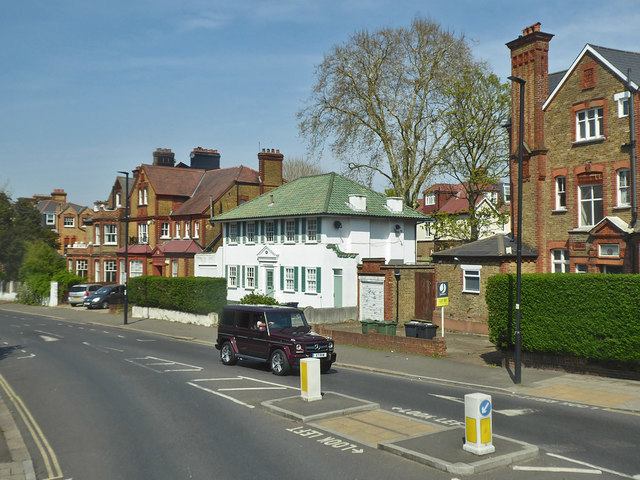
A stockbroker's marriage, not an engineer, gave this Streatham avenue its name. Walking it today, the eye catches dark red-brick mansion blocks from the 1930s, a plain red-brick church, and the sense of a quiet residential edge to Streatham Hill.
Beneath the mansion flats lies an older, emptier landscape. Maps from the late 1800s show the road running as "Telford Road" through open fields. That rural beginning is the key to the name that follows.
Name Origin
A Dowry from the Kymers
The avenue is named after Charles Telford, a stockbroker working in the City of London. His wife, Sarah, was the sister of Maximilian Richard Kymer, and she brought part of the Kymer family estate into the marriage as her dowry. That inherited land is what the Telford name came to mark.
Charles Telford died in 1876, or possibly before that date, at which point the land reverted to the Kymer-Stewart estate. Ordnance Survey maps from 1877 and 1900 already show the road as "Telford Road," set among fields, with the surrounding streets of Criffel, Killieser and Kirkstall beginning to appear around it. The road's present name, Telford Avenue, followed from that same form.
History
From Fields to Flats
The fields shown on the old maps gave way, in the 1930s, to a run of substantial mansion blocks. Telford Court was the first of them: plans by architect Frank Harrington were submitted for approval in 1930, and the flats were ready for occupation by 1933.
Telford Avenue Mansions followed in about 1935, built once the grounds of the old Telford Court Hotel became available. Designed by Frank Verity, Beverley and Horner in dark red brick with metal windows, the complex rises to three storeys, with a central block of four storeys overlooking a garden; the ground floor is painted cream, with sunray metalwork over the front door of each block.
The same architects designed Telford Parade Mansions for the Telford Property Trust in 1935 — flats over shops at street level, set back above a curved brick front that turns the corner into Telford Avenue. A short way along, Wyatt Park Mansions was designed by H.J.S. Abrams and Sons, with plans submitted in 1935 and the building occupied by 1938. On the night of 24 June 1944 it took a direct hit from a flying bomb; its solid construction withstood the blast and the building did not structurally collapse.
St Thomas's Church also stands on the avenue: a large red-brick building with a plain tiled roof and simple Gothic detailing, its entrance porch on the south side.
Wyatt Park Mansions was hit directly by a flying bomb on the night of 24 June 1944 — yet its solid construction meant the building never structurally collapsed.
People
The Avenue's Builders
Three architectural practices shaped the avenue within a few years of each other. Frank Harrington designed Telford Court, Frank Verity (with Beverley and Horner) designed Telford Avenue Mansions and Telford Parade Mansions, and H.J.S. Abrams and Sons, of Buckingham Street, designed Wyatt Park Mansions.
Today
A Boundary Still Marked
Telford Avenue still marks a boundary today — not of a stockbroker's estate, but of a conservation area. It forms one edge of the Streatham High Road and Streatham Hill Conservation Area, which stretches from the avenue to the Streatham United Reform Church. The 1930s mansion blocks that replaced the Telford-era fields remain the avenue's dominant presence.
On the Map
Telford Avenue Then & Now
Frequently Asked Questions
Why is it called Telford Avenue?
It is named after Charles Telford, a city of London stockbroker. His wife Sarah brought part of her family's Kymer estate into the marriage as a dowry, and this land underlies the avenue's name.
What is Telford Avenue known for?
Its run of 1930s mansion flats — Telford Court, Telford Avenue Mansions, Telford Parade Mansions and Wyatt Park Mansions — built by several different architects within a single decade, and its position on the boundary of the Streatham High Road and Streatham Hill Conservation Area.
Did Telford Avenue suffer bomb damage in the Second World War?
Yes. Wyatt Park Mansions took a direct hit from a flying bomb on the night of 24 June 1944, but its solid construction meant the building did not structurally collapse.