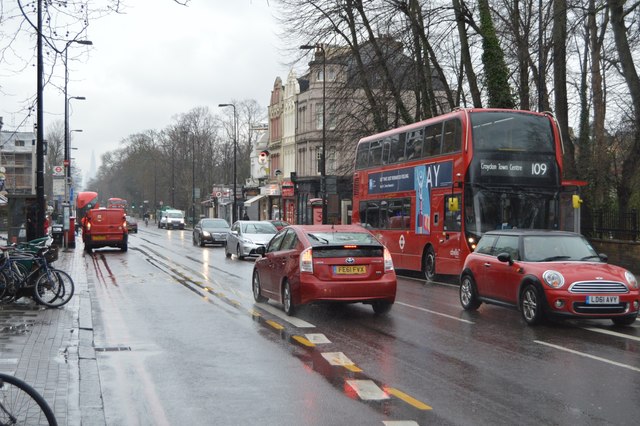
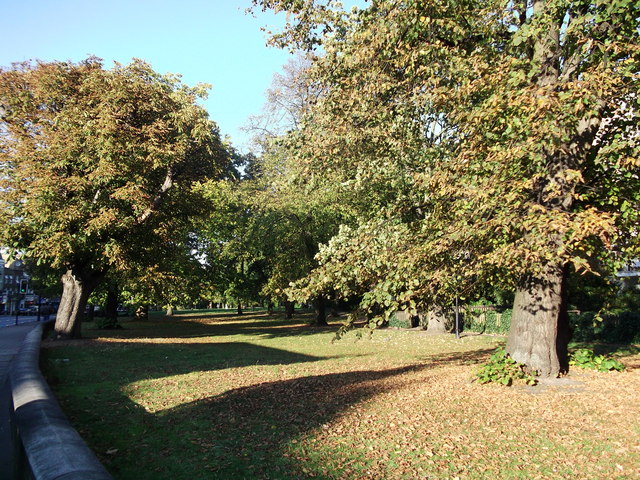
The road follows the line of a Roman road, the London to Brighton Way, which diverges from Stane Street near Kennington and led south from Londinium to a port on the south coast. For centuries, the lane we now call Brixton Hill ran through marsh and farmland. The earliest known reference to the causeway is contained in a will of 1530, when Hugh Acton left £20 for making and repairing the highway from Streatham Church to the foot of “Bristowe Cawsey.”
1062
Brixiges Stan
First recorded mention of the Saxon boundary stone in an Anglo-Saxon charter, giving the area its name.
1530
Bristowe Cawsey
Hugh Acton’s will leaves £20 to repair the highway to the foot of “Bristowe Cawsey” — the earliest written reference to the causeway.
1806
Rush Common Enclosed
The Rush Common Enclosure Act shapes all future development: no buildings within 150 feet of the road on the eastern side.
1816
Windmill & Vauxhall Bridge
John Ashby builds his windmill half-way up Brixton Hill. Vauxhall Bridge opens, triggering suburban growth along the A23 corridor.
1819
House of Correction
Brixton House of Correction (later Brixton Prison) is built on five acres just up the hill, becoming a defining institution of the neighbourhood.
1891
Cable Trams
Brixton Hill becomes London’s first cable-tram route south of the river, with steam-powered winding gear hauling cars up the gradient.
1904
Electric Trams
Cable haulage is replaced by conventional electric trams, which serve Brixton Hill until the 1950s.
Did You Know?
A will dated 1530 records a bequest of £20 to repair the highway to the foot of “Bristowe Cawsey” — making Brixton Causeway one of the earliest road-repair bequests documented in Lambeth’s history.
With the enclosing of the Manor of Lambeth — owned by the Archbishop of Canterbury — in 1806 and the opening of Vauxhall Bridge in 1816, terraced houses and detached villas started to line the main roads. The Survey of London records, as published on British History Online, that houses on Brixton Hill were erected between 1816 and 1824, with some described as empty as late as 1824 and one inscribed as erected in 1820.
Soon after Brixton Windmill was built, Brixton House of Correction — more commonly known as Brixton Prison — was built in 1819–20 on five acres of land purchased from the manor. The prison moved to Wandsworth in 1851 and the land was sold, only to be bought back in 1853 for a Women’s Prison. That experiment closed in 1869, and it was used as a military prison from 1882 to 1898, before becoming London’s male remand prison in 1902.
c. 1900

Brixton Windmill (1816) — the Grade II* listed tower mill built by John Ashby, yards from Brixton Hill Place.
Wikimedia Commons · Public domain
1820s

Brixton Hill Terrace (Nos 139–145), erected c. 1820 — Regency stucco terraces of the type that defined the corridor.
Wikimedia Commons · Public domain
c. 1892
Cable-tram era image
not available on
Wikimedia Commons
Brixton Hill carried London’s only southern cable tram from 1891, with winding gear at the Streatham Hill depot.
No free image available
present

Brixton Hill today — the A23 corridor unchanged in alignment since Roman times.
Geograph / Wikimedia Commons · CC BY-SA 2.0