Time Walk
Gardens into Shopfronts


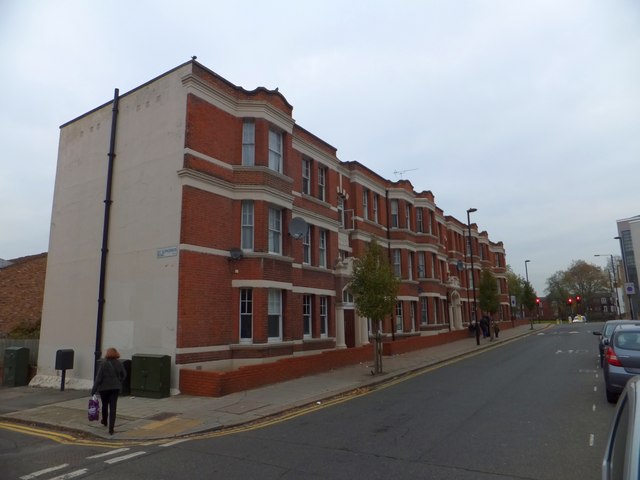
Grand villas stood here, and within twenty years every one of their gardens had become a row of shops. Walking Abbeville Road today means passing a continuous run of Victorian shopfronts, their timber fronts, stained-glass bullseyes and small gables still largely intact. The road runs close to the line of Stane Street, the Roman road from London to Chichester.
Underneath the shopfronts lies a much emptier landscape: fields, with a scatter of large villas set in extensive grounds along the common's edge. That buried layer of villas and farmland is where the road's name begins.
Name Origin
A Name Without an Explanation
The sources used here do not explain why the road was called Abbeville. What they do record is where it came from physically: the most southerly stretch, near the junction with Cavendish Road, was laid out in 1875 when Clock House Farm was sold, and the road as a whole was built across the former gardens of the large mansions that had lined Clapham Common Southside.
Those mansions, among them The Clock House and Eagle House, appear on Stanford's map of 1860, standing in extensive grounds. By 1875 the land behind them was still open fields. The name Abbeville Road belongs to the new road laid out that year across that vanished ground.
History
From Farmland to Shopping Parade
Horse-drawn trams, widely available from the early 1870s, made a daily commute possible and sparked a speculative building boom across this part of Clapham. Abbeville Road was laid out from 1875 onward, and neighbouring Hambalt Road, Narbonne Avenue and Shandon Road followed with terraced housing through the 1880s.
The shops came in two bursts: the west side of Abbeville Road was developed in the early 1890s, the terraces on the east side following in 1894 and 1895. The building was piecemeal, carried out by different speculative builders to serve the new residential streets around it. Broadway, at nos. 37-45, went up in 1891, and Collonade Buildings, nos. 27-35, in 1893 — both built by Bailey S Linfott. By the time the Ordnance Survey mapped the area in 1897, the shopping parades on the west side were already complete, while housing was still being laid out on the side streets.
A faded Hovis sign still hangs on the upper floors of 37 Abbeville Road — the same spot where it appears in a photograph of W. Norris Bakery taken around 1914.
People
The Builder Behind the Parade
One name recurs on the early deeds of Abbeville Road's shops: Bailey S Linfott. His two terraces, Broadway and Collonade Buildings, account for a sizeable stretch of the road's western shopping parade.
Today
Still a Shopping Street
Abbeville Road is still almost entirely commercial units with flats above, three storeys tall along most of its length, the short terrace at nos. 47-53 the only exception. Decoration carries throughout: patterned brickwork above the windows at 27-35, and bullseye stained glass at 47-53, 55-71 and 73-79.
Original timber shopfronts survive at nos. 42, 52-54 and 63, with their angled fascias and fabric roller blinds, and the decorative shopfront framework remains even where fittings have changed, particularly at 28-42. A large lime tree stands in front of no. 71, and a cast-iron water hydrant of an early-20th-century type stands south of no. 81, near the Elms Road junction. At no. 2, Banachie Lodge — built in 1876 in Venetian Gothic style, with towers, gables and a boot scraper at the door — still marks the corner.
On the Map
Abbeville Road Then & Now
Frequently Asked Questions
Why is it called Abbeville Road?
The sources used here do not explain the name. What is recorded is that the road was laid out from 1875 across the former gardens of large villas on Clapham Common Southside, after Clock House Farm was sold.
What is Abbeville Road known for?
Its well-preserved Victorian shopping parades, built speculatively from the early 1890s, with original timber shopfronts, decorative brickwork and a Hovis sign surviving at no. 37 since at least 1914.
When was Abbeville Road built up?
The road was laid out from 1875. Its west side was built in the early 1890s and the east side followed in 1894/95, with the shopping parades complete by the time of the 1897 Ordnance Survey map.
Who built the shopping parades on Abbeville Road?
Development was piecemeal, carried out by different speculative builders. Bailey S Linfott built Broadway (nos. 37-45) in 1891 and Collonade Buildings (nos. 27-35) in 1893.