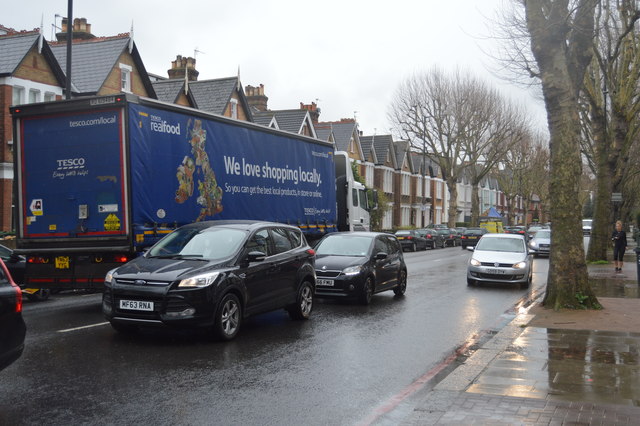
For most of its history the land in this part of Brondesbury was agricultural. As British History Online records in the Survey of London, Lambeth’s flat central plain — comprising South Lambeth, Stockwell, and areas such as Brondesbury — lay across land formerly divided among ten manors, whose lords controlled development well into the nineteenth century. Building on these estates was slow until turnpike roads and, later, the railways began to open the area to speculative builders.
1086
Domesday Record
The village of Cavendish in Suffolk is recorded as Kavandisc in the Domesday Book, establishing the place-name that would eventually reach this Lambeth street.
c. 1302
Family Name Established
Geoffrey de Cavendish, taking his name from the Suffolk manor, appears in London records, marking the early documented presence of the Cavendish name in the capital.
1731–1810
Henry Cavendish
The scientist Henry Cavendish — member of the noble family — conducts pioneering experiments in London, including the celebrated measurement of Earth’s density, cementing the Cavendish name in scientific history.
c. 1825
Lambeth Expansion Begins
The parish of Lambeth is divided into five administrative districts. Building development accelerates across the flat central plain as landowners begin granting building leases.
c. 1870–1900
Victorian Build-Out
Speculative builders transform the remaining open land in Brondesbury. Terraced stock-brick houses — the type that defines Cavendish Road today — fill in the street grid across this part of Lambeth.
1980
Postcode Introduction
The SE11 postcode for the area is formalised, with residential buildings on Cavendish Road and surrounding streets confirmed predominantly as pre-1900 terraced construction.
Did You Know?
The Cavendish name entered London’s street map in multiple boroughs — from Cavendish Square in Marylebone to Cavendish Avenue in St John’s Wood — all ultimately tracing back to a single Suffolk pasture recorded in the Domesday Book nearly a thousand years ago.
The Survey of London volumes, accessible via British History Online, document how building development in this part of Lambeth was shaped by the manorial landholding system that persisted long after other parts of London had been absorbed into continuous urban development. Streets were typically laid out only when landowners chose to grant building leases, meaning the precise date of Cavendish Road’s formation is tied to the leasing activity of whoever held the relevant plot — records for this specific street have not been individually documented in the published Survey volumes.
Excavations carried out by MOLA (Museum of London Archaeology) across inner south London have consistently shown that the area’s subsoil conceals evidence of earlier land use — drainage channels, field boundaries, and occasional finds from the medieval and post-medieval periods — beneath the Victorian terraces. No specific excavation record for Cavendish Road has been published, but the stratigraphic picture for Brondesbury and adjacent streets is consistent with the wider pattern of agricultural land converted to housing in the second half of the nineteenth century.