Time Walk
A Roman Road Beneath the Shopfronts


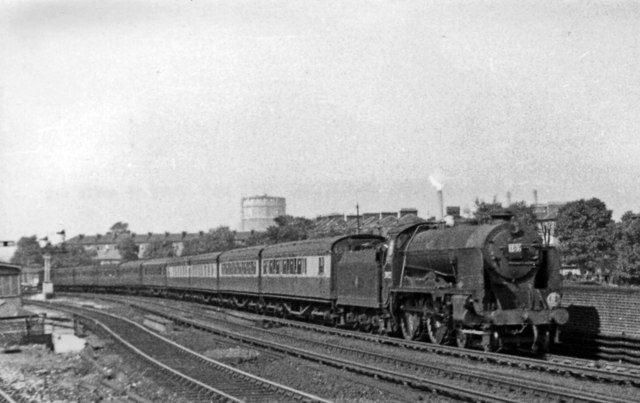
A Roman road to Chichester once ran where the shops and bus stops now stand. Today the street is a busy run of shopfronts and cafés, crossed by railway bridges, with the raised platforms of Clapham High Street station on one stretch and Clapham North's tube entrance at the other end.
Little of that ancient road, or of the quieter Regency rows that once lined it, is visible now. What survives instead is the layered record of three separate railways that have crossed and recrossed the street since the 1860s — and even the name on the station sign has a story of its own.
Name Origin
Simply the Street Called High
Clapham High Street takes its name directly from the settlement of Clapham, as its principal commercial street. The sources used here do not explain the origin of the name "Clapham" itself.
The name did matter enough to cause confusion on the railway. When the local station took the plain name "Clapham" in the national timetable, it had to be distinguished from Clapham railway station in Yorkshire. On 15 May 1989 it was formally renamed Clapham High Street for that reason, fixing the station's name to the street it stood on.
History
Four Names for One Station
The street's oldest claim runs far back. Clapham High Street lies on the route of a Roman road linking London to Chichester, a fact recorded on a Roman monumental stone. The stone, raised by Vitus Ticinius Ascanius, was dug up during building works near Clapham Common South Side in 1912 and has been dated to the 1st century AD.
The modern street's story, though, belongs to the railway age. The London, Chatham and Dover Railway opened a station here on 25 August 1862, simply called Clapham. It was renamed Clapham & North Stockwell from May 1863. A second company began running parallel services eastwards from 1867, though those platforms closed in 1916. The station reverted to plain Clapham in 1937, and the eastbound platform building was destroyed by a bomb in 1944. The original 1862 station building, later sold and used as a furniture warehouse, was eventually redeveloped as housing in 2003; it is protected.
Along the street itself, Regency terraces survive among the later shopfronts. Nos. 101, 103, 105 and 107 form a protected pair of Regency houses, three storeys each, with ground-floor shops added in the mid-to-late 19th century. No. 49, of similar date, has a porch of the kind seen on grand Roman buildings. Lambeth Council designated the street a conservation area in 1997.
Clapham High Street's railway station has carried four different names since it opened in 1862 — Clapham, Clapham & North Stockwell, plain Clapham again, and finally Clapham High Street in 1989, when it had to be distinguished from Clapham station in Yorkshire.
Culture
A Hall Built on Temperance
The company built similar alcohol-free venues across London.
People
The Explorer's Widow
At No. 136 lived Elizabeth Cook, widow of the explorer Captain James Cook. She remained in the house on the High Street for many years after his death, a quiet ending to a life shaped by voyages she never made herself.
Recent Times
New Rails, Old Trouble
The East London line extension reached Clapham High Street in 2012, a 6.7-mile link running via Peckham Rye and Denmark Hill, with Transport for London taking over management of the station from that point. A Southern service connecting the station to Kensington Olympia, running on weekday mornings and afternoons, was withdrawn that December.
More recently the street made the news for less welcome reasons. On 28 and 31 March 2026, groups gathered and caused unrest on Clapham High Street and around Clapham Common, leading to six arrests and five people assaulted, with one responder hospitalised.
Today
Three Railways, One Street
Three different rail lines still shape the street. Clapham High Street station sits between Wandsworth Road and Denmark Hill and now also carries the London Overground. Clapham North tube station, a short walk away at the street's northern end, serves the Northern line between Stockwell and Clapham Common.
Nearby, Cycle Superhighway 7 leaves the main road at Clapham High Street on its way toward Clapham South. The Roman road, the Regency terraces and the railway history all sit within one short stretch of shopfronts.
On the Map
Clapham High Street Then & Now
Frequently Asked Questions
Why is it called Clapham High Street?
It is simply the principal street of Clapham. The railway station on it was specifically renamed Clapham High Street in 1989 to distinguish it from Clapham station in Yorkshire.
What is Clapham High Street known for?
Its much-renamed railway station, Regency terraces including a listed Roman Doric porch at No. 49, a 1906 Temperance Billiard Hall, and its position on the Roman road to Chichester.
Did anyone famous live on Clapham High Street?
Elizabeth Cook, widow of the explorer Captain James Cook, lived at No. 136 for many years following his death.