Lambeth London England About Methodology
Lambeth · SW2 · Clapham

Acre Lane

One of the oldest parish highways in Lambeth, Acre Lane takes its name from the Saxon word for a cultivated field — a reminder that this was once farmland stretching south of the Thames marshes.

Name Meaning
Field / Ploughed Land
First Recorded
c. 1741 (Roque’s Map)
Borough
Lambeth
Character
Civic & Mixed-Use
Last Updated
Time Walk

Saxon Fields at the Heart of Clapham

Lambeth Town Hall anchors the eastern end of Acre Lane, its Edwardian stone façade presiding over the junction with Brixton Hill. The building, completed in 1908 and now a Grade II listed landmark, gives the lane a civic weight that belies its age — this was a country track threading through open fields long before a single house stood along it. Today the lane is a busy arterial route carrying traffic west through Clapham, lined with a mixture of late-Victorian terraces, post-war rebuilding, and the occasional surviving Georgian fragment.

2010
Detail of 125 Acre Lane
Wikimedia Commons · CC BY-SA 2.0
2018
Lambeth Town Hall and Acre Lane
Wikimedia Commons · CC BY-SA 2.0
c. ?
Acre Lane (A2217 road)
Wikimedia Commons · Public domain
Today
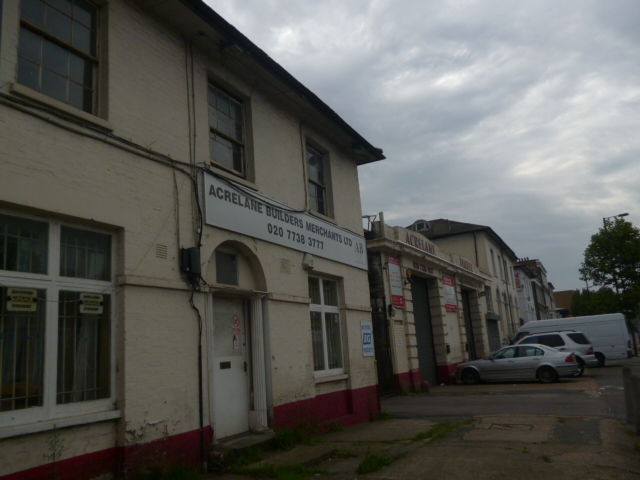
Acre Lane Builders Merchants, Acre Lane SW2
Geograph · CC BY-SA 2.0

Behind every passing bus is a depth of history most commuters ignore. The name itself is the oldest clue — a single word from the Old English tongue that tells you exactly what this land once was.

✦   ✦   ✦
Name Origin

Old English Æcer: Land a Man Could Plough in a Day

That single word — “acre” — is one of the oldest surviving place-name elements in the English language. It derives from the Old English æcer, itself from proto-Germanic *akraz and ultimately the proto-Indo-European root *ag’ro-, meaning “field.” As recorded by etymologists and confirmed by the Online Etymology Dictionary, the word originally denoted a day’s ploughing for a yoke of oxen — the practical measure of an agricultural working unit, not a precise geometric area. The lane is most likely named after one or more such open-field strips that bordered it in the medieval period, when the ancient parish of Lambeth was predominantly farmland and market garden.

As documented by British History Online in the Survey of London (Vol. 26), Acre Lane was an old parish highway — a pre-enclosure route repaired by parish surveyors rather than turnpike trusts. The word “acre” enters into many combinations in London street names — Long Acre, Goodacre, Whitacre — each recording a specific parcel of arable land that once defined a landscape since paved over entirely.

How the name evolved
pre-1741 Parish Highway (unnamed in surviving records)
c. 1741 Acre Lane (Roque’s Map)
19th c. Acre Lane / Clapham Park Road (western section renamed)
present Acre Lane
✦   ✦   ✦
History

From Medieval Lane to Doodlebug Ground Zero

Acre Lane is one of a network of medieval country lanes — alongside Coldharbour Lane and Brixton Water Lane — that once connected the Roman roads running south from the Thames. The lane existed long before any building lined it: it was a route across open ground, worn into the clay by centuries of farm traffic moving between the scattered holdings of the Archbishop of Canterbury’s manor of Lambeth. The enclosure of that manor in 1806 and the opening of Vauxhall Bridge in 1816 began the transformation, and by the 1820s the first substantial institutions were taking root along the lane.

Key Dates
c. 1741
First Map Record
Roque’s Map of the Environs of London names the lane; its western end is shown extending to what is now Clapham Park Road.
1806
Enclosure Act
The Lambeth Manor Enclosure Act begins parcelling the Archbishop’s open fields for development, setting the stage for rapid suburban growth.
1822
Trinity Homes Founded
Trinity Homes (formerly the Trinity Asylum) is established on Acre Lane; the institution remains on its original site to this day.
c. 1865
Peabody Estate
Philanthropist George Peabody purchases a sixteen-acre estate near the lane. After his death in 1869, his trustees develop the land with small terraced houses between Ferndale Road and Acre Lane.
1908
Town Hall Opens
Lambeth Town Hall, designed by Septimus Warwick, opens at the junction of Acre Lane and Brixton Hill, becoming the civic focus of the borough.
1944
V-1 Strike
On 28 June 1944 a flying bomb strikes Acre Lane, killing 72 people and causing serious damage to the Town Hall opposite.
Did You Know?

Trinity Homes on Acre Lane, founded in 1822 to shelter “aged and decayed freemen and householders of London,” was established to mark the passing of the Reform Bill of 1832 — a group of City gentlemen decided that founding almshouses was a more lasting memorial than a night of illuminations. The institution has stood on the same site for over two centuries.

The Victorian building boom transformed Acre Lane from a country highway to a suburban street within a single generation. After George Peabody purchased a sixteen-acre estate near the lane around 1865, as recorded by British History Online, his trustees developed the land with small terraced houses in the area between Ferndale Road and Acre Lane after his death in 1869. By 1908, when the Town Hall opened at the eastern end, the lane had taken on the form it broadly retains today — a mixed civic and residential thoroughfare, denser and more urban at the Brixton Hill end, calmer towards Clapham.

The Second World War interrupted that settled character violently. On 28 June 1944, a V-1 flying bomb struck the lane, destroying a large part of the 8th Church of Christ and resulting in 72 fatalities, with the Town Hall opposite sustaining serious damage. The post-war rebuilding that followed accounts for much of the gap-site architecture still visible on the north side of the lane.

✦   ✦   ✦
Culture

Town Hall, War Memorial and a Plaque for a Spy

Lambeth Town Hall, whose longest façade runs along Acre Lane, is the street’s defining building and a Grade II listed structure, as recorded by Historic England. Designed by Septimus Warwick and H. Austen Hall, it features a symmetrical rounded frontage at the Brixton Hill junction, Doric pilasters, and five tall windows with Ionic columns — an Edwardian baroque set-piece that was extended westwards between 1935 and 1938. The Town Hall carries two plaques of particular weight: one commemorating the 50th anniversary of the arrival of HMT Empire Windrush in 1998, and one unveiled in 1964 in memory of Violette Szabo GC, the Special Operations Executive agent who grew up in Brixton and was executed at Ravensbrück concentration camp in 1945.

Grade II Listed — Civic Landmark
Lambeth Town Hall, Acre Lane

Completed in 1908 and listed by Historic England, the Town Hall occupies the triangular site where Acre Lane meets Brixton Hill. Its Edwardian baroque design by Septimus Warwick survived the 1944 flying bomb blast that struck the lane, though it sustained serious damage. A plaque inside commemorates Violette Szabo GC, who grew up nearby and became one of the most celebrated SOE agents of the Second World War.

The lane’s Victorian churches also form part of its cultural texture. The area between Ferndale Road and Acre Lane was developed after 1869 on the former Peabody estate, and a church was an early priority for the new neighbourhood. St Paul’s, designed by W. G. Habershon, was consecrated by the Bishop of Rochester on 29 July 1881 and could accommodate 1,500 worshippers — a signal of how rapidly this stretch of south Lambeth had filled with working families in a single decade.

✦   ✦   ✦
People

The SOE Agent Remembered on the Lane

Violette Szabo is the most celebrated name connected to Acre Lane, through the plaque on the Town Hall wall. Born in Paris in 1921 to a French mother and an English father, she grew up in Brixton and was recruited into the Special Operations Executive during the Second World War. She was captured by the Gestapo in France in 1944 and executed at Ravensbrück in February 1945. She was posthumously awarded the George Cross — one of the first women ever to receive it — and her story was later told in the 1958 film Carve Her Name with Pride. The plaque unveiled at Lambeth Town Hall in 1964 is the most visible memorial to her on the lane she grew up beside.

The lane also borders the site of Trinity Homes, founded in 1822 and still operating, which has sheltered generations of elderly Londoners — an institutional continuity of over two centuries on a single stretch of road that survived enclosure, the Victorian building boom, and the Blitz.

✦   ✦   ✦
Recent Times

Regeneration, the Windrush and a New Ward

The Town Hall underwent a major £25 million refurbishment completed in 2018, carried out by Morgan Sindall as part of a wider regeneration that included new residential units and the consolidation of council offices into a new Civic Centre at 6 Brixton Hill. The building’s council chambers continue in use, and the Windrush Square just to the east — named partly to acknowledge the plaque inside the Town Hall marking the 50th anniversary of the Empire Windrush’s arrival — has been remodelled as a public space several times since the 1990s.

In 2022, Lambeth Council created a new electoral ward named Brixton Acre Lane, recognising the lane as a distinct community boundary. Acre Lane now formally divides the Ferndale ward to the north from the Brixton Hill ward to the south — a division that encodes, in the bureaucratic language of local government, the same topographical reality that Saxon farmers saw when they named this track after the fields it crossed.

✦   ✦   ✦
Today

A Civic Artery Between Two Neighbourhoods

Acre Lane today runs west from the Town Hall junction through Clapham, a mixed-use arterial road of Victorian terrace, post-war infill, and modern conversions. The eastern end remains the busiest, anchored by the Town Hall and by the retail and market activity spilling over from Brixton. Further west, the lane quietens into a residential character, the scale dropping as it moves away from the civic hub. The lane’s western extremity, once extending further still, was absorbed into Clapham Park Road during the nineteenth century — the lane effectively shortened by the logic of Victorian street naming.

5 min walk
Brockwell Park
50 hectares of open parkland on the hill above Brixton; lido, walled garden, and panoramic views across London.
8 min walk
Clapham Common
220 acres of common land, one of south London’s largest green spaces, with ponds and tree-lined avenues.
10 min walk
Windrush Square Gardens
A civic square at the heart of Brixton, remodelled with trees and seating; a gathering point for the community.
12 min walk
Kennington Park
Former Kennington Common, now a formal Victorian park with garden plots and a historic lodge building.

The nearest Underground station is Brixton on the Victoria line, a short walk east. Clapham North is accessible to the west. The lane sits at the boundary of two worlds — the dense, energetic streetscape of central Brixton and the calmer residential stretches of Clapham — a position it has occupied, in one form or another, since it was first worn into the clay of a Saxon field.

✦   ✦   ✦
“Acre Lane was an old parish highway — the only old houses still standing along it a testament to centuries of continuous use.”
Survey of London, Vol. 26 (London County Council, 1956), via British History Online
✦   ✦   ✦
On the Map

Acre Lane Then & Now

National Library of Scotland — Ordnance Survey 6-inch, c. 1888. Hosted by MapTiler. Modern: © OpenStreetMap contributors.

✦   ✦   ✦

Frequently Asked Questions

Why is it called Acre Lane?
The name most likely derives from the Old English word æcer, meaning a cultivated field or ploughed land. The lane crossed agricultural ground divided into open-field strips, each measuring roughly an acre — the area a yoke of oxen could plough in a single day. The name reflects the lane’s pre-urban identity as a route across farmland in the ancient parish of Lambeth.
When was Acre Lane first recorded?
Acre Lane appears on Roque’s Map of the Environs of London, surveyed between 1741 and 1745, confirming it was already a well-established thoroughfare by the mid-eighteenth century. As a recognised parish highway maintained by parish surveyors rather than turnpike trusts, it almost certainly pre-dates that survey by several centuries.
What is Acre Lane known for?
Acre Lane is known today as the civic address of Lambeth Town Hall, a Grade II listed Edwardian baroque building at its eastern end. The lane has a long history as one of Lambeth’s oldest parish highways, and carries a plaque commemorating Violette Szabo GC, the SOE agent who grew up in the area. In June 1944 a V-1 flying bomb struck the lane, killing 72 people — a tragedy that shaped the post-war streetscape still visible today.