Time Walk
A Crescent on the Old Common


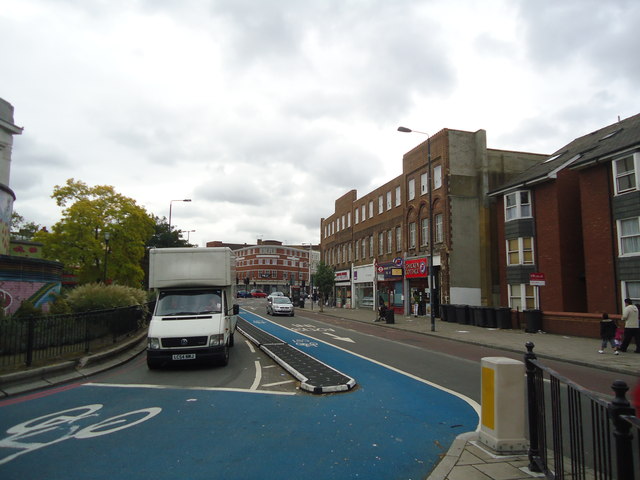
Cattle once grazed here, on open common land, before eight houses rose in a gentle curve. Today the terrace's raised ground floors face the War Memorial Gardens across the road, and the slight bow in the building line is easy to miss on a quick pass.
Beneath it all lies a patch of South Lambeth Common, enclosed and built over within a few years in the 1840s — pasture turned to parlour almost overnight. That change is where this street's name begins.
Name Origin
From Crescent to Terrace
The street was first known as Stockwell Crescent before it became Stockwell Terrace, taking its name from the surrounding district of Stockwell. The sources do not fully explain how Stockwell itself got its name, though they note a wood, referred to as a "stoc," which probably stood in the area until it disappeared in the 17th century, and a public well that once stood at the south-west corner of nearby Stockwell Green. Together a wood and a well point toward the obvious reading of the name, though no single source states it outright.
Stockwell had achieved manorial status by about the end of the 13th century, after South Lambeth Manor passed to the Crown in 1293 and was divided into Vauxhall and Stockwell manors. That older manorial Stockwell long predates the terrace that now carries its name.
History
Builder on Common Ground
In 1838 John Notley, a builder of Clapham Road, was admitted as tenant of three and a half acres of South Lambeth Common. Five years later he obtained the discharge of the building restrictions that had kept the common open, and covered the ground with houses, their ground floors finished in pale render and their end houses treated a little differently from the rest. A Lambeth Council designation report gives the completion date as about 1845.
Writing in the 1950s, the Survey of London called it a grand Italianate terrace, noting that the building line curves slightly to form a gentle crescent. The terrace, consisting of nos. 1–8, was protected as a listed building in 1981.
The Survey of London noted in the 1950s that the building line of Stockwell Terrace curves slightly, giving the row the shape of a gentle crescent — a trace, perhaps, of its earlier name, Stockwell Crescent.
People
A Family Opposite the War Memorial
Violette Szabo, G.C. (1921–1945), is remembered a short walk from the terrace. Born in Paris to a French dressmaker and a British soldier, she spoke fluent French, and her family settled in Stockwell in 1932. She married Étienne Michel René Szabo in 1940; he was killed in action in North Africa in 1942.
Szabo joined the Special Operations Executive in 1943 and was parachuted into France twice in 1944. On the second mission she was captured by the Germans, interrogated, sent to concentration camps, and executed in early 1945. She was awarded the Croix de Guerre and the George Cross, and is commemorated by a green plaque on the deep-level air raid shelter next to the Stockwell War Memorial, opposite Stockwell Terrace.
Today
Eight Houses, Still Standing
The terrace Notley built still stands as he left it, its eight houses facing the War Memorial Gardens — and the memorial it overlooks carries Violette Szabo's story a few steps from the terrace's own front doors.
On the Map
Stockwell Terrace Then & Now
Frequently Asked Questions
Why is it called Stockwell Terrace?
It was first called Stockwell Crescent and later Stockwell Terrace, taking its name from the surrounding district of Stockwell. The sources used here do not fully explain Stockwell's own name, though they mention a wood and a well once nearby.
What is Stockwell Terrace known for?
A Grade II listed Italianate terrace of eight houses built shortly after 1843 by builder John Notley on former common land, facing the War Memorial Gardens where Violette Szabo, G.C. is commemorated.
When was Stockwell Terrace built?
Building began after 1843, when builder John Notley obtained discharge of restrictions on the common land; a Lambeth Council report dates completion to about 1845.
What did Stockwell Terrace used to be called?
It was formerly known as Stockwell Crescent before becoming Stockwell Terrace.