Time Walk
A Lane That Used to Be Called Love


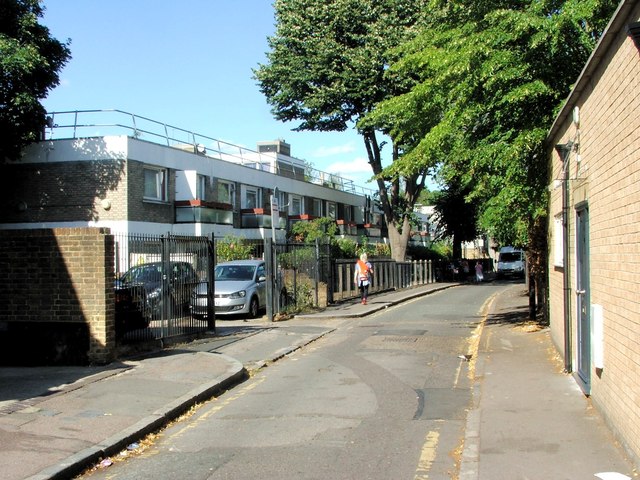
This narrow lane once went by a softer name: Love Lane. Walking it today, a visitor notices a terrace of mid-18th-century cottages, a pair of pedimented Georgian cottages, and houses standing only on one side of the road.
Beneath that modest row lies the edge of an old manor. The lane's quiet, one-sided shape is a trace of the village lane it once was, long before it took the manor's name — a story told next.
Name Origin
From Love Lane to the Manor's Name
At some point the lane traded its old name for that of the wider district and manor of Stockwell.
Stockwell itself had been a manor in its own right since around the end of the 13th century. It came into being when South Lambeth Manor was divided, under the Crown's ownership from 1293, into Vauxhall Manor and Stockwell Manor. For centuries afterwards the courts of Vauxhall Manor continued to exercise authority over Stockwell, a jurisdiction that lasted at least into the early 19th century.
The sources used here do not explain the origin of the word "Stockwell" itself, only the manor's administrative history. What they do show is that the lane's current name is a late layer over an older, more personal one.
History
Stocks, Pledges, and a Nurseryman's Fields
Stockwell Manor ran its own ancient rituals for centuries. From at least 1326 it paid a token "head penny" rent to the View of Frank Pledge of Vauxhall, a payment still being made in 1528–9. In 1626 Sir George Chute, then Lord of the Manor, held a Court Baron and View of Frank Pledge for Stockwell. As late as 1722 the Dean and Chapter of Canterbury, acting on their own court's order, presented themselves to put up new stocks in both Stockwell and Vauxhall — and when a new pound was needed in Stockwell in 1814, it was again the View of Frank Pledge of Vauxhall that ordered it built, even though responsibility fell on the Lady of Stockwell Manor.
The land itself changed hands through the 18th century. In 1736 Sir John Lade bought 20 acres in Stockwell that abutted Martin Lane, now Clapham Road. In 1782 he sold it on to William Malcolm, a nurseryman, and for a time the ground was known as Malcolm's Nursery Grounds. A further agreement in 1791 between the Duke of Bedford and the Fulham builder Archer Willson brought houses to part of the old manor land that had passed to the Dukes of Bedford earlier in the century.
On the lane itself, Nos. 15–19 are a terrace of houses built in stock brick around 1750, with paired doorways under wooden hoods. Nos. 10 and 11, a pair of cottages once called Rose Cottage and White Rose Cottage, share a front crowned with a pediment holding a recessed quatrefoil. At the lane's east end stood No. 28 Sidney Road, probably built in the early 18th century on land let with Stockwell Manor to Henry Store back in 1580; in the 19th century it was used as two separate houses, Grove House and Burnley House, before it was demolished in 1952.
Despite having its own name, Stockwell Manor spent centuries under someone else's thumb: from at least 1326 until the early 19th century it paid a token "head penny" rent to, and fell under the legal jurisdiction of, the neighbouring View of Frank Pledge of Vauxhall.
Culture
Painting the Old Name Back On
By 2017 the lane was also noted for littering and anti-social behaviour. The murals arrived against that backdrop, their title reaching back to the old name recorded in the Survey of London.
Frequently Asked Questions
On the Map
Stockwell Lane Then & Now
Why is it called Stockwell Lane?
The lane was formerly known as Love Lane. Its current name ties it to Stockwell, which became a manor in its own right around 1300 after South Lambeth Manor was split in 1293. The sources used here do not explain the origin of the word "Stockwell" itself.
What is Stockwell Lane known for?
It is known for a short run of surviving Georgian buildings — a c.1750 terrace at Nos. 15-19 and a pair of pedimented cottages at Nos. 10-11 — and for three murals completed in 2017 under the "Love Lane" community project.
What stood at the east end of Stockwell Lane?
No. 28 Sidney Road faced the east end of the lane. Probably built in the early 18th century on land let with Stockwell Manor in 1580, it was used as two houses, Grove House and Burnley House, in the 19th century before demolition in 1952.