Time Walk
The Green That Refused to Flatten


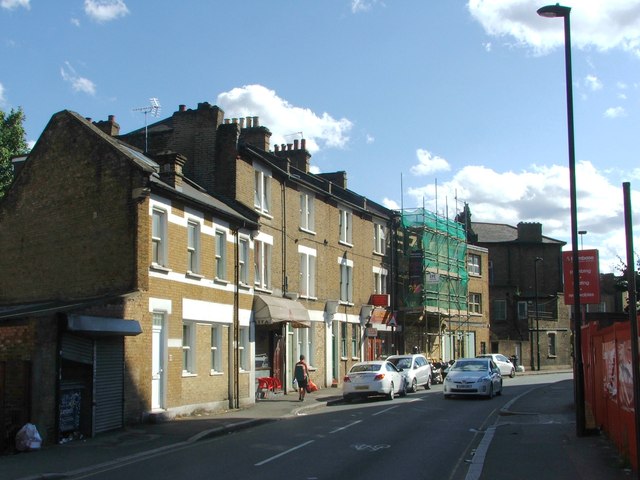
A moated manor house once stood where cottages and a converted chapel now face each other across a curved green. Today's visitor finds a crescent of early 19th-century cottages, a grand former chapel with an Italian campanile, and a small memorial hall given by a brewer. The shape of the green itself is older than almost everything standing on it.
Beneath the pavements, springs that gave the place its name once fed a brewery and, before that, a manor's moat. The crescent you can walk today was probably laid out well before the 15th century. That older curve is where the name Stockwell Green begins.
Name Origin
Woodland, Stumps, and Springs
Stockwell is first recorded in 1197. The name is formed from "stoc", referring to woodland or tree stumps, and "well", referring to nearby natural springs. Stockwell was granted manorial status in the 13th century, giving the hamlet an administrative identity to match its name.
The wood that gave the place its "stoc" probably disappeared in the 17th century. The springs proved more durable: the plentiful water supply around the green later made it a suitable site for a brewery, and a public well stood at its south-west corner.
History
From Moated Manor to Village Green
A manor house with a moat once stood at Stockwell Green. In 1580 its gardens and orchards, covering about four acres, were leased to Henry Store for a term of 1,000 years. Legend connects the house with Thomas Cromwell, who may have stayed there while it belonged to Henry VIII, though this is not certain.
The leasehold passed to Francis Gofton and then, in 1640, to Samuel Lewes along with about 42 acres of land. The manor house itself was demolished shortly before 1756. Isaac Barrett, a wax-chandler, bought the lease to the site in 1770 and built a large mansion there, which was in turn pulled down in the middle of the 19th century. Some stretches of the old moat, said to have been 30 to 40 feet wide, could still be seen at the start of the 19th century.
In 1802 the Manor, together with Stockwell Green and Stockwell Common, was sold at auction to William Lambert, who became Lord of the Manor. By the late 18th century, improved river crossings including Thames bridges had let London spread across the water, changing the character of Vauxhall and Stockwell. Merchants began building houses on Stockwell Road and facing the green itself, drawn by its semi-rural air and clean water while staying within reach of the City — the start of Stockwell's shift from hamlet to suburb. The opening of Vauxhall Bridge in 1816 spurred further piecemeal building around the green. By the 1860s, with the railways arriving, the wider area was largely urbanised.
The green stayed open space until 1876, when the freeholder, Mr Honey, won a long and contentious dispute to build on it.
Culture
Chapels, a Brewer, and the Salvation Army
Two chapels dominated the green's religious life. Stockwell Chapel, built in 1767 on land from the Duke of Bedford's estate, was remodelled in 1867 by the architect Henry Edward Coe and reopened as St Andrew's Church, holding over a thousand worshippers. Its grey brick was rendered over in the 1880s, and its side galleries removed in a 1924 restoration. Stockwell New Chapel, meanwhile, was enlarged and reopened in 1850 to designs by the architect James Wilson, and served as the site of Booth's wedding.
Brewing also shaped the green. Hammerton's Stockwell Brewery stood on its north side, at the corner of Lingham Street, drawing on the area's plentiful springs. Lambeth's appraisal of the green dates it to the 1780s; the Survey of London found no reference to a brewery here before 1801. By the 1830s it was trading around 12,000 barrels a year. Charles Hammerton, a local brewer turned temperance campaigner, later gave the Hammerton Memorial Hall and keeper's house to the green in 1906, designed by the architect of the Old Bailey.
People
A Pastor, a Chandler, and a Brewer
Thomas Jackson was inducted as pastor of Stockwell New Chapel in 1801 and remained until his death in 1843. He is buried in a vault in the chapel graveyard, with a tablet to his memory above the pulpit.
Isaac Barrett built a mansion there. Charles Hammerton gave his name and his money to the memorial hall that still stands on the green.
"remarkable fine water"Survey of London, Vol 26, on the spring supplying the Barrett family's house opposite the green
Today
A Crescent of Survivors
Early 19th-century cottages still line the green, mostly built singly or in twos and threes between about 1790 and 1840. No. 21, probably late 18th century, is a plain two-storey brick cottage, while Nos. 28 to 30 form a terrace inscribed "VICTORIA PLACE" on their parapet. Many of these houses, along with No. 1 — built around 1848 as an Educational Institute — are now protected.
St Andrew's Church and the former United Reformed Church, with its protected gate piers and railings, still stand on the green, among the oldest church buildings in Lambeth besides the parish church of St Mary. Two wells survive on the site of the former Congregational Church and two more on the old brewery site, quiet traces of the springs that named the place.
The date "1730" inscribed on the old brewery building at Stockwell Green is unsubstantiated — the earliest confirmed reference to a brewery here is from 1801.
On the Map
Stockwell Green Then & Now
Frequently Asked Questions
Why is it called Stockwell Green?
The name Stockwell combines "stoc", meaning woodland or tree stumps, with "well", referring to natural springs. Stockwell is first recorded in 1197, and the green takes its name from the wider settlement.
What is Stockwell Green known for?
It is known for its moated manor house, demolished before 1756, its crescent of early 19th-century listed cottages, and Stockwell New Chapel, where William Booth, founder of the Salvation Army, married in 1855.
Is the old manor house still standing?
No. The moated manor house was demolished shortly before 1756, and a later mansion built on its site in 1770 was itself pulled down in the mid-19th century. Parts of the moat were visible into the early 1800s.
What is Stockwell New Chapel used for today?
Its Dissenting congregation moved to new premises in 1989, and the building now serves as Stockwell Green Mosque.