Lambeth London England About Methodology
Oval · SE11

Hackford Road

The Victorian terrace where Vincent van Gogh sketched London and fell in love, renamed in the 1860s and now home to the world’s greatest typographic collection.

Named After
Uncertain
First Recorded
c. 1830s
Borough
Lambeth
Character
Victorian Terrace
Last Updated
Time Walk

From Farmland to Artistic Haven

Hackford Road runs north to south through Oval, sandwiched between Clapham Road to the west and Brixton Road to the east. It is a quiet residential street of early Victorian terraced houses, many dating to the 1820s, their stucco facades and sash windows still intact from the era when the street itself was countryside.

2015
Hackford Road, Brixton
Wikimedia Commons · CC BY-SA 2.0
Today
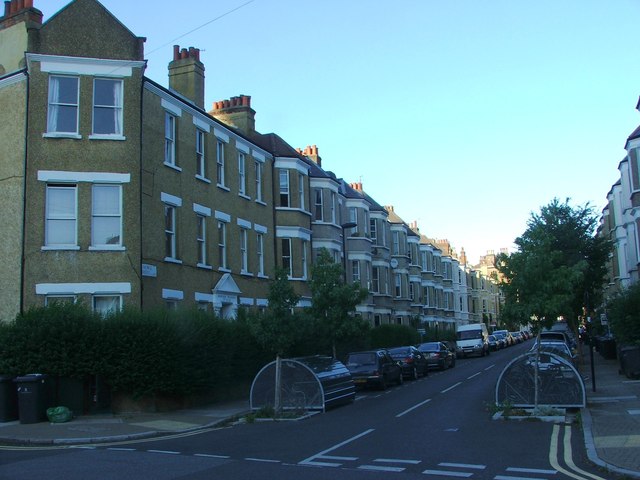
Mowll Street, Oval — near Hackford Road
Geograph · CC BY-SA 2.0

The street’s identity is inseparable from two things: a painter who lived in one house for eighteen months, and a museum that holds the rarest letters and types from the history of printing. But neither of these came by accident. The street had to change its name first.

✦   ✦   ✦
Name Origin

From St Ann’s to an Unknown Hackford

When the street first appeared on maps in the 1830s, it bore the name St Ann’s Road. This name persisted through the 1840s and 1850s—a simple dedication to a parish saint, common in London’s expanding suburbs. By the early 1860s, the name had vanished. Maps from the mid-1870s show only Hackford Road, yet the exact moment and reason for the change are not recorded. The origin of the name itself remains uncertain; no deed, council minute, or historical document explains who Hackford was or why the street inherited his name.

The shift happened during a time of rapid suburban development. British History Online records that the area around Hackford Road stood on land that had been part of Lambeth Wick Estate, once appurtenant to the Manor of Lambeth and granted to the Archbishop of Canterbury in the medieval period. By the 1820s the estate had been subdivided and developed into terraced housing. The name change from St Ann’s to Hackford may have reflected a local landowner or builder involved in these developments, but without primary sources, this remains speculation.

How the name evolved
c. 1830s St Ann’s Road
c. 1860s Hackford Road
✦   ✦   ✦
History

An Artist’s Room and a Collector’s Dream

Hackford Road stands where there was once open countryside and in historical documents is often referred to as part of Stockwell. The first appearance of residents was in the building of small houses and shops at the north end of the street in the 1820s, none of these buildings remain but can be seen below. In the post war years Hackford Road took on a shabbier appearance, many of the cottages and terraces were run down and occupied beyond their natural capacity. In a move to regenerate the area the local authority built the Caldwell Gardens housing estate alongside Hackford Road while private developers had their eye on flattening many of the early victorian cottages on the south eastern side of the street.

Key Dates
c. 1820s
First Houses
Small houses and shops built at the northern end of the street, replacing farmland.
1873–74
Van Gogh in London
Vincent van Gogh lodges at 87 Hackford Road while working for Goupil & Co., sketching the street.
1971
Discovery
Postman Paul Chalcroft identifies the Van Gogh connection during a postal strike; 87 Hackford Road verified as his residence.
1973
Blue Plaque
GLC installs blue plaque at 87 Hackford Road, exactly 100 years after Van Gogh’s arrival.
1974
Conservation Area
Small conservation area of early-mid 19th century semi-detached and terraced houses designated.
1992
Type Museum Opens
The Type Museum, opened in 1992, is located at 100 Hackford Road, at the southern end.
Did You Know?

The street’s link to the painter was only discovered in 1971 by postman and avid Van Gogh enthusiast Paul Chalcroft, who took it upon himself to locate Van Gogh’s London home during a postal strike.

In 1973, when Lambeth Council declared 63 to 79 Hackford Road a conservation area, stating that the Victorian villas form part of the original development of Stockwell and the loss of these properties would be regrettable, the conservation area imposed strict building and alteration rules on this part of the street. The listing of number 87 as Grade II followed swiftly, anchoring the street firmly in the borough’s protected heritage.

✦   ✦   ✦
Culture

Art and Type on a South London Lane

Blue Plaque & Artistic Legacy
Van Gogh’s London Home

Vincent Van Gogh visited London as a young man in 1873–5 and stayed at 87 Hackford Road in Stockwell, South Lambeth. A blue plaque now commemorates his stay there. Two months after arriving he found cheap lodgings at 87 Hackford Road in Stockwell. The house was a three-storey terraced house dating from about 1840 and the home of Mrs Sarah Loyer and her daughter Eugenie.

Van Gogh sketched the Georgian terrace opposite Durand School in Hackford Road during the 1870s. He sketched the 1824-built, three-storey Georgian terrace including the house, opposite Durand School, using pencil with chalk highlights. He lettered the wall “Hackford Road” and the gate “Maison Loyer”. But his happiness was marred by his unrequited love for Eugenie Loyer. He eventually left number 7 in summer 1874 after declaring his feelings and discovering that she was already engaged.

Living Museum Collection
The Type Archive

The area boasts the most significant typographic collection in the world at the National Museum of Type and Communication (now known as the Type Archive), 100 Hackford Road. The Type Archive holds the National Typefounding Collection, purchased with grants from the National Heritage Memorial Fund; broadly comprising the typefounding materials of the Sheffield typefounders, Stephenson Blake, a collection dating from 16th century London typefounders to their 20th century counterparts; the hot-metal archive and plant of the Monotype Corporation, operating from Salfords in Surrey from 1897, and in London’s Lambeth from 1992 to date.

· Art
87 Hackford Road
Vincent van Gogh · 1873
Post-Impressionist painter lived at house; sketched Georgian terraces before leaving.
Hackford Suite
Albert Irvin · 1980s
Series of four abstract paintings using the street as coordinate reference.
🎭 Theatre
Vincent in Brixton
Nicholas Wright (playwright), Richard Eyre (director) · 2002
National Theatre play about Van Gogh's London years; Olivier Award winner.
✦   ✦   ✦
Notable People

The Lodger and the Landlady

The artist Vincent van Gogh (1853–1890) lived at 87 Hackford Road, then the house of Ursula Loyer and her daughter Eugenie, in 1873 and 1874. He arrived in London to start work at the art dealership Goupil & Co. in Southampton Street, central London, on 19 May 1873. From August of that year, van Gogh lived in Hackford Road. Though Van Gogh’s love for Eugenie was unrequited, his time at Hackford Road is said to be some of the happiest of his life.

The young Dutchman Vincent Van Gogh was sent to London in 1873 by his employers, the Dutch art dealer Goupil & Co, in order to work in their Covent Garden branch. The 20-year-old Van Gogh carried a sketchbook on his walks around South London, but he had not yet found his vocation as a painter. The works for which he became famous date largely from the last five years of his life, and include Sunflowers (1888) and The Starry Night (1889). However British culture had an enormous impact on him and his later development as an artist.

✦   ✦   ✦
Recent Times

From Dereliction to Contemporary Arts Space

87 Hackford Road’s link to the painter was only discovered in 1971 by postman and avid Van Gogh enthusiast Paul Chalcroft, who took it upon himself to locate Van Gogh’s London home during a postal strike. At the time, the house’s residents were Arthur and Marjorie Smith. The Smiths had moved to Hackford Road in the early 1950s and were baffled to learn that the eponymous artist had lived at the house. This discovery was made in 1971 and the blue plaque followed in 1973.

Built in the 1820s, by 2012 the property had fallen into a state of disrepair. Bordering on dereliction, the building was purchased at auction by James Wang and Alice Childs, who saw the potential to bring this cultural landmark back to life. Conservation works took place over 7 years, guided by an ambition to save as much existing material as possible, and making sensitive repairs where necessary. Opening in March 2019 after a major conservation project, The Van Gogh House London is conceived as an evolving opportunity to support emerging artists to make a living from their work in their lifetime - something Van Gogh himself was never able to achieve. The house is a space for research and learning; hosting contemporary exhibitions and artist residencies; alongside a programme of public tours, events and education activities.

✦   ✦   ✦
Today

A Street Where Art and Heritage Stand Together

Hackford Road remains a quiet residential street of Victorian terraces, with little visible change to its streetscape beyond gentle restoration. The blue plaque at number 87 marks van Gogh’s presence with quiet certainty, drawing art historians and curious visitors. The house itself operates as Van Gogh House London, open by tour and hosting artist residencies and exhibitions. One hundred years of anonymity was reversed in a single discovery; now the street’s connection to the painter is its defining identity.

At the southern end, the Type Museum continues as a world-class archive. The conservation area, first designated exactly one hundred years after van Gogh’s arrival, protects the early Victorian terraces and enforces sensitivity to the street’s character. The street runs quietly between two major roads, overlooked by the hurrying traffic on Clapham Road and Brixton Road, yet it holds two irreplaceable collections: one of sketches and love letters, the other of metals and type.

8 min walk
Archbishop Park
Open green space with mature trees and community garden.
10 min walk
Myatt’s Fields Park
Victorian park with sports facilities and tree-lined avenues.
6 min walk
Kennington Common
Open grassland; site of the 1848 Chartist Rally for democratic reform.
Nearest station
Oval (Northern Line)
Opened 1890; short walk north from the street.
✦   ✦   ✦
On the Map

Hackford Road Then & Now

National Library of Scotland — Ordnance Survey 6-inch, c. 1888. Hosted by MapTiler. Modern: © OpenStreetMap contributors.

✦   ✦   ✦

Frequently Asked Questions

Why is it called Hackford Road?
The street was originally named St Ann’s Road when it first appeared on maps in the 1830s. By the 1860s, the name had changed to Hackford Road, though the exact reason for the change and the origin of the name itself remain unclear. No documentary evidence has been found to explain the etymology.
Did Vincent van Gogh really live on Hackford Road?
Yes. Van Gogh lived at 87 Hackford Road from August 1873 to summer 1874 while working at the art dealership Goupil & Co. in Covent Garden. He lodged with Ursula Loyer and her daughter Eugenie, and sketched the Georgian terrace houses opposite Durand School. The connection remained unknown until 1971, when a postman discovered it during a postal strike. A blue plaque was installed in 1973, exactly a century after his arrival.
What is Hackford Road known for?
Hackford Road is best known as the home of Vincent van Gogh during his formative London years, marked by a blue plaque at number 87. The street also houses the Type Museum at 100 Hackford Road, which opened in 1992 and holds the world’s most significant typographic collection, including materials dating from the 16th century to the present. The conservation area, first designated in 1974, preserves the early Victorian terrace architecture that van Gogh himself sketched.