Time Walk
The Lane Behind the Big Houses


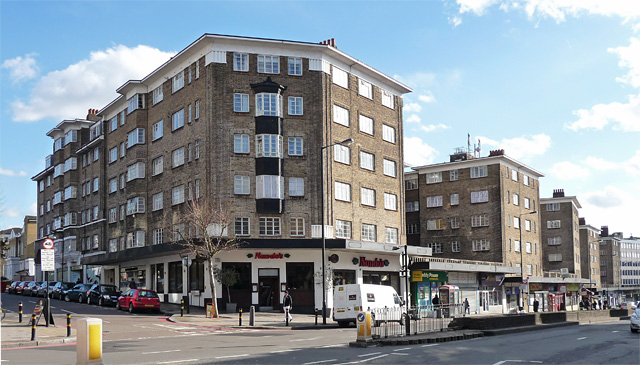
This quiet avenue began as nothing more than a farm track to Mount Nod Farm, not a through road at all. Today it rises gently toward Leigham Court Road, past a boxy 1930s telephone exchange and black cast-iron bollards still set along its pavement.
Beneath these modest houses lies a working yard: the ones on the north side began life as service cottages for the grand villas of Leigham Court Road. That servant's lane took its name from a much older manor.
Name Origin
A Detached Portion of Leigham Court
Leigham Avenue takes its name from the Manor of Leigham Court, whose grounds reached into the parish of Streatham as a detached portion of about 160 acres. That portion was bounded by Leigham Vale, Norwood Road and the parish boundary.
In 1786 the manor was held by the Duke of St Albans. Lord Thurlow had already leased the neighbouring Knight's Hill from the Duke in 1778, when it was known as Brockwell Green Farm, and bought it outright in 1785 for £3,255. In 1789 he bought the Manor of Leigham Court itself from the Duke's trustees, bringing the two holdings under one owner.
History
From Mount Nod Farm to the Telephone Exchange
The avenue's farm track led to Mount Nod Farm, whose farmhouse probably stood near the present junction with Conifer Gardens. The farm's own history reached back to 1340, when it belonged to the monks of Bermondsey Abbey.
Lord Thurlow, who had bought the Manor of Leigham Court in 1789, built "a spacious mansion house" on Knight's Hill. It was later amalgamated with Leigham Court and pulled down after an Act of 1809.
"a spacious mansion house"Victoria County History, Surrey, vol. 4 (1912)
Houses began to appear along the old trackway through the rest of the century, including small cottages on the north side built as servants' quarters for the villas and mansions of Leigham Court Road.
At No. 17, a modest two-storey brick cottage was probably built for the domestic staff of Barham House; a large arch on its front probably marks the original cart and carriage entrance. Next door at No. 19, the building may once have held three cottages around a service yard; it is today used as a garage.
By the 1930s the avenue had new neighbours. Endsleigh Mansions, a block of flats with bay windows, was designed by John S. Quilter & Sons. Garages were added behind it soon after to give secure parking for residents' motor cars. On the plot that had been the garden of No. 20 Leigham Court Road, a telephone exchange went up, with a keystone over its door carrying the royal cipher and the date 1949.
Accounts differ on exactly when Beriah Drew bought Mount Nod Farm from Lord Thurlow's estate — the 2016 appraisal says 1836, the 2002 designation report says 1838.
People
A Lord, a Farmer and an Architect
Lord Thurlow shaped much of the land that became Leigham Avenue, leasing then buying Knight's Hill before buying the Manor of Leigham Court in 1789 and uniting the holdings under one name.
Beriah Drew bought Mount Nod Farm, and the track that would become this avenue, from Thurlow's estate in the late 1830s.
A separate detached holding, the Manor of Levehurst on the south side of Knight's Hill but reckoned part of Leigham Court's lands, had been held in 1471 by Ralph Leigh.
In the 1930s the architects John S. Quilter & Sons of St James's Street designed Endsleigh Mansions, the red-brick block of flats that still stands on the avenue.
Today
Cottages, Flats and a Keystone
Three early 20th-century houses at Nos. 21, 23 and 25 survive with rendered walls and a shared arched porch. The telephone exchange keeps its symmetrical face of brick and stone, its tiled roof, and its 1949 royal-cipher keystone. Black cast-iron bollards still line the pavement where the 2016 appraisal found only a short stretch of the avenue, near the rise toward Leigham Court Road, worth protecting.
On the Map
Leigham Avenue Then & Now
Frequently Asked Questions
Why is it called Leigham Avenue?
It takes its name from the Manor of Leigham Court, a detached 160-acre portion of which lay in the parish of Streatham. The manor passed through the Duke of St Albans and then Lord Thurlow in the 1780s.
What is Leigham Avenue known for?
Its origins as a farm track to Mount Nod Farm, and the small cottages on its north side that were built as servants' quarters for the grand villas of Leigham Court Road.
What stood here before Leigham Avenue was built up?
A farm track leading to Mount Nod Farm, whose farmhouse probably stood near the present junction with Conifer Gardens. The farm's history traced back to 1340, when it belonged to the monks of Bermondsey Abbey.