Time Walk
Up the Hill from the Church


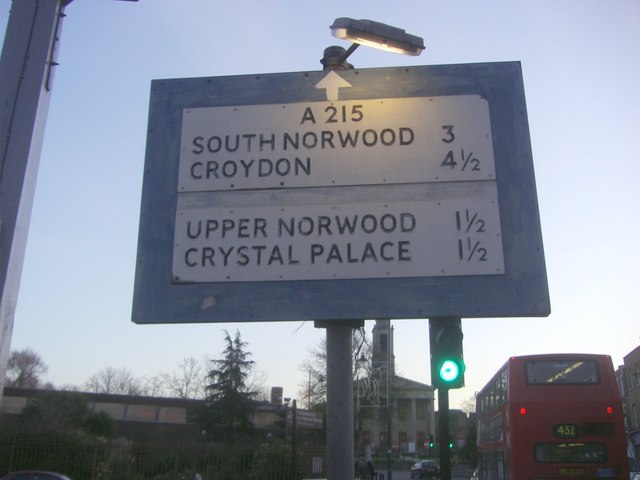
A lane that once wound so persistently it was simply called "Night's Hill" still climbs here today. At the bottom stands St Luke's Church on its rising ground, and near it a Victorian drinking fountain marks the spot where Knight's Hill meets Norwood Road. Further up, a solid brick library building from the 1880s still faces the street, though it has not been a library for decades.
Underneath the pavement runs a railway tunnel, cut beneath the hill in the 1860s. The name above ground is older still, tracing back to a Tudor family rather than any knight on horseback.
Name Origin
The Knight Family of Lambeth and Streatham
The name is thought to come from a man, not a title. Lambeth's conservation records suggest Knight's Hill derives from a Henry Knyght living in the area around 1535. A Henry Knight is independently recorded in 1545 holding a copyhold estate called Knights Hill of the lord of Leigham Court, in a detached portion of Streatham lying within Lambeth parish. The Knight family held a good deal of land across both Lambeth and Streatham, and by the 16th century members of the family occupied two quite separate areas that both came to be called Knight's Hill — one part of Lambeth Manor, south of St Luke's Church, the other a detached piece of the Manor of Leigham Court between what are now Norwood Road and Croxted Road. That double naming is the source of some lasting confusion between the two.
Before it carried the family's name in its present form, the route was known simply as an ancient winding country lane, "Night's Hill Lane," following the course now taken by Norwood Road and Knight's Hill. A Parliamentary Survey of 1647 already used the form "Knight's Hill" for a small common wood of forty pollard oaks and two elms standing nearby.
History
A Lord Chancellor's Folly, and the Institutions That Followed
Edward Thurlow, who became Lord Chancellor in 1778, spent the second half of the eighteenth century assembling an estate around Knight's Hill Farm. He was admitted to Knight's Hill House and a hundred acres of copyhold land in 1772, took a lease of the detached Leigham Court portion in 1778, and in 1785 bought a further 160 acres then called Brockwell Green Farm for £3,255.
Between 1792 and 1795 Thurlow had a large mansion built near what is now the junction of Thurlow Park Road and Elmcourt Road, to a design by Henry Holland, finished by Samuel Wyatt after Holland's build ran drastically over budget. Thurlow never moved in, living instead at the much smaller Knight's Hill Farm; the mansion was pulled down in 1810, its materials sold for £7,230 following an Act of 1809.
Lord Thurlow's architect built him a mansion costing roughly three times its £6,000 budget — and Thurlow never spent a night in it before it was pulled down in 1810.
On the west side of the street an eighteenth-century house was rebuilt shortly before 1840 as St John's Lodge; it was sold at auction in 1884 and demolished soon after. By then the hill was filling with civic buildings. The West Norwood Methodist Church was erected in 1852–3, with a chancel added in 1894. In 1858 Arthur Anderson built the Norwood Institute on the street, intended, in its own words, "to promote the moral, intellectual and social improvement of the Inhabitants residing within a radius of five miles."
"to promote the moral, intellectual and social improvement of the Inhabitants residing within a radius of five miles"Norwood Institute, 1858
It was renamed the Norwood Technical Institute in 1894 and used as a school of domestic economy and commerce. Nearby, the Jewish Orphanage was built on former Thurlow land, its foundation stone laid on 6 June 1861 by Sir Anthony de Rothschild. A tunnel for the London, Brighton and South Coast Railway, running from Peckham to Streatham, opened beneath the street in 1868.
The West Norwood Free Public Library, designed by Sidney R. J. Smith, opened on 21 July 1888 on a site given by Frederick Nettlefold, who had laid its foundation stone the previous November. It was one of four public libraries built across Lambeth between 1888 and 1906.
People
Benefactors, an Architect, and a Family Lost to War
Frederick Nettlefold gave the ground for the Free Public Library; he is buried in nearby West Norwood Cemetery, though his monument there is now lost. A short way from the library's site, a drinking fountain of 1896 commemorates Amelia Woodford Fawcett, a Temperance campaigner also buried in the Cemetery.
War reached the street itself on 13 August 1944. At No. 8 Knight's Hill Square, Sybil Louisa Antingham, her mother Louisa, and Olive May Antingham were all killed in the same V1 flying bomb attack. Knight's Hill Square was later completely demolished; the site is now an industrial estate.
Recent Times
A Library Outlives Its Purpose
The Free Public Library closed in 1969, once a new library opened opposite. The old building at Nos. 14–16 Knight's Hill still stands, though its original use ended there.
Today
A Name Older Than Any Building On It
Almost everything Thurlow built or that followed him has gone or changed use: his mansion demolished in 1810, St John's Lodge in the 1880s, Knight's Hill Square after the war, the library's purpose in 1969. What remains fixed is the name itself, carried by a family recorded here since at least 1545, long before any of it was built.
On the Map
Knight's Hill Then & Now
Frequently Asked Questions
Why is it called Knight's Hill?
It is thought to come from Henry Knyght, recorded living in the area around 1535; a Henry Knight is separately recorded in 1545 holding a copyhold estate called Knights Hill here. The Knight family held extensive land across Lambeth and Streatham in the 16th century.
What is Knight's Hill known for?
For Lord Thurlow's hugely over-budget Georgian mansion, demolished in 1810 having never been lived in, and for the cluster of Victorian civic buildings that followed it — a library, a technical institute, a Jewish orphanage and a Methodist church.
Was Knight's Hill always called that?
No. The route was earlier known as the winding "Night's Hill Lane." A Parliamentary Survey of 1647 already used the form "Knight's Hill" for a small common wood standing nearby.
What happened at Knight's Hill Square?
On 13 August 1944, three members of the Antingham family died there in a V1 flying bomb attack. The square was later completely demolished and the site is now an industrial estate.