Time Walk
A Solicitor's Road Over a Monk's Farm


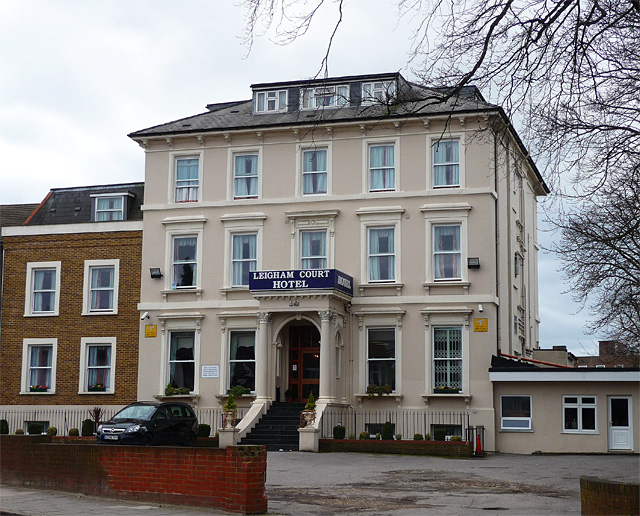
A Bermondsey solicitor bought a 260-acre farm here and cut a road straight through it. Today Leigham Court Road climbs from Streatham towards Streatham Hill past Victorian villas, a Gothic church tower, and a 1970s block of sheltered flats. The large houses at its southern end still sit in generous gardens, much as they did when first built.
Underneath the Victorian villas lies a much older landscape: the farm Beriah Drew bought had belonged to the monks of Bermondsey Abbey since 1340. That long farming history, and the manor it sat within, gave the road its name.
Name Origin
The Manor That Gave Its Name
The road is named after the Manor of Leigham. Beriah Drew bought the farmland from the estate of Lord Thurlow, the manor's last Lord — sources differ slightly on whether the purchase was 1836 or 1838. Drew laid out the road across that land in 1839, and it took the manor's name.
Not the whole road carried the name from the start. The northern stretch, towards Streatham Common, was known as St Julian's Road until 1902, when it was brought under the Leigham Court Road name.
History
From Monastic Farm to Victorian Suburb
Mount Nod Farm, Streatham's largest, stretched to some 260 acres and had belonged to the monks of Bermondsey Abbey as far back as 1340. Beriah Drew's purchase of it in the 1830s and his 1839 road scheme turned that farmland into building plots, and Drew built his own house, Leigham Lodge, at No. 22 in 1843.
Development was slow until the railway arrived. Streatham Hill station opened in 1856, and development of the road accelerated sharply afterwards. Over the following half-century the land on either side was built up, the southern stretch following the pattern of grand family houses in spacious gardens already set along nearby Crown Lane. The building firm George Trollope and Sons alone put up seventeen or more houses along the road.
A church followed the houses. A temporary church for 300 people went up opposite the present St Peter's in or shortly before 1866. George Henry Drew and Richard Drew gave land for a permanent church to the Ecclesiastical Commissioners in 1870, against opposition from the incumbent of St Luke's, Norwood. Richard Drew designed St Peter's; its east end was consecrated on 2 July 1870. G. H. Fellowes Prynne completed the building between 1886 and 1887, adding two more bays and a baptistery. Writing in the 1950s, the Survey of London described its west front as a "balanced but slightly asymmetrical composition".
"balanced but slightly asymmetrical composition"Survey of London, Vol. 26, 1950s
People
The Drews, a Manor Lord, and Two Twentieth-Century Architects
Beriah Drew began it all. A solicitor from Bermondsey who had settled in Streatham, he bought the old Mount Nod Farm from the estate of Lord Thurlow and cut the road through it in 1839.
His family stayed involved in the road's growth: George Henry Drew and Richard Drew gave the land for St Peter's Church in 1870, with Richard Drew designing the building himself, before G. H. Fellowes Prynne completed it between 1886 and 1887.
Nearly a century on, the architect Kate Macintosh designed No. 269 for Lambeth Council as sheltered accommodation for older people, built between 1968 and 1973 with 44 flats, a common room, shop, laundry, guest room and warden's flat.
Recent Times
Protecting the Arcadian Streets
Much of the Victorian road has survived into recent decades. A number of its Victorian houses weathered twentieth-century redevelopment pressure, and the southern stretch kept much of its original character. Lambeth Council completed the conversion and rehabilitation of two large Victorian houses, Nos. 286 and 288, in March 1977, and rehabilitated No. 286 again in 1979.
That survival was formally recognised. The southern section was protected as a conservation area in 1981, and the northern section followed as its own in 2002; the two remain separate today.
Today
Clay, Gravel and a High Ridge
The road still climbs towards Streatham Hill's ridge, reaching some 300 feet above ordnance datum, over ground of London clay, gravel and sand. Along it, Arts and Crafts-influenced houses such as Nos. 521 and 525, and the castellated porch of No. 286, sit alongside the twentieth-century sheltered flats of No. 269 — a road still carrying the marks of nearly two centuries of building on top of a much older farm.
The land Leigham Court Road was built across had been farmed continuously since at least 1340, when it belonged to the monks of Bermondsey Abbey.
On the Map
Leigham Court Road Then & Now
Frequently Asked Questions
Why is it called Leigham Court Road?
It takes its name from the Manor of Leigham. Beriah Drew bought farmland from the estate of Lord Thurlow, the manor's last Lord, and named the road he laid out across it in 1839 after the manor.
What is Leigham Court Road known for?
For its Victorian villas built after the 1839 laying-out and the 1856 arrival of Streatham Hill station, for St Peter's Church (1870–1887), and for Kate Macintosh's Grade II-listed sheltered housing at No. 269.
When was Leigham Court Road built?
It was laid out in 1839 by the solicitor Beriah Drew across the former Mount Nod Farm, with development accelerating after Streatham Hill station opened in 1856.
Was Leigham Court Road ever called something else?
Its northern end, towards Streatham Common, was known as St Julian's Road until 1902, when it was brought under the Leigham Court Road name.