Time Walk
A Lane That Outlasted Its Own Estate


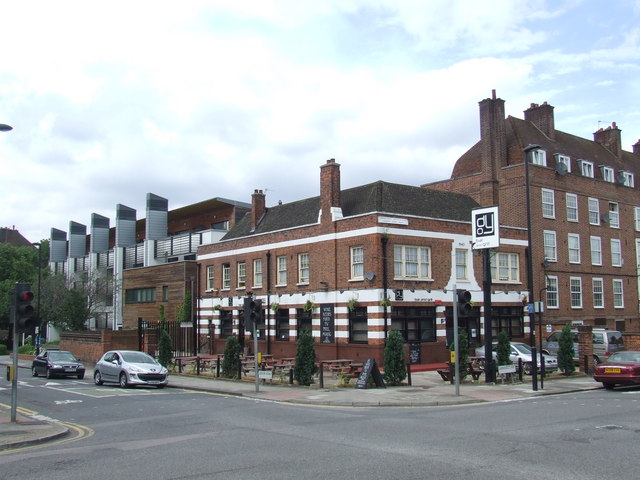
A street named for caged songbirds now runs downhill through solid Victorian terraces. The ground falls away steadily underfoot, houses on one stretch sit behind tall gate piers, and near Gauden Road garden walls close the street in with a pleasant sense of enclosure.
But the terraces came later than the lane beneath them. A scatter of houses had already gone up here earlier in the 19th century, well before the surrounding grid existed, then was swept away in the 1870s rebuilding — a reminder that this rise was a route first, and an estate second. That earlier name is where the story really starts.
Name Origin
The Tavern Keeper and His Larks
The name is thought to go back to a pub. Lambeth Council's conservation reports record that Larkhall Rise is believed to derive from the Lark Hall Tavern, remembered for a former licensee who kept larks in a cage. The street appears on an 1849 map of the parish of Clapham as Larkhall Lane, the earliest dated record of it.
A separate Lambeth report on the neighbouring Larkhall conservation area instead describes the street as named after the wider Larkhall area and its estate. The two accounts are not necessarily in conflict — a tavern could easily have given its name to a district as well as a lane — but the sources used here do not join the two explanations directly.
History
From Larkhall Lane to the Clapham Rise Estate
A small number of houses stood along it, at the bottom of what is now Albion Avenue, during the course of the 19th century — before Clapham Rise had been laid out as an estate at all. Those early houses were swept away when the area was comprehensively redeveloped after 1874.
What replaced them was planned. The area became known as the Clapham Rise Estate when its roads, Larkhall Rise among them, were laid out by the architect E B I'Anson in 1875–76 for the landowner George Hankey. Terraces at Nos. 1–21 were built to look like semi-detached villas, with an inset bay between each pair of houses. The builder John Lucas put up Nos. 25–39, and houses at Nos. 41–63 carry scrolled brackets under their ground-floor bay windows.
Several houses stood on Larkhall Rise decades before the estate around it was even planned — only to be demolished when the Victorian development finally arrived.
People
Landowner, Architect, Builder
Three names run through the making of this street: George Hankey, who owned the land; E B I'Anson, who drew up the roads for him in 1875–76; and John Lucas, the builder who put up the terrace at Nos. 25–39.
Today
Listed Survivors on a Victorian Street
A handful of older buildings stand out among the 1870s terraces. No. 97 is a Grade II listed mid-19th-century villa of two storeys and basement. Nos. 79 and 81 form an early 19th-century listed pair, matched in height and window arrangement.
On the Map
Larkhall Rise Then & Now
Frequently Asked Questions
Why is it called Larkhall Rise?
It is thought to derive from the Lark Hall Tavern in Lambeth, remembered for a licensee who kept larks in a cage. A separate council report links the name instead to the wider Larkhall area and its estate; the sources used here don't reconcile the two.
What is Larkhall Rise known for?
It is known for its Victorian terraces laid out in 1875–76 by E B I'Anson for landowner George Hankey, and for a handful of older Grade II listed houses, including No. 94, that predate the estate around them.
When was Larkhall Rise first recorded?
It appears on an 1849 map of the parish of Clapham under the name Larkhall Lane, before the surrounding estate was built.