Time Walk
The Back Road to Brixton Hill


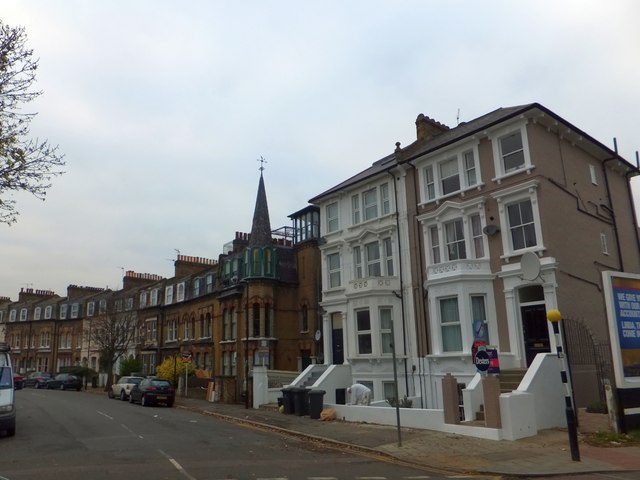
It was once just "The Back Road" — a quiet short-cut from Clapham to Brixton Hill, not a destination in itself. Walking it today, three things stand out: a run of ornate Victorian terraces with bay windows and terracotta trim, a gabled Gothic church front, and a plain stuccoed pub on the corner.
Beneath the terraces and chapel fronts, the older pattern survives in the street's shape alone: a cut-through, not a grand route, still running much the same line the Survey of London once traced. That older, working name is the place to start.
Name Origin
Two Bedfords, One Road
The road's working name was once plain and practical. Lambeth's Survey of London volume describes "The Back Road" running along what is now Bedford Road and Lyham Road, a route rather than an address.
Where "Bedford" comes from is less certain. One Lambeth account ties it to Stockwell: the old Stockwell estate was subdivided over generations, and through inheritance, sale, death and marriage part of it passed into the Estate of the Duke of Bedford — hence, it is said, nearby Bedford Road. A separate Lambeth account instead points south, to Bedford House, a manor house dating from 1695 that belonged to the Dukes of Bedford. The sources used here do not settle which explanation the name actually follows.
History
From Mission Hut to Gothic Church
A mission here grew into a landmark church over two decades. The Mission of the Epiphany was established in 1887, and a temporary church was put up in 1891 to serve it. Permanent premises followed only in 1911, when the Bishop of Southwark opened the Church of the Epiphany on Bedford Road, designed in Gothic style by F. H. Greenaway and J. E. Newberry. It was built plain, in multi-coloured brick with stone dressings, its asymmetrical gabled front holding a seven-light traceried window.
The Baptists, too, had a chapel on the road, noted in the Victoria County History's account of Clapham parish. By the 1870s the street was also filling with housing: nos. 53-63, four-storey houses over semi-basements with canted bay windows and terracotta dressings, were built around 1870 by Jennings to designs by T. Collcutt, and were first listed by Historic England on 27 March 1981. A cardboard box factory stood fronting the road, between a school and the railway, by around 1930.
Culture
A Gothic Front at No. 15
Several buildings along the road still carry their original character. The Falcon public house, at no. 33, is an early-to-mid 19th-century two-storey building with a stucco façade, quoins, and twin columned entrances. Nos. 119-121 are a pair of early 19th-century semi-detached houses in stock brick, with the brick at no. 121 tinted red, presumably in the late 19th century; nos. 123-125 nearby form a symmetrical pair with stucco classical detailing.
Only the buildings around the junction of Bedford Road with Ferndale Road fall within the Ferndale Conservation Area. A 2024 bid to extend that area was turned down by Lambeth's officers.
A cast iron marker post dated 1862, stamped "P 121 L", still stands opposite nos. 119-121 Bedford Road.
People
The Builders Behind the Bricks
The names recorded for Bedford Road are mostly its builders. T. Collcutt designed the c.1870 terrace at nos. 53-63, built by a developer named Jennings — identified elsewhere in Lambeth's own records as George Jennings. F. H. Greenaway and J. E. Newberry gave the Church of the Epiphany its Gothic front.
Recent Times
Drawing New Lines
Conservation boundaries here are still being argued over. In 2024 the Brixton Society pressed for nos. 65-69 Bedford Road to be brought into the Ferndale Conservation Area, but Lambeth's officers turned the proposal down, since the houses were not built by George Jennings, the developer behind the listed terrace nearby. Lambeth's 2025 appraisal of the area confirms that only the buildings flanking the Ferndale Road junction are actually included.
On the Map
Bedford Road Then & Now
Frequently Asked Questions
Why is it called Bedford Road?
The street was once known as "The Back Road". Lambeth's own records offer two explanations for "Bedford": one ties it to the Stockwell estate passing partly to the Duke of Bedford's estate, the other to Bedford House, a 1695 manor house of the Dukes of Bedford. The sources do not resolve which is correct.
What is Bedford Road known for?
Its 1911 Gothic church at no. 15, designed by F. H. Greenaway and J. E. Newberry, and its Grade II listed terrace at nos. 53-63, built c.1870 by Jennings to designs by T. Collcutt.
What was Bedford Road called before?
"The Back Road", a short-cut between Clapham and the top of Brixton Hill, as described in the Survey of London's account of the area.