Time Walk
Villas, Chapels and a Switchboard


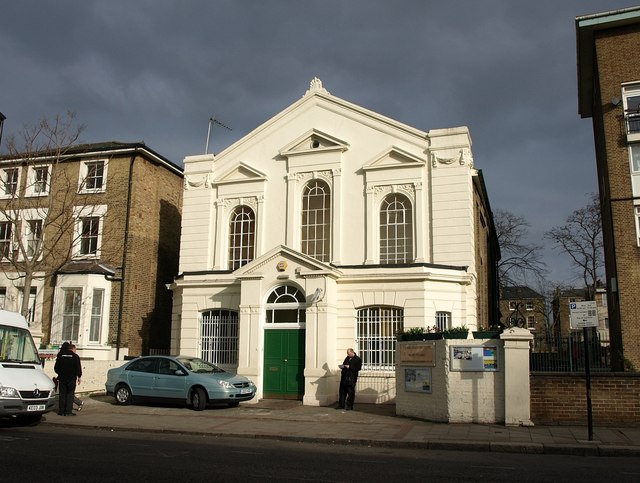
A building put up to teach a new estate its manners ended up running Brixton's first telephone exchange. Walk the north side today and it still feels green and quiet, its early houses now a school, a place of worship and an education centre.
That calm hides a street of villas built before 1871, among them a former chapel at No. 7. Worship, education and quiet brick houses are what Gresham Road has always offered — a residential Brixton side street, never a high road. Its name is a different story.
Name Origin
An Unexplained Name on the Angell Estate
The sources used here do not explain where the name Gresham came from. What they do establish is the ground the road sits on: Angell Town, developed from the 1850s as part of an estate on the east side of Brixton Road, arranged around Wiltshire Road. Angell Terrace, running between St John's Crescent and Gresham Road, was only completed in 1868, which gives the earliest dated reference to Gresham Road itself.
History
From Villas to Institute to Exchange
The early villas went up before 1871. No. 1 is a stock-brick villa with stucco details, and Nos. 3–5 a matching pair of villas from the same period. No. 7, the former chapel, has a gabled front with a projecting ground floor and delicate metal windows.
In 1877 the building now known as the Karibu Centre opened as the Angell Town Institution, later becoming Brixton's first telephone exchange. In 1907 tram tracks were being laid at the junction of Brixton Road with Gresham Road and Canterbury Road, work carried out by W. Manders, a contractor from Leyton.
The conservation boundary here has shifted more recently. In 2024 the Coal Lane development, along with No. 71 and Nos. 86–88 Gresham Road, moved out of the Loughborough Park Conservation Area and into the Brixton Conservation Area.
Culture
Two Music Hall Lives on One Street
Two Victorian performers made their homes on this quiet street. Kate Paradise, a dancer and choreographer born in 1856, lived at 4 Gresham Road between 1892 and 1895, giving stage dance lessons there after building a reputation in ballet, pantomime and music hall.
Tom Leamore, a comic singer and clog dancer, took rooms at 35 Gresham Road — 'Lyric House' — from 1902 to 1906. He had already written 'Percy from Pimlico' in 1898, and was a popular music hall star through the 1890s and 1900s.
Kate Paradise's white skirt dance at the Canterbury Music Hall was reviewed in The Era on 21 August 1886 — six years before she settled at 4 Gresham Road.
Today
Still a Street of Houses, Not Shops
Gresham Road remains green, tree-lined and residential, its old houses serving as a school, a place of worship and an education centre. It is a street shaped less by grand design than by the steady accumulation of ordinary lives — an institute, an exchange, a dancer's lessons, a comic singer's lodgings.
On the Map
Gresham Road Then & Now
Frequently Asked Questions
Why is it called Gresham Road?
The sources consulted for this page do not explain the origin of the name. The street runs through Angell Town, developed from the 1850s, and is first referenced by name in 1868 in connection with the completion of nearby Angell Terrace.
What is Gresham Road known for?
Its early 19th-century villas and former chapel, now a school, place of worship and education centre, and the Karibu Centre, which opened in 1877 as the Angell Town Institution and later became Brixton's first telephone exchange.
Who lived on Gresham Road?
Dancer and choreographer Kate Paradise lived at No. 4 from 1892 to 1895, and comic singer Tom Leamore lived at No. 35, 'Lyric House', from 1902 to 1906.