Time Walk
A Turnpike Branch Off the Vauxhall Road


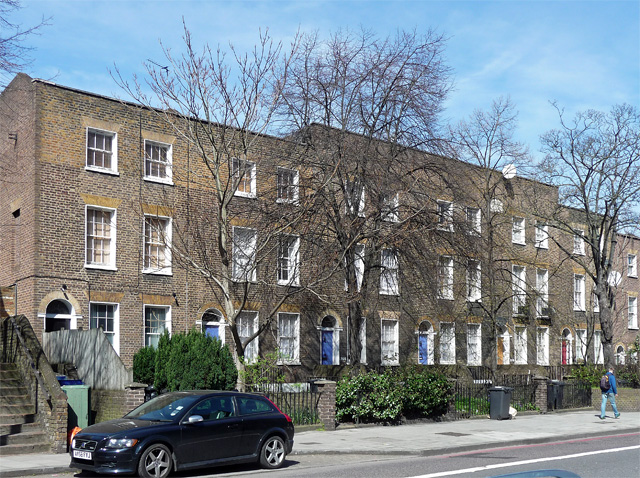
A medieval manor gave this road its name, long before turnpike trustees fixed its route in 1717. Walking it today, you pass a red-brick Victorian library, terraces from its turnpike days, and the cafés of Little Portugal.
Beneath the shopfronts lies older ground: this was once the edge of the manor of South Lambeth, with a stone bridge over Vauxhall Creek already being repaired by the Abbot of Westminster in 1340. The road's present line was fixed as a turnpike in the 18th century, long after that bridge, and its name goes back further still.
Name Origin
The Manor That Gave Vauxhall and Stockwell Their Names
The road is named after South Lambeth, a manor held in the 13th century by the de Redvers family. It passed to Edward I in 1293 and was subsequently divided into the manors of Vauxhall and Stockwell. South Lambeth Road itself became a fixed route in 1717, when Turnpike Trustees established it as a branch road running from Vauxhall to Brixton, and it was upgraded to a maintained surface under the Act of Parliament that created the Trust. The road still sits on the old boundary between the former parishes of Lambeth and Battersea.
History
Chapel, Vinegar Works and Library
Development along the road ran in fits and starts across a century and a half. A terrace at Nos. 282–298 went up in 1790–91, built by the local builder William Head. Beulah House, at No. 274, followed about 1800, a three-storey house with single-storey wings, its keystone masks stamped "COADE LAMBETH 1791" — the same masks appear on Kennington Road. A decade later, in about 1810, John Hanbury Beaufoy erected the Beaufoy's Vinegar Works at No. 87, a group the Survey of London calls an unusually attractive run of industrial buildings.
Religious and civic buildings followed. South Lambeth Chapel was erected on the road in 1793, consecrated as the parish church of St. Anne's on 3 February 1869, and rebuilt in 1876 to designs by R. Parkinson with a new chancel, vestry and Romanesque tower. War damage in 1941 put it out of use; by 1956 the Survey of London recorded that it had stood empty for some years, with restoration only then hoped for. Stockwell Baptist Church was founded on the road in 1866 by the pottery manufacturer James Stiff, and in 1884 a mid-Victorian terrace of shops and flats known as Barren's Corner went up nearby. Tate Free Library opened at No. 180 on 1 December 1888, designed by Sidney R. J. Smith and funded by Henry Tate, and was formally inaugurated by the M.P. A. J. Mundella. The South Lambeth Road Conservation Area was designated in 1982.
Culture
The Museum That Became the Ashmolean
The museum's ground lies just off the road rather than on it, but its legacy — the Ashmolean itself — began here. Centuries later the street gained a different cultural identity: through the 1980s and 1990s, Portuguese restaurants, hairdressers and delicatessens opened along South Lambeth Road, giving rise to the informal name Little Portugal for the surrounding area.
People
A Postmaster-General, an Illustrator and an Activist
Henry Fawcett, the blind Postmaster-General and M.P., lived at No. 51 South Lambeth Road from 1875 until his death in 1884. At No. 210, the book illustrator Arthur Rackham was born in 1867. The Swiss-born author Charles William Heckethorn lived at No. 67 through the 1890s and died at his home on the road on 13 January 1902.
At No. 274, the Bridewell Hospital clerk and solicitor John Poynder moved in during 1825 and remained there until his death in 1849. In 1881, the Church of England Children's Society was founded at a meeting held at Mark Beaufoy's house on the road. In Flat 55, Victoria Mansions, the Sudanese-Egyptian actor and political activist Dusé Mohamed Ali lived from 1911; English Heritage marked the address with a Blue Plaque in 2026.
Recent Times
Shelter, Squat and Bus Stops
The road has carried London's infrastructure underground as well as along its surface. One entrance to the Stockwell Deep Tube Shelter, a spiral staircase down its shaft, opened in 1942 at the junction of South Lambeth Road and Clapham Road. In 1975, the See Red Women's Workshop moved to a squat on Radnor Terrace, off South Lambeth Road, which also housed the South London Women's Centre. In 2004, bus stops that had stood on South Lambeth Road, Wandsworth Road and Vauxhall Bridge were consolidated at a new central point at the Vauxhall Cross junction.
A small triangle of open space at the junction with Clapham Road, holding a war memorial clock tower, is the only surviving remnant of Stockwell Common, which once covered three and a half acres.
Today
Library, Viaduct and Little Portugal
South Lambeth Library still occupies its original red-brick building at No. 180. Vauxhall station's viaduct straddles the road at its northern end, alongside South Lambeth Place. The road now forms part of the A203 route through south London, and its southern stretch remains the heart of Little Portugal.
On the Map
South Lambeth Road Then & Now
Frequently Asked Questions
Why is it called South Lambeth Road?
It takes its name from South Lambeth, a medieval manor held in the 13th century by the de Redvers family, which passed to Edward I in 1293 and was later divided into Vauxhall and Stockwell Manors.
What is South Lambeth Road known for?
It is known for Tate Free Library, Beaufoy's Vinegar Works, the birthplace of illustrator Arthur Rackham, and for being the heart of the area informally known as Little Portugal.
When was South Lambeth Road established as a road?
It was established as a turnpike branch road from Vauxhall to Brixton in 1717 under an Act of Parliament creating Turnpike Trustees.
What stood near South Lambeth Road before it was built up?
The Musaeum Tradescantianum, England's first public museum, stood nearby in South Lambeth; its collection later became the founding core of Oxford's Ashmolean Museum in 1691.