Time Walk
A Road That Never Changed Direction


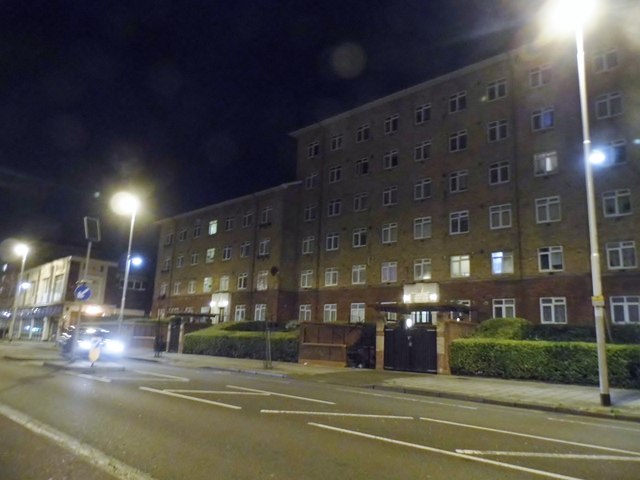
This has been the way out of London toward Wandsworth and Kingston for centuries, long before anyone called it by that name. Today it carries buses, shopfronts and steady traffic between Vauxhall and Clapham, with an Overground station tucked into its length and a lone Georgian mansion still standing among later building.
Beneath the modern road lies a much older crossing: a medieval bridge once carried this road over a stream here, kept in repair by the Abbot of Westminster. That buried watercourse, and the land it once served, are the layer Name Origin picks up next.
Name Origin
The Road to Wandsworth
The name is a destination, not a dedication: the road led from the Thames toward the south-west London town of Wandsworth. Locally it was sometimes known instead as Vauxhall Road.
The road itself long predates either name. It formed part of an ancient route running from the Thames to Kingston and the south-west, and may even follow a Roman road continuing north from Croydon and Streatham through Brixton. It had been a parish highway before it was placed under Turnpike Trustees by Act of Parliament in 1717, when it was known as the Sutton and Kingston road.
History
A Bridge, a Mansion, and a Duke
At the junction with South Lambeth Road, where a railway bridge now stands, there once stood Cox's Bridge — also called Cocks Bridge or Vauxhall Bridge. In 1340 the Abbot of Westminster was charged with its repair, and by 1504 the Abbot was paying rent to Christ Church Canterbury for a wharf there. By the early 17th century the bridge had been damaged by flooding, its fallen stones blocking the water's flow.
Further along, at No. 30, a handsome mid-Georgian mansion was built in 1758. By 1776 it stood with its own coach-house, stable and nearly three acres of garden, lately erected by John Dawson. In 1791, under the name Belmont, it was divided in two and leased separately to David Hunter and William Anderson. In 1811 William Anderson's half was bought by the Duke of Brunswick. The two halves were later reunited as Brunswick House and used as a railway workers' institute and club.
By the 1950s the Survey of London could still call it a handsome mid-Georgian mansion, though by then it stood amid very different surroundings.
"a handsome mid-Georgian mansion now surrounded by industrial squalor"Survey of London, describing No. 30 Wandsworth Road in the 1950s
Culture
Where Vauxhall Got Its Name
The motor industry briefly put this stretch of road on an international map, before the works moved away from the area.
The Granada Theatre also stood on Wandsworth Road, its ordinary evenings interrupted by war, as the People section describes.
People
A Duke, a Musician, and a Single Night in 1940
Brunswick House takes its name from its owner. Friedrich Wilhelm, Duke of Brunswick, bought half the mansion at No. 30 in 1811. He returned to Brunswick to raise fresh troops after the Battle of Wagram, and died at the Battle of Quatre Bras in 1815.
Sir George Grove, later Director of the Royal College of Music, was born at a house in Thurlow Terrace — the spot now occupied by Wandsworth Road railway station.
On the night of 12 November 1940, the road recorded several deaths in close succession. William Lawrence Ames, 24, and Iris Maud Bohn, 14, both died that night at No. 184. The same night, 18-year-old Clifford James Bowen died at the Granada Theatre on Wandsworth Road.
Earlier, in 1806, James Humphrys had bought land on the road's west side; he is thought to have co-designed St. Barnabas' Church, which stood on that land, and died in 1861.
The man after whom Brunswick House is remembered was related by marriage to the Prince Regent — his sister Caroline became Princess of Wales.
Recent Times
Clearance, Rail, and Reconnection
The area suffered heavily from bomb damage in the Second World War, owing to its closeness to south London's railway complex, Battersea Power Station and nearby ammunition and engineering works. Comprehensive clearances followed between 1970 and 1974, making way for South Bank University and Lambeth College. A purpose-built campus for the Polytechnic of the South Bank opened on the road in 1972 and was sold in 2001.
The railway pattern also shifted. East Brixton station closed in 1976, and Wandsworth Road station stopped Sunday services that October. In 2012 the East London line was extended to Wandsworth Road and Clapham High Street, restoring a direct link to Peckham Rye, Canada Water, Shoreditch and Highbury and Islington.
Today
Georgian Survivors Among the Terraces
Listed buildings still punctuate the road. Early 19th-century terraces stand at Nos. 101–109 and Nos. 553–557, and mid-19th-century villas at Nos. 335–337 and 372–376, while the Tudor-style range at Nos. 339–343 carries a battlemented corner tower toward Lansdowne Way. Wandsworth Road station now sits on the Windrush line of the London Overground, about two miles from Victoria. Brunswick House remains standing — a mansion that has outlasted the duke who owned it, the industry that once surrounded it, and the turnpike road it always faced.
On the Map
Wandsworth Road Then & Now
Frequently Asked Questions
Why is it called Wandsworth Road?
It is named for its destination: the road led from the Thames toward the south-west London town of Wandsworth. It was also sometimes known locally as Vauxhall Road.
What is Wandsworth Road known for?
It is known as an ancient route toward Kingston, for Brunswick House — a 1758 mansion once owned by the Duke of Brunswick — and as the birthplace, in 1903, of the first Vauxhall motorcars.
How old is Wandsworth Road?
The road was already a parish highway before it was placed under Turnpike Trustees in 1717, and a medieval bridge on its line was being repaired as early as 1340.
Is Brunswick House still standing on Wandsworth Road?
Yes. No. 30, built in 1758, survives; it was later owned by the Duke of Brunswick and has since been used as a railway workers' institute and club.