Time Walk
A Row Built on No One's Land


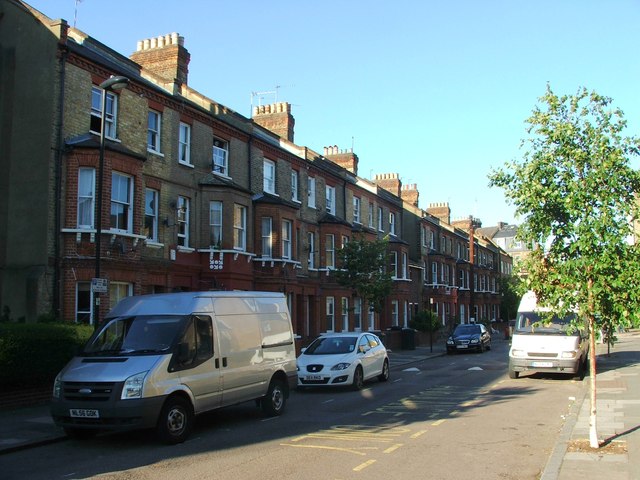
Before it had an owner, this ground belonged to nobody at all. Walking its length today means passing a continuous terrace of plain cottages, each with a round-arched doorway, tucked between Clapham Road and Brixton Road.
Beneath the brickwork lies an older story of boundaries rather than buildings: this patch of Lambeth once sat outside every manor's reach, before builders carved it into streets in the early nineteenth century.
Name Origin
An Unexplained Name
The sources used here do not explain why the street was named South Island Place. No lease, survey description or rate record among them gives a reason for either "South" or "Island" in the name.
History
Between Three Manors
This no-man's-land was bounded by the Manor of Kennington and Vauxhall Creek to the north, Vauxhall Manor to the west, and Lambeth Wick Manor to the east and south. Only later was it drawn into the building leases of the surrounding estates.
In 1809 the trustees of John Wright let the Clapham Road frontage, from the site of No. 35 to the site of what would become South Island Place, on an 80½-year building lease. The terrace came over a decade later. Nos. 11–41 were built for William Richard Self, completed on 23 March 1822, and No. 43 followed on 29 July 1823 for James Collins, a mason of Kennington.
When the Survey of London examined the terrace in 1956, it described a run of plain cottages: each with a window beside a round-arched doorway, two windows above, and a plain parapet. At the eastern end, four cottages had their ground-floor windows set in arched recesses; only Nos. 31 and 41 carried fanlights, of radiating and circular pattern respectively.
Before any street existed here, this stretch of Lambeth was claimed by no manor at all — a no-man's-land wedged between the Manor of Kennington, Vauxhall Manor and Lambeth Wick Manor.
People
The Builder and the Mason
Two named men stand behind the terrace: William Richard Self, who had the bulk of it built, and James Collins, the Kennington mason who completed the last house.
On the Map
South Island Place Then & Now
Frequently Asked Questions
Why is it called South Island Place?
The sources consulted here do not explain the name. No lease, survey or record among them gives a derivation for "South Island Place".
What is South Island Place known for?
A continuous terrace of plain two-storey cottages built in 1822–23, with round-arched doorways and, on two houses, decorative fanlights, recorded in detail by the Survey of London in 1956.
When was South Island Place built?
Most of the terrace, Nos. 11–41, was completed on 23 March 1822 for William Richard Self; No. 43 followed on 29 July 1823 for the mason James Collins.