Time Walk
Fields, Then Terraces


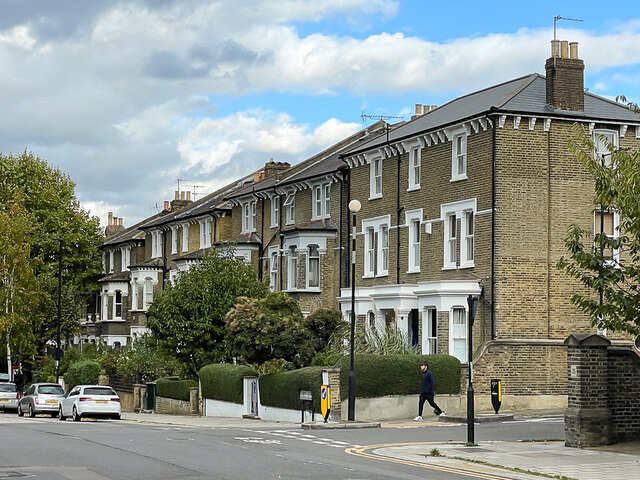
A Victorian terrace here stands on the site of a former private lunatic asylum, hidden beneath its leafy respectability. Walk the street today and you find tessellated paths, raised front steps and paired turrets along the rooflines, with mature trees giving the whole road a settled, leafy air.
Before the terraces came, this was farmland, then briefly the grounds of the Hankey family home that became an asylum. The Clapham Rise Estate was laid out over it in 1875-76, its new streets named for figures from Clapham's history — though Sibella's own story is still untold.
Name Origin
A Name Without an Explanation
The road's name comes from a deliberate scheme, not a developer's whim. When the Clapham Rise Estate was laid out in 1875-76 for the landowner George Hankey, its new streets were named after important figures from Clapham's history. But the sources used here do not say which figure "Sibella" was meant to recall, or why this particular name was chosen for this particular street.
Neighbouring Larkhall Rise offers a contrast: its own name is explained in the record. It appeared on an 1849 map of the parish of Clapham as Larkhall Lane, a name believed to derive from the Lark Hall Tavern in Lambeth, recalling a former licensee who kept larks in a cage. No equivalent explanation survives in these sources for Sibella Road itself.
History
From the Hankey Estate to the Retreat
The land stayed as farmland well into the 19th century. A few houses had gone up along Larkhall Rise, but these were swept away when the whole area was comprehensively redeveloped after 1874. The following year, E B I'Anson laid out the new roads of the Clapham Rise Estate for George Hankey. Union Road, running through the same area, is older still, following a pre-existing thoroughfare, which is why its shape is less regular than its Victorian neighbours.
The site of what is now No.16 Sibella Road had a stranger past: before the asylum, it was the Hankey family's own home. It was demolished in the 1860s, more than a decade before the family's land became the street that stands there now.
The conservation area took its modern protected status later still. Lambeth Council's own designation report for Sibella Road dates this to 11 December 2001.
No.16 Sibella Road now stands on the site of a private lunatic asylum, The Retreat, which had itself replaced the Hankey family's own home before being demolished in the 1860s.
Today
Stock Brick and Street Trees
The leafy, suburban character the council identified in 2001 is still what defines the street. Stock brick walls form the garden boundaries at both ends of Sibella Road, giving a pleasant sense of enclosure.
On the Map
Sibella Road Then & Now
Frequently Asked Questions
Why is it called Sibella Road?
It was one of a group of streets named after important figures from Clapham's history when the Clapham Rise Estate was laid out in 1875-76. The sources used here do not say specifically who Sibella was.
What is Sibella Road known for?
Its Victorian terraces with tessellated paths, stock brick garden walls and turreted roofs, and for standing on the site once occupied by a private lunatic asylum called The Retreat.
When was Sibella Road built?
Its roads were laid out in 1875-76 by E B I'Anson for landowner George Hankey, on land that had been farmland until the early 19th century.
When was the Sibella Road Conservation Area designated?
Lambeth Council's own designation report for the area gives 11 December 2001.