Time Walk
Three Houses Left Standing


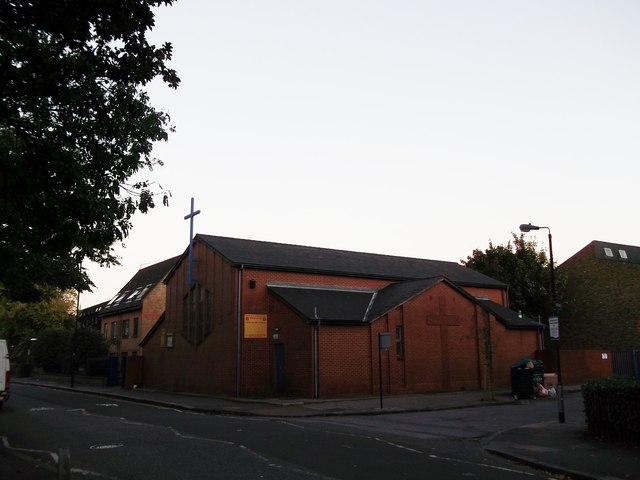
Of a whole Victorian street of villas, only three houses still stand. Estate housing from the 1970s now sits alongside the grand columned front of Mostyn House at No. 7, and a Methodist church, rebuilt after wartime damage, still marks the street with its octagonal spire.
Beneath this altered street lies older ground: land once part of a fourteen-acre holding sold in 1735, long before any road carried this name. That quiet land history gives way, in the next section, to the question of where the name itself came from.
Name Origin
An Unexplained Name on Old Ground
The sources used here do not explain where the name Mostyn comes from. What can be traced is the land beneath it. The ground was part of fourteen acres inherited by Thomas Fox, grandson of a man named Scaldwell, and sold by Fox in 1735 to James Wall. No road of this name is recorded on that land until more than a century later, when a church's foundation stones were laid in Mostyn Road in 1868.
History
From Villas to a Vanished Terrace
Mostyn Road grew up as a street of substantial houses before much of it disappeared. The Ordnance Survey map of 1871 shows three detached villas at Nos. 3, 5 and 7, probably built in the 1860s. No. 7, known as Mostyn House, had a grand entrance with columns and a decorated front, with a low wall running along the street.
In 1868 the foundation stones of Mostyn Road Methodist Church were laid. Designed by the architect John Tarring and built by George Myers and Sons, it had a tower and octagonal spire at the north-west corner. By 1912 the Victoria County History recorded a Wesleyan chapel standing in Mostyn Road. The church was heavily damaged in the war of 1939-45 and restored in 1954-5.
Culture
A Street of Music Hall Turns
For a run of decades, Mostyn Road housed a succession of variety and circus performers. At No. 21 lived Edith Geretti, a trapeze artist from an acrobatic family of nine children, who performed as one of the Sisters Geretti with her sister Minnie. She married the comedian and dancer John Cruden, who performed as Dan Crew, and the couple advertised from 8 Mostyn Road in 1914.
At that same address, between 1914 and 1916, lived Victoria and Alfred Edwards, who performed as "Ramoo" in a crystal pyramid act built from glass bottles, balancing and juggling as they climbed. They toured South America by sea in 1916 before Edwards was called up for war service and later discharged as medically unfit. Edward Cragg, of the long-running Cragg family troupe of acrobats, lived at 69 Mostyn Road between 1896 and 1901.
"giving a marvellously clever display on the trapeze"Review of the Sisters Geretti, December 1898
Recent Times
Clearance and What Was Left
The 1970s reshaped Mostyn Road more than any decade before it. The construction of the Angell Town Estate brought mass clearance to the eastern side of Brixton Road south of Mostyn Road. Along Mostyn Road itself, the same decade saw the demolition of most of the once-elegant terrace, leaving only Nos. 3, 5 and 7 as survivors of the original villas.
Charles Walker and Ida May, the music hall couple who lived at No. 69, were deported to America in 1918, sailing third class back to a country neither had lived in for twenty years.
Today
Part of a Wider Neighbourhood
Mostyn Road now falls within the area served by LEAF TRA, the tenants and residents association covering Loughborough Road, Evandale Road and Akerman Road as far as Mostyn Road itself. It remains a street defined as much by what was taken away in the 1970s as by what survives from its Victorian beginnings.
On the Map
Mostyn Road Then & Now
Frequently Asked Questions
Why is it called Mostyn Road?
The sources consulted here do not explain the origin of the name. The earliest dated reference to the road by name is the laying of a church's foundation stones in 1868.
What is Mostyn Road known for?
A Methodist church of 1868 designed by John Tarring, three surviving Victorian villas, and a run of music hall and circus performers who lodged there in the early twentieth century, including a blind comedian, a trapeze act and a crystal-pyramid duo.
What happened to the rest of Mostyn Road's Victorian houses?
Most were demolished in the 1970s, when the nearby Angell Town Estate was built and brought mass clearance to the area. Only Nos. 3, 5 and 7 remain today.
Who lived at 69 Mostyn Road?
The comedian Charles Walker and his partner Ida May lived there from 1904 to 1906, and the acrobat Edward Cragg lived there earlier, between 1896 and 1901.