Time Walk
A House That Vanished, A Road That Kept Its Name


A Civil War baron's mansion once stood here; the house is gone, but its name never left. Today the walker finds a broad, gently curving road of Victorian terraces, front gardens, and mature trees, grander at one end than the other.
Beneath the pavements lies the footprint of Loughborough House, cleared in the 1850s when the road was laid out as part of the old Lambeth Wick Estate. That buried history is where the road's name begins.
Name Origin
A Royalist Baron's Country House
The road is named after Loughborough House, a mansion that stood on the triangular piece of ground later covered by Evandale, Claribel, Lilford and Akerman Roads as well as part of Loughborough Road itself. The house in turn took its name from Henry Hastings, 1st Baron Loughborough, who was living there in 1664.
Hastings was the younger son of the fifth Earl of Huntingdon and an eminent Royalist commander during the Civil War; he was created 1st Baron Loughborough in 1643. In 1664 he obtained a private Act of Parliament to make a navigable canal of the stream running from near Brixton Causeway to the Thames. He died two years later.
History
From Academy to Estate
Long before the street existed, the house that named it had a life of its own. In 1661 it was occupied by a Mr Younge, with ten acres of land, most of it planted. Towards the end of the 18th century it became "a superior Academy," and in 1787 a collection of elocution lessons was dedicated to "the Young Noblemen and gentlemen receiving their education at Loughborough House School."
In 1825 Thomas Willett bought the leasehold of the house and grounds for £5,000; he died in 1846. By 1820 the house had been described as "a very large old house of light construction," with grounds of about 11 acres. It was pulled down around 1854 to make way for new housing.
The new streets, Loughborough Road among them, formed the earliest phase of development on what became the Lambeth Wick Estate, and the estate's plan depended on Loughborough Road for access to the main highway of Brixton Road. At the corner with Brixton Road stands the White Horse, on the site of an earlier pub of the same name first recorded in 1786. Loughborough Road station opened on the London, Chatham and Dover Railway in October 1864, and was renamed Loughborough Junction in 1872.
The road's archaeological designation, Archaeological Priority Area No. 07, marks the site of the former Loughborough Manor House — the mansion that gave the street its name is still registered beneath it.
"the Young Noblemen and gentlemen receiving their education at Loughborough House School"Dedication in R. Turner's collection of elocution lessons, 1787
Culture
A Salsa Club on Film
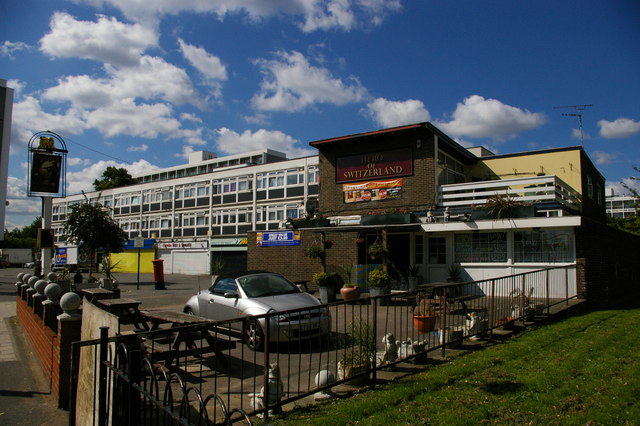
A Victorian pub became an unlikely film set.
People
Music Hall's Back Gardens
For a stretch of the Victorian era this was a street of performers. Fred Evans senior, a legendary comic performer of the 1860s and 1870s, lived at 162 Loughborough Road and died in 1909 aged 70; he was the father of music-hall comedian Will Evans.
Next door in spirit if not number, R G Knowles — a Canadian-born singer and comedian from Hamilton, Ontario, born in 1858 — lived at 164 Loughborough Road in 1893. He set up a music-hall baseball team that practised in his own back garden, before his death in 1919.
At 145 Loughborough Road in 1911 lived Ernie Mayne, born Percy Ernest Barratt in 1871; he died in 1937. A different kind of talent lived above her father's watchmaker's shop on the road: Nellie Roberts, born in 1872, spent her career as a botanical illustrator employed by the Royal Horticultural Society from 1897 to 1953 to paint life-sized illustrations of orchids; she died in 1959.
George Riddell, later 1st Baron Riddell, was born on 25 May 1865 at 2 Stanhope Place, Loughborough Road, Brixton.
Recent Times
Council Estates and Restoration
The Loughborough Estate around Loughborough Road and Minet Road was built by the London County Council and houses more than 3,000 families in a mix of 1940s low-rise buildings and 1960s and 1970s tower blocks and houses.
The older Victorian housing fared differently. In the late 1970s the houses on Loughborough Road were restored to their original appearance and brought up to modern standards under the direction of borough architect Ted Hollamby, as part of a wider council-led rehabilitation scheme running into the 1980s. The nearby Myatt's Fields South Estate today includes 15 refurbished Victorian houses on Loughborough Road.
Today
An Intact Victorian Street
A consistent building line and mature front-garden trees still give the street its definition. Front-garden parking is uncharacteristic here, which has helped keep the road's Victorian character exceptionally intact. Several terraces are listed Grade II, including Nos. 99–113 and Nos. 16–50.
At the corner of Moorland Road a small triangular green has been protected from development since the London Squares' Preservation Act of 1931.
On the Map
Loughborough Road Then & Now
Frequently Asked Questions
Why is it called Loughborough Road?
It is named after Loughborough House, a mansion that once stood nearby. The house itself was named after Henry Hastings, 1st Baron Loughborough, a Royalist Civil War commander who was living there in 1664.
What is Loughborough Road known for?
Its Victorian terraces, several of them listed, its connection to a string of music-hall performers including Fred Evans, R G Knowles and Ernie Mayne, and its Victorian pub that doubled as a film set for Born Romantic.
When was Loughborough House demolished?
Around 1854, clearing the site for new housing and the streets, including Loughborough Road, that now occupy its former grounds.
Is Loughborough Junction station named after the road?
Yes. It opened as "Loughborough Road" in October 1864 on the London, Chatham and Dover Railway, and was renamed "Loughborough Junction" in 1872.