Time Walk
A Private Road That Became a Through Road


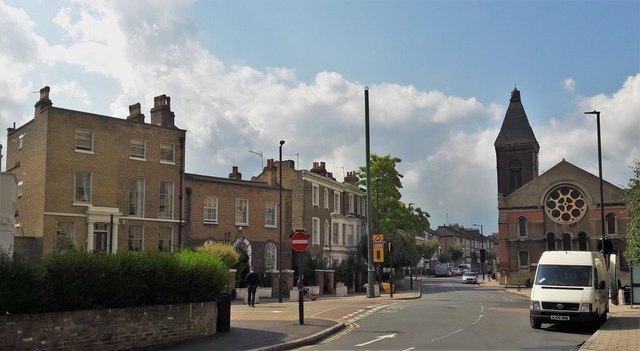
This road was once gated off as private property, not a public right of way. Today it runs quietly past Victorian terraces and corner pubs. Three things stand out: the tower of St Andrew's Church at the Lingham Street junction, the long brick flank of a corner pub, and a handsome pair of stone gate piers.
Beneath the terraces lies an older layer: a fever hospital, a remodelled church, and a road that only slowly became public. That shift from private lane to parish thoroughfare is where its name begins.
Name Origin
From Stockwell Private Road to Landor Road
Landor Road was formerly known as Stockwell Private Road. During the early-to-mid Victorian period it was privately maintained rather than adopted as a public highway. The sources used here do not explain where the name Landor itself came from.
History
Terraces, a Fever Hospital and a Church Rebuilt
The late Victorian period brought a wave of terrace building along Landor Road. By the mid-20th century the Survey of London described most of its buildings as dating from the mid to late nineteenth century, in a variety of forms. A pub had already gone up at the junction of Clapham Road, Bedford Road and Landor Road earlier in the Victorian period.
The street's most substantial Victorian building was the South Western Hospital, built in 1869–70 for patients suffering from fever and smallpox. It took the form of two symmetrical groups of buildings joined by a wide central corridor, arranged across a long north–south site. Thomas Henry Wyatt designed the northerly group and Frederick Marrable the southerly one; William Howard was contractor for both.
At the Lingham Street and Stockwell Green junction stands St Andrew's Church. Lambeth's Local Heritage List dates it to 1767, one of the oldest churches in the borough, and records that it was substantially remodelled in 1867, when its plain Georgian front was reworked in an Italian Romanesque style with a campanile and spire. The Victoria County History of 1912 gives a different date, describing a Romanesque church "built about 1860", with a chancel and nave of equal width, a three-sided gallery and a north transept chapel. The two are probably describing the same thing from different angles: the county historians seem to have dated the Victorian Romanesque building they could see, not the Georgian church underneath it. The parish of St Andrew's, Stockwell Green, was formed in 1868.
A pair of Portland stone gate piers on Landor Road still marks the site of the former South Western Mental Hospital, which opened in 1870.
Culture
A Social Club on the Street
People
The Architects Behind the Hospital
The South Western Hospital's two symmetrical blocks had two different designers, Wyatt and Marrable, with William Howard as contractor for both.
Today
Pubs, Piers and a Parish Church
Landor Road's Victorian character is still visible in its surviving buildings. The Landor pub is a large corner building with its bar still fitted with slender iron columns and an ornate bar back. Further along, the Clapham North pub presents a long elevation to Landor Road, with brown brick below and red brick above, and historic casement windows facing the street. At the eastern end, varied Victorian houses give the road an attractive setting within the Stockwell Green area, with St Andrew's tower still dominating the junction with Lingham Street and Stockwell Green.
On the Map
Landor Road Then & Now
Frequently Asked Questions
Why is it called Landor Road?
The road was formerly called Stockwell Private Road, reflecting its status as a privately maintained road in the early-to-mid Victorian period. The sources used here do not explain the origin of the name Landor.
What is Landor Road known for?
It is known for the South Western Hospital, built in 1869–70 for fever and smallpox patients, and for St Andrew's Church, which stands at its junction with Lingham Street and Stockwell Green.
What survives from the South Western Mental Hospital?
A pair of Portland stone gate piers on Landor Road survives from the former South Western Mental Hospital, which opened in 1870.