Time Walk
A Street of Wells, Mills and Markets


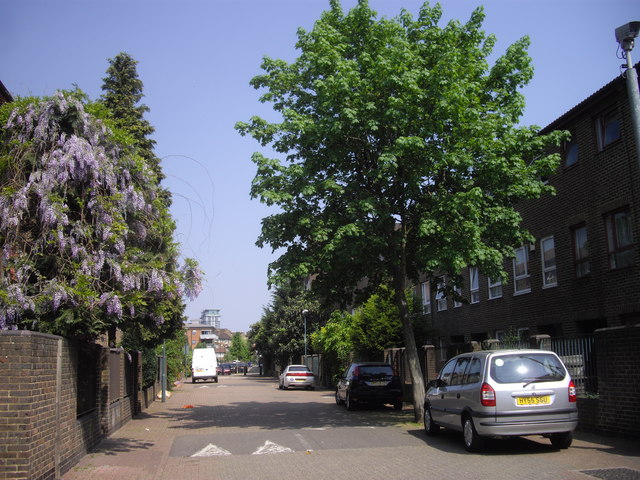
A country lane here once led to mineral springs sold as a cure for almost anything. Walking it today, a visitor passes Victorian pub buildings turned to other uses, a converted Edwardian mission hall, and blocks of council flats raised after wartime bombing.
Underneath that is an older layer: windmills once stood near the lane, grinding for market gardens that fed the growing city across the river. The street itself has worn at least two names, and the second one came from the district it belongs to.
Name Origin
From Three Coney Walk to Lambeth Walk
In the 18th century this was a country lane called Three Coney Walk. By 1785 it was generally known as Lambeth Walk instead, a name given by the builders putting up new houses along it.
The new name borrowed from the wider district of Lambeth. Lambeth itself is a Saxon name, thought to mean either a harbour or quay from which lambs were shipped, or simply a loam or muddy harbour.
History
Wells, Windmills and a Thriving Market
Lambeth Wells opened here towards the end of the 17th century, a place of public entertainment built around mineral springs. A "Great Room" for music and dancing was in use before 1697, and in William III's reign the waters were held in high repute. Public days ran Mondays, Thursdays and Saturdays, with music from seven in the morning until sunset, admission threepence. Around 1750 a musical society met there, and Dr Erasmus King gave lectures with experiments in natural philosophy.
The Wells flourished for about fifty years before growing disreputable. In 1755 the dance hall lost its licence, and the premises passed to the Methodists for a meeting house. The Fountain pub remained on the street after the Wells closed, and was rebuilt in 1829.
Windmills stood near the lane through the 18th and into the early 19th century, serving market gardens that supplied food to the growing population north of the river. One, drawn by Bernard Lens in 1735, was a tower mill with four sails standing before Lambeth Palace. By 1820 it had become a seven-storey circular stone tower with a wooden upper section, painted in a watercolour by H. Pyall.
By the 1840s a street market had grown up along the Walk, and in 1861 Henry Mayhew, author of London Labour and the London Poor, counted 164 costermongers' stalls there. By 1938 the market supported 159 shops, among them eleven butchers, two eel and pie shops, a bird dealer and a tripe dresser.
A lane that once led to a windmill is now called Juxon Street, after William Juxon, an Archbishop of Canterbury in the 1660s; it was formerly known as Mill Street.
Culture
Doin' the Lambeth Walk
The street gave its name to a song before it gave its name to a dance. "The Lambeth Walk" had music by Noel Gay and words by Douglas Furber and L. Arthur Rose. It was popular enough that The Times devoted a leader article to it in October 1938, said to be the only popular song to receive such treatment.
The 1939 film The Lambeth Walk, directed by Albert de Courville and starring Lupino Lane and Sally Gray, took its title from the song and was adapted from the stage musical. The reach of the song went further still: a wartime tunnel in Sydney's Garden Island Tunnel System, excavated in 1941, was named after it.
The novelist George Gissing set his 1887 novel Thyrza in late Victorian Lambeth, with scenes placed in Newport Street, Lambeth Walk and Walnut Tree Walk. A jazz connection survives too: the Lambeth Walk pub at 17 Lambeth Road, an Ind Coope house, traded until 2010.
People
Millers, Mayhew and a Cockney Star
Henry Mayhew, author of London Labour and the London Poor, surveyed the market here in 1861.
Lupino Lane, who had performed the song in 1937, returned in 1951 to rename the Mason's Arms the "Lambeth Walk" pub.
Nearby, in Walcot Place close to the Walk, the actress Mrs George Anne Bellamy spent her declining years in poverty after an earlier life of profligacy and splendour; she took her final leave of the stage in 1784 and died in February 1788.
At the windmill that once stood near the lane, Thomas Corner was recorded in a rate book of 1770, charged fifteen shillings on a rateable value of £30. John Fleet took over as miller in 1809, though the London Gazette reported him bankrupt by 1811.
Recent Times
Clearance and Conservation
The western side of the street was cleared in the Second World War, sparing only the Mason's Arms at 17 Lambeth Road. Before the site was redeveloped with council blocks, it served as the outdoor set for the film Passport to Pimlico.
Post-war redevelopment killed off the street market, and the shops that remained fell into decline. A campaign to save the surviving 19th-century buildings led to the Lambeth Walk and China Walk Conservation Area being designated in 1998.
Today
What Remains
Several of the market-era buildings survive. No. 73, once the Sportsman and known in the 1930s as the Angel Tavern, is a late Victorian three-storey pub building. At Nos. 77–87, a corner turret with half-timbered gables from around 1910 stands in the Arts and Crafts manner. The former French Horn, at No. 49, is an Edwardian four-storey building in stock brick with red-brick banding.
The Edwardian Pelham Mission Hall of 1910, designed by Waring & Nicholson, now houses the Henry Moore Sculpture Studio. The China Walk Estate, Neo-Georgian flats built by the L.C.C. between 1928 and 1934 around lawned quadrangles, still stands at five storeys in brown brick. A memorial stone marks where a watch-house once held the "drunk and disorderly" from 1825 to 1930. The market stalls are long gone, but the street that gave its name to a dance still carries its working past in brick.
On the Map
Lambeth Walk Then & Now
Frequently Asked Questions
Why is it called Lambeth Walk?
It took the name of the district of Lambeth, a Saxon name probably meaning a harbour from which lambs were shipped, or a muddy harbour. Before builders began calling it Lambeth Walk by 1785, the lane was known as Three Coney Walk.
What is Lambeth Walk known for?
It is known for its 19th-century street market, counted at 164 stalls in 1861, and for giving its name to the 1937 song and dance craze "Doin' the Lambeth Walk" from the musical Me and My Girl.
What was Lambeth Wells?
A place of public entertainment built around mineral springs, open on the street from before 1697 until it lost its licence in 1755 and was taken over by the Methodists.
What happened to the street in the Second World War?
Its western side was cleared by bombing, sparing only the Mason's Arms pub, and the cleared ground was used as a film set before being rebuilt with council flats.