Time Walk
A Lane That Outgrew Its Fields


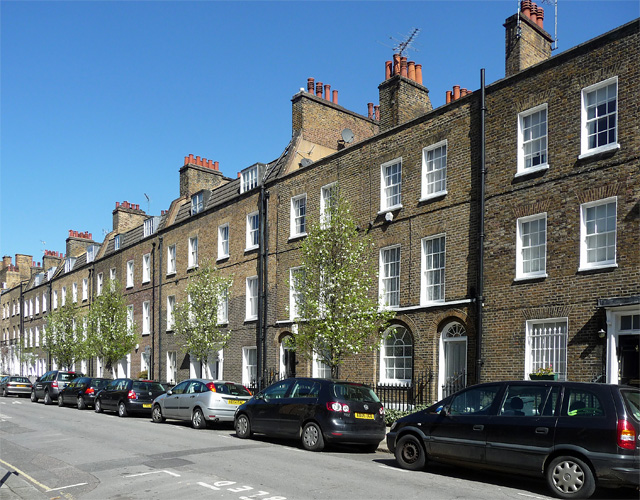
This was once a lane lined with walnut trees, and it still carries their name. Walking it today means a narrow, quiet route between Kennington Road and Lambeth Walk, its buildings shifting from Georgian terrace to twentieth-century estate block.
Beneath that mixture lies an older pattern: fields, a gardener's smallholding, and builders working plot by plot under leases granted two and a half centuries ago. That beginning is where the street's name comes from.
Name Origin
The Trees That Gave the Walk Its Name
Walnut Tree Walk is named after walnut trees formerly prominent in the area, according to Sheila Fairfield's The Streets of London: A Dictionary of the Names and Their Origins (1983). The sources used here give no further detail about the trees themselves — how many there were, or exactly where they stood — only that they were enough of a local landmark to lend their name to the lane that ran past them.
History
From Walcott's Charity to Two Rival Leases
At the start of the 18th century this was a working lane, leading out into open fields from Lambeth, or Three Coney Walk. The land around it had belonged since 1668 to Edmund Walcott, who left his freehold estate in trust for the poor of St. Mary, Lambeth, and St. Olave, Southwark — an estate that stretched across what is now the ground between Walnut Tree Walk and Brook Drive, either side of Kennington Road. A gardener, Simon Harding, kept a cottage and a smallholding of just over three acres here while the lane was still largely rural.
Building came in 1755, and from two directions at once. The St. Olave trustees granted Robert Hardcastle a 61-year lease to build on both sides of the walk. The Lambeth trustees separately leased land to Richard Summersell, on condition he spend £500 on building. Whether Summersell ever built is unclear: his 1772 will makes no mention of the lease, and the trustees soon granted fresh building leases on the Kennington Road frontage as though nothing already stood there.
Hardcastle's houses fared better. Nos. 9–11 and Nos. 56–63 survive from his development, and by the 1950s the Survey of London recorded their original doorways still in place at Nos. 9–11 despite alterations for a vehicle way through. Further building followed: Nos. 14–17 and probably Nos. 64–66 around 1817, with Nos. 15 and 16 put up by the St. Marylebone builder John Money I'Anson, and Nos. 53–55 around 1830, by which point No. 56 had likely been substantially altered.
At Nos. 58–63, the Survey of London recorded wooden doorways set in pairs, with trefoil-headed panels at the sides sitting on Tuscan-type pilasters — joinery detail that has outlasted most of the Georgian streets around it.
People
Trustees, a Gardener, and Two Builders
The street's earliest named figure is a working man, not a gentleman: Simon Harding, a gardener, held a cottage and smallholding here while it was still a lane through fields. Behind him stood the charity of Edmund Walcott, whose 1668 bequest for the poor of two parishes created the trust that would, nearly a century later, decide who built here and on what terms.
Building itself came down to two men working in parallel. Robert Hardcastle took his lease from the St. Olave trustees in 1755 and built houses that still stand. Richard Summersell took a matching lease from the Lambeth trustees the same year, but his name drops out of the record after his 1772 will fails to mention it. Six decades later, John Money I'Anson added Nos. 15 and 16 to the row.
Recent Times
A School and an Estate
The 19th century brought education to the street. Walnut Tree Walk Primary School, a London Board School, opened in 1875 and was remodelled in 1907.
Social housing followed in the interwar years. Blocks of the China Walk Estate, built between 1928 and 1934, face the street in brick with tiled roofs, tall chimney stacks and curved dormer windows.
Today
Narrow, Quiet, and Still Mixed
Walnut Tree Walk remains a narrow, quiet street between Kennington Road and Lambeth Walk. The protected Georgian and Regency houses at Nos. 9–11 and 53–66 sit alongside the Board school building and the China Walk Estate. The walnut trees that gave the street its name are gone, but the piecemeal, lease-by-lease building they presided over is still legible in the row of surviving houses.
On the Map
Walnut Tree Walk Then & Now
Frequently Asked Questions
Why is it called Walnut Tree Walk?
It is named after walnut trees formerly prominent in the area, according to Sheila Fairfield's The Streets of London (1983). The sources used here do not give further detail about the trees themselves.
What is Walnut Tree Walk known for?
Its surviving Grade II-listed Georgian and Regency houses, built under leases granted by the Walcot Estate trustees from 1755, alongside a Victorian Board school and 1930s estate housing.
What are the oldest buildings on Walnut Tree Walk?
Nos. 9–11 and 56–63, built by Robert Hardcastle under an 1755 lease from the St. Olave trustees of the Walcot Estate, are the oldest surviving houses on the street.