Time Walk
A Road Built for Farms That Housed a Workhouse Instead


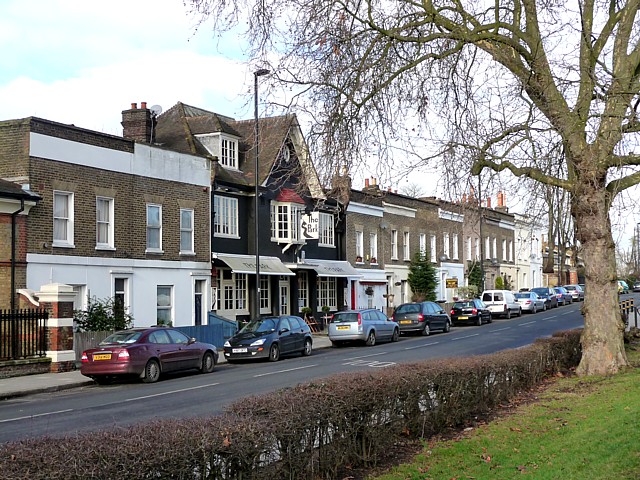
Workhouse children once filled the buildings that now sit quietly behind suburban gardens here. Walking Elder Road today, you pass the arts-and-crafts Peace Tavern, the old school building Elderwood, and St Paul's Children's Church, all still standing on land set out two centuries ago.
Underneath the pavement runs the culverted River Effra, which has flooded nearby houses more than once, its level recorded on a stone tablet still fixed to one of the buildings. That buried river, and the inclosure road built over it, are the two layers worth knowing before the road's name is explained.
Name Origin
A Road for the Inclosures
Elder Road was one of several roads built by the Lambeth Manor Inclosure Commissioners under their Award of 1810, to give access to land newly enclosed from Rush Common and Norwood Common. The occupiers of the enclosed land and houses were made responsible for keeping the new roads in repair, forming committees and raising a rate of up to one shilling in the pound, topped up with tolls. That arrangement lasted until 1823, when Elder Road and the other inclosure roads passed to the parish Surveyors of the Highways.
Why the road itself carries the name "Elder" is not explained in the sources used here.
History
From Common Land to Children's Home
The same year the road was cut, the parish Vestry bought just over an acre on its west side from John Barnard and opened a House of Industry for the Infant Poor there. It grew for over a century, through enlargement, renaming and rebuilding, into the group of buildings later known as Elderwood, Norwood House and Wood Vale.
The complex kept growing through the nineteenth century: enlarged in 1824 and 1828, it stopped using pauper labour in 1837 in favour of hired staff. By 1882 the old buildings could not cope, which led to the construction of Wood Vale two years later.
The institution on Elder Road began in 1810 when pauper children were moved out of an overcrowded workhouse in Kennington to a brand-new House of Industry for the Infant Poor, built on just over an acre of land bought from John Barnard.
Culture
A River Still Rising Beneath the Street
Flooding along the buried Effra was not a one-off. Further floods in the 1920s led to works to enlarge the sewer running beneath the road.
An arts-and-crafts pub, the Peace Tavern, stands on Elder Road close to Elderwood.
People
The Builders Behind the Institution
James C. Wright was the architect of St Paul's Children's Church, built in 1897 at a cost of £1,335 with Mr Bugg as builder. The land the institution stood on had come from John Barnard, who sold the Vestry just over an acre on the west side of Elder Road in 1810.
The buildings grew under a succession of named professionals: Mr Rogers as surveyor and Joshua Higgs and Son as contractors for the 1849–50 school-house that became Elderwood, and Mr Coe as architect with Mr Lucas as builder for the much larger Wood Vale of 1883–4. The last major addition, the Outdoor Relief Station of 1887, was designed by Sidney R. J. Smith.
Today
Elderwood Still Stands
Elderwood, raised in 1849–50, still stands on Elder Road. Its 1887 lodge at 62A is protected, built in brick with stone and stucco trim. St Paul's Children's Church and the Peace Tavern remain nearby, marking a road still shaped by the institution it was built to serve.
On the Map
Elder Road Then & Now
Frequently Asked Questions
Why is it called Elder Road?
Elder Road was built in 1810 under the Lambeth Manor Inclosure Award to give access to newly enclosed common land. The sources used here do not explain why the road itself was named "Elder".
What is Elder Road known for?
Elder Road is known for the Victorian pauper institutions built along it from 1810, which grew into Elderwood, Wood Vale and Norwood Children's Home, as well as St Paul's Children's Church and a flood tablet marking the 1890 Effra flood.
What stands on Elder Road today?
Elderwood, built in 1849–50, still stands, along with its Grade II listed 1887 lodge, St Paul's Children's Church of 1897, and the arts-and-crafts Peace Tavern pub.