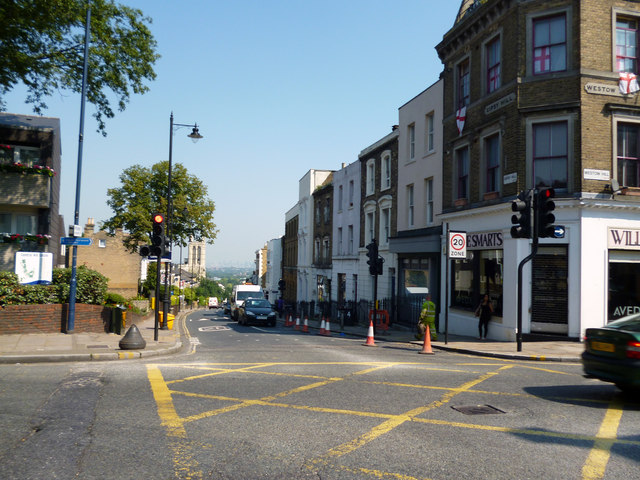
Until the early 19th century, Central Hill was a remote country lane through the Great North Wood. The Survey of London, held at British History Online, records that around 1802 a Dr Leese who lived on Central Hill would “fire off a pistol to let people know he had firearms” on winter nights — the neighbourhood was that isolated. The Lambeth enclosure of 1806 began to change this, opening up road access and releasing land for private development.
c.1802
Rural isolation
A Dr Leese, resident on Central Hill, fires a pistol on winter nights as a signal — the lane is so remote it serves as a warning to travellers.
1806
Lambeth Enclosure
The Lambeth Manor Enclosure Act and its 1810 Award begin opening up road access across the Norwood ridge, enabling suburban development.
1848
Virgo Fidelis founded
The Virgo Fidelis Convent Senior School is established on Central Hill, occupying a grand 18th-century house that had once belonged to Mary Nesbitt.
1856
Railway arrives
Gipsy Hill railway station opens, triggering rapid construction of large private villas along the ridge, many of which were later subdivided into flats.
1963–66
Cold War bunker
An 18-room nuclear bunker is constructed within Pear Tree House on Lunham Road as part of the Central Hill Estate development — one of London’s hidden civil defence facilities.
1967–74
The Estate rises
Rosemary Stjernstedt and Ted Hollamby’s Lambeth Architects Department complete the Central Hill Estate in two phases — 374 dwellings stepping down a gradient of up to 1:3.
2017
Demolition voted
Lambeth Council votes to demolish the estate on 24 March 2017, sparking a prolonged and ongoing residents’ campaign to save it.
Did You Know?
Gipsy Hill Police Station stood on Central Hill for many years and was recorded as London’s highest police station: a Bench Mark opposite it stated 360.6 feet (109.9 m) above Ordnance Datum — higher than any other Metropolitan Police station.
The Victorian era transformed Central Hill into a prestigious address. Two Lord Mayors of London lived here in succession: Sir Francis Wyatt Truscott at Essex Lodge and his son Sir George Wyatt Truscott at Emilena House. The opening of the Crystal Palace on nearby Sydenham Hill in 1854 drew wealthy residents to the ridge, and by the 1880s the road was lined with substantial villas and institutional buildings. The Norwood District Hospital also stood nearby, which would later influence the design of the Estate.
The Second World War left its mark. V-1 flying bombs struck the Highland Road and Lunham Road area, reducing houses to rubble and clearing ground that would eventually become the site of the post-war housing estate. Investigations by MOLA (Museum of London Archaeology) into the broader Norwood Ridge area have documented the pre-urban landscape of woodland and managed coppice that characterised this elevated ground before modern settlement.