Time Walk
Walking the Edge of an Old Wood


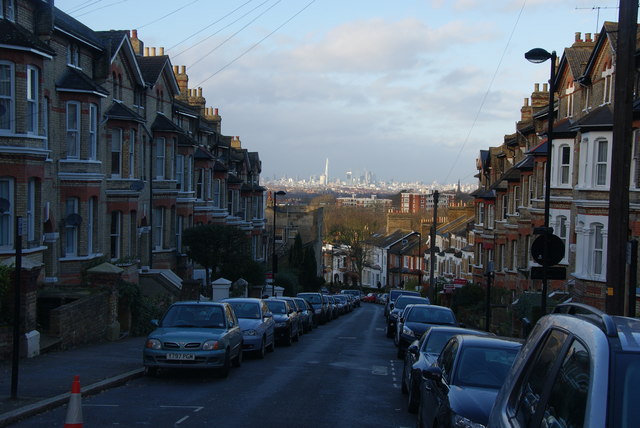
This hill once stood inside the Great North Wood, the forest that gave Norwood its name. Walk it today and you pass three ages at once: a plain 1960s block at the corner with Westow Hill, Victorian terraces and villas further up, and flats that replaced older cottages, with a small 1990s infill near the bottom.
Beneath that patchwork lies land once held by a single owner, the first Lord Thurlow, until 1806, when the Lambeth Inclosures map first marked the road's line. That same wood is where the road's own name begins.
Name Origin
A Road Named for a Vanished Forest
The name points straight at a vanished forest. The Survey of London records that some 300 acres of woodland called Northwood were granted by the Archbishop of Lambeth to Thomas Scott and Mathew Hardy, part of the Great North Wood that spread over the hills to the south of London and gave the wider district its name. Woodland Road was built just off the lower part of that wood.
The sources used here do not explain who chose the road's own name or when; they only place it within land once covered by that wood. The earliest dated use of the name "Woodland Road" found here comes from the 1861 census, when the builder George Plummer was recorded living at No. 1.
History
From Thurlow's Ground to Plummer's Cottages
Before the road existed, this land changed hands in large blocks. The first Lord Thurlow owned the ground on which Woodland Road was later laid out. By 1847 the Lambeth tithe map shows the adjoining plots, numbered 14 and 15, held by James Corner and George Corner respectively.
The road then grew from the bottom up. Its lower, northern end was first lined with terraces of working-class cottages, while middle-class villas and larger Victorian terraces appeared higher up the hill. The oldest survivors are a small terrace at Nos. 102–110, once called Plummers' Cottages, built in the 1850s by the builder George Plummer. Plummer, born in Hastings in 1818, employed sixteen men by 1851, and by 1861 he had moved onto the road he had built, at No. 1.
Below the surface, a watercourse possibly running down from what is now Crystal Palace Parade was used in 1854 for the route of the new London, Chatham and South Eastern Railway line between Crystal Palace Lower Level and West Norwood stations.
Culture
From Woodland Road School to Paxton Primary
A single building has anchored this road since 1887. Woodland Road Elementary School opened on 10 January that year, designed by the architect T. J. Bailey and built by Walls Bros. of Kentish Town for £9,879, to hold 800 children. It was an imposing four-storey red brick block of eight rooms.
Boys and girls entered by separate gates and were taught apart until 1921, when the two were finally combined.
The ground-floor windows of the 1887 school were covered with heavy mesh screens, specifically to protect the glass from stray balls.
People
Builders, Tenants and Pupils
Two generations of one family can be traced at the cottages Plummer built. Hugh Helyar was recorded in the 1871 census at 8 Willow Terrace, Woodland Road. Sophia Helyer appears in the 1889 street directory at 104 Woodland Road, formerly 4 Plummers Cottages, and was still there in the 1901 census with her youngest son Hugh, then seventeen and working as a draper's porter.
The road also produced a less respectable moment in the newspapers. On the night of 24 October 1897, Bella Beatty and Kate Crawley, servants of Woodland Road, were charged at Penge Police Court with assaulting Fanny Mannering.
Other named residents include John Henry Webb, at No. 34 (formerly 9 Florence Villas) in 1881, and the coffee-house caterer William Gostick, at 4 St John's Villas the same year. Harry Tyrrell moved to No. 67 with his widowed mother and his brothers Frederick and Frank, and Alice Gillett lived at No. 90 from at least 1921 to 1939. Among the school's pupils were Kathleen Foreman, who started in 1901 aged five, Sidney George Lewcock, who started in 1899 at the same age, and Frank Allpress Scott and Herbert Columbine, admitted in 1902 and 1899; the school's headmaster, Stratten Alldridge, had retired by 1907.
Recent Times
Flats, Infill and a Rebuilt School
Much of the road's older fabric did not survive the twentieth century. Most of the early cottages were replaced by blocks of flats in the 1960s, and a small row of flats and houses was added at the bottom of the road in the 1990s.
The school changed just as much. Its Victorian building was demolished and replaced in 1973 by a single-storey, pre-fabricated school with an open-plan layout. A nursery extension with its own outdoor play area was added in the early 1980s, the school was substantially redeveloped and enlarged in 2000, and the nursery playground was remodelled again in 2009.
Today
Three Ages Side by Side
Woodland Road today still reads as three ages standing together: the 1960s block at Westow Hill, the 1850s cottages and Victorian terraces further up, and the flats and 1990s infill that followed them. Paxton Primary School, rebuilt and extended since the 1970s, still occupies the site of the Victorian school that opened here in 1887.
On the Map
Woodland Road Then & Now
Frequently Asked Questions
Why is it called Woodland Road?
It was built on the lower slopes of the Great North Wood, the forest that once spread over these hills and gave Norwood its name. The sources used here do not record exactly who chose the road's own name.
What is Woodland Road known for?
Its Victorian school, opened in 1887 and later renamed Paxton Primary School after the Crystal Palace's designer Joseph Paxton, and its surviving 1850s cottages at Nos. 102–110, the oldest buildings on the road.
Who owned the land before the road was built?
The first Lord Thurlow (1730–1806) owned the ground on which Woodland Road was later laid out; by 1847 the adjoining plots were held by James Corner and George Corner.
What are the oldest buildings on Woodland Road?
A small terrace at Nos. 102–110, once called Plummers' Cottages, built in the 1850s by the local builder George Plummer, who later lived on the road himself.