Time Walk
From St George's Circus to the river


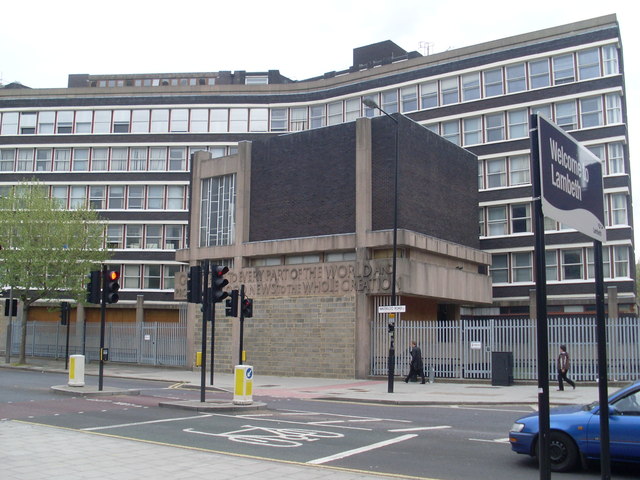
Start where Waterloo Road meets Westminster Bridge Road, close to St George's Circus, and walk north-west. The Old Vic Theatre sits just south of the corner with The Cut, and further along the London Ambulance Service headquarters occupies the west side of the road. St John's Waterloo, its tower rebuilt after wartime damage, marks the approach to Waterloo station, standing to the west of the road. Nearer the river the road opens onto a large roundabout, threaded with underground walkways and centred on the BFI London IMAX Cinema, with King's College London's Maxwell Building close by to the east. Beyond it, at the northern end near the Thames, sit the Royal National Theatre, the Hayward Gallery, the Queen Elizabeth Hall and the National Film Theatre, before the road crosses Waterloo Bridge towards the West End.
Name Origin
A road named for a battle
Waterloo Road takes its name from the same source as Waterloo Bridge and Waterloo station: the Battle of Waterloo and the wave of Napoleonic-era commemoration that followed it. The clearest evidence of this naming impulse on the road itself is St John's Waterloo, designed by Francis Octavius Bedford and built in 1824 explicitly, Wikipedia's account records, "to celebrate the victory of the Napoleonic Wars." That the parish church standing on the road was conceived as a monument to the victory suggests the road's own name carried the same commemorative weight, even where the documentary record does not spell out the precise moment of naming.
Today the road is formally classified as the A301, a designation that continues across Waterloo Bridge itself, tying the road's modern administrative identity to the same crossing that gave the district its name. The road's route is also its own kind of evidence: it runs from close to St George's Circus at its south-eastern end to Waterloo Bridge at its north-western end, a route shaped entirely around delivering traffic to and from that Thames crossing, reinforcing the sense that road, bridge and church all belong to a single act of naming after 1815.
"to celebrate the victory of the Napoleonic Wars"Wikipedia, on the building of St John's Waterloo, 1824
History
From St George's Fields to a modern thoroughfare
The road's documented history begins with its connections into the surrounding street grid rather than with the road itself. The Survey of London records that Stamford Street's extension to Waterloo Road was made in 1815, tying the new road into the developing street pattern of St George's Fields. Development followed quickly on the surrounding plots: between 1821 and 1825, several houses on St George's Circus, on the stretch between Blackfriars Road and Waterloo Road, were built for Mary Johnson of the "Equestrian Coffeehouse," as the Survey of London's account of the area's enclosure and development notes.
St John's Waterloo, completed in 1824 to Francis Octavius Bedford's design, gave the road its parish church and its clearest monument to the Napoleonic victory behind the name. The church suffered badly in the Second World War: it was firebombed in 1940 and much of its interior destroyed, before being restored and reopening in 1951 — the same moment it took on a new civic role, serving as the parish church for the Festival of Britain on the South Bank.
The road's charitable and institutional history is also documented in the Survey of London's account of St George's Fields' charitable institutions. A Blind Employment Factory operated from the basement of a workshop on Waterloo Road, itself the successor to a workshop established after 1874 at the School for the Indigent Blind. That school's site was compulsorily purchased by the Baker Street and Waterloo Railway in 1901, part of the wave of railway-driven redevelopment that reshaped the area around the turn of the century.
Culture
Theatres, screens and galleries at the river end
The northern end of Waterloo Road, closest to the Thames, is dense with cultural institutions. The Royal National Theatre stands to the east, while the Queen Elizabeth Hall and the Hayward Gallery lie to the west near the river, on ground once occupied by the pleasure gardens of Cuper's Gardens. The National Film Theatre sits below the road itself at this northern stretch, and the BFI London IMAX Cinema occupies the centre of a large roundabout further along, reached by underground walkways. Close by to the east stands King's College London's Maxwell Building, named for James Clerk Maxwell, who became a professor at the college in 1860.
Further south, the Old Vic Theatre sits just south of the road's corner with The Cut, adding a long-established theatrical presence to a road otherwise defined by its cluster of post-war South Bank institutions.
People
An architect, a physicist and a coffeehouse proprietor
The road's documented human history is thin but specific. Francis Octavius Bedford, the architect responsible for St John's Waterloo, gave the road its parish church in 1824, a building whose commemorative purpose and later wartime damage and restoration have made it the road's single most storied structure.
James Clerk Maxwell's connection to the road is more indirect but no less concrete: he became a professor at King's College London in 1860, and the college's Maxwell Building, standing near the BFI roundabout at the road's northern end, carries his name into the present streetscape.
Further back in the road's development, Mary Johnson of the "Equestrian Coffeehouse" had several houses built for her between 1821 and 1825 on the St George's Circus stretch between Blackfriars Road and Waterloo Road, one of the few named individuals tied directly to the area's early nineteenth-century building boom, as recorded in the Survey of London's account of St George's Fields.
Recent Times
Institutions old and new
Waterloo Road today carries a mix of civic and institutional occupants alongside its cultural landmarks. The London Ambulance Service's headquarters sits on the west side of the road further south, while the Union Jack Club, a short distance away in Sandell Street, stands close to the road to the east. At 157, Partnership House was formerly the headquarters of the United Society Partnership for the Gospel (USPG), the Church Mission Society (CMS) and other church mission and community-based organisations, reflecting the road's long association with charitable and religious institutions dating back to the nineteenth-century School for the Indigent Blind and its successor Blind Employment Factory.
Physical survivals from the road's institutional past include the former Waterloo Road Fire Station, first listed Grade II by Historic England on 5 March 1986, a marker of the municipal infrastructure that once lined the road alongside its charitable and religious buildings.
Today
A road straddling two boroughs
Waterloo Road still runs its original course, from near St George's Circus at the south-east to Waterloo Bridge at the north-west, straddling the boroughs of Lambeth and Southwark along the way, as Wikipedia's account of the road notes. Waterloo station lies just to its west, and the road remains classified as the A301, carrying traffic across the bridge and on towards the West End. Its character now is defined largely by the concentration of national cultural institutions at its northern end — the National Theatre, Hayward Gallery, Queen Elizabeth Hall, National Film Theatre and BFI IMAX — set against the surviving parish, charitable and civic buildings, from St John's Waterloo to the former fire station, that trace the road's longer institutional history.
The BFI London IMAX Cinema sits in the middle of a large roundabout on Waterloo Road, reached only via underground walkways — one of the more unusual settings for a major cinema anywhere in London.
On the Map
Waterloo Road Then & Now
Frequently Asked Questions
Why is it called Waterloo Road?
The road shares its name with Waterloo Bridge and Waterloo station, commemorating the Battle of Waterloo. St John's Waterloo, built on the road in 1824, was constructed specifically to celebrate the victory in the Napoleonic Wars, underlining the commemorative naming of the wider area.
What is Waterloo Road known for?
Waterloo Road is known for the cluster of cultural institutions at its northern, riverside end — the Royal National Theatre, Hayward Gallery, Queen Elizabeth Hall, National Film Theatre and BFI London IMAX Cinema — alongside St John's Waterloo, its parish church since 1824.
What borough is Waterloo Road in?
Waterloo Road straddles two London boroughs, Lambeth and Southwark, with the boundary running along its length rather than at either end, according to Wikipedia's account of the road.