Time Walk
From Waterloo Road to Blackfriars Road


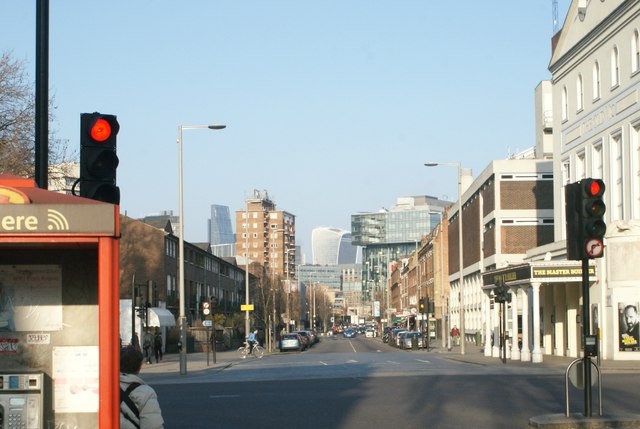
Walk The Cut from its western end and the first landmark is the Old Vic, its front elevation to the street a mix of stone facing and render, as the Survey of London's account of the Royal Victoria Hall records. Head east and, on the opposite side roughly halfway along, the Young Vic sits amid the same stretch of pavement that once carried market barrows. Lewisham Southwark College occupies ground on the south side further along, a reminder that this has long been a working street rather than a purely residential one. The road runs on, roughly parallel to the railway lines of the old South Eastern Railway, until it meets Blackfriars Road and Southwark Underground station at its eastern end — a short walk that crosses from Lambeth's Waterloo Road into Southwark proper.
Name Origin
A meadow, a lease, and a literal cut
The Cut was, for most of its history, known plainly as New Cut — a name Wikipedia confirms and which the Survey of London's account of Waterloo Road also records directly. The name describes exactly what happened on the ground: a new roadway was cut through open land around 1820, continuing the line of Lower Marsh eastward past Waterloo Road. Before that, the Survey of London notes, this was a meadow called Chalcroft, which through the 18th century had been let out simply as garden ground — allotments and plots rather than streets and houses.
The transformation from meadow to thoroughfare was the work of a named individual: Samuel Short, a carpenter, who held a building lease covering the ground bounded by the New Cut, Webber Street and Short Street (a name that still commemorates him), and who developed the whole property. Between 1818 and 1821 he built the houses along the south side of the New Cut himself. The Survey of London describes these as "third-rate" houses, with front walls faced in stock brick, rubbed and gauged arches over the windows, and stone-coped parapets — solid, unpretentious speculative housing of exactly the kind that filled the streets radiating from Waterloo Bridge in this period. The shortened, familiar form "The Cut" is the name that has stuck into the present day, though the pack of surviving records does not pin down precisely when the abbreviation took hold.
"third-rate" houses with "rubbed and gauged arches to the windows and stone coped parapets"Survey of London, Vol 23, on the houses built by Samuel Short, 1818–1821
History
Market, decline, and a new road designation
From the early 19th century, Wikipedia's account records, Lower Marsh and the Cut together formed the commercial heart of this part of Lambeth and Southwark. It was a street of trade rather than grand residence, and by the 1840s that trade had a very specific character: the social researcher Henry Mayhew estimated that around 300 costermongers — street sellers with barrows and stalls — attended the market that ran along the Cut. It was, in Mayhew's account, a bustling, densely worked commercial strip.
That character did not last unaltered. By 1851, Mayhew was writing that the Cut had lost much of its commercial vigour, attributing the change to new police regulations that restricted the fixed stalls traders had relied on. The market did not vanish outright, however — Wikipedia's account has it continuing in some form until the 1950s, when the street's role changed again with its designation as the B300 thoroughfare, folding it formally into the road network rather than leaving it as an informal market street.
One further, more colourful claim survives in the record, though marked as less certain: a boxing gymnasium situated above a pub on the Cut is alleged to have been the place where the modern rules of boxing were drawn up. The pack's sourcing treats this as probable rather than verified, but it has become one of the street's most repeated stories.
Short Street, which still meets the Cut today, is named after Samuel Short, the carpenter who developed the whole stretch of ground between the New Cut, Webber Street and Short Street in the years around 1820.
Culture
Two theatres and a boxing legend
The Cut's cultural weight today rests chiefly on its theatres. The Old Vic anchors the western end, its Cut-facing front part stone, part rendered, according to the Survey of London's detailed account of the Royal Victoria Hall. Further along, on the opposite side, the Young Vic occupies a spot roughly halfway between Waterloo Road and Blackfriars Road — placing two working theatres within a short walk of each other on the same street. Lewisham Southwark College adds an institutional, educational presence to the south side, while the market history described above gives the street a less formal cultural inheritance: a place built on trade and performance in roughly equal measure.
People
The builder and the chronicler
Two named individuals dominate the surviving record of the Cut's early character. Samuel Short, a carpenter by trade, held the building lease for the ground between the New Cut, Webber Street and Short Street, and it was he who built the row of "third-rate" brick houses along the street's south side between 1818 and 1821 — modest but solidly built homes with stock-brick fronts and stone-coped parapets, as the Survey of London describes them. His name survives today in Short Street itself, a quiet but permanent trace of the man who turned Chalcroft meadow into streets and housing.
The other figure is Henry Mayhew, whose observations of London's working poor brought the Cut's market to written record. In the 1840s he put a number on the trade there — some 300 costermongers working the stalls — and by 1851 he was documenting its retreat, attributing the change to new police regulations that cracked down on fixed stalls. Mayhew's two observations, a decade apart, give the Cut one of its few directly dated commercial snapshots, showing a street economy rising and then contracting within living memory of a single writer.
Recent Times
From market street to designated thoroughfare
The Cut's market tradition, weakened by Mayhew's 1851 account, did not disappear immediately — Wikipedia's account has trading continuing along the street in some form all the way into the 1950s. That decade marked a formal turning point: the street was designated the B300 thoroughfare, embedding it within the postwar road classification system rather than leaving it as the semi-informal market street it had been for over a century. This shift coincided with the Cut settling into the institutional and cultural role it holds today, with theatres and a college replacing costermongers' barrows as the street's defining activity. The road's position running roughly parallel to the former South Eastern Railway line has kept it a connecting route between Lambeth and Southwark, with Southwark Underground station providing a modern transport anchor at its eastern end.
Today
Theatre, education, and a market memory
The Cut today runs a short, busy course between Waterloo Road and Blackfriars Road, bookended by two theatres — the Old Vic to the west and the Young Vic partway along — with Lewisham Southwark College on its south side and Southwark station marking its eastern end. Its B300 designation, dating from the 1950s, keeps it functioning as a proper through-road rather than a backwater, even as its 19th-century identity as a costermongers' market street lingers only in written record. The houses Samuel Short built two centuries ago, and the meadow of Chalcroft they replaced, are long gone from view, but the street's name — cut, quite literally, from open ground — still marks the spot.
On the Map
The Cut Then & Now
Frequently Asked Questions
Why is it called The Cut?
The street was originally known as New Cut, describing how it was physically cut through open ground — a former meadow called Chalcroft — around 1820, continuing Lower Marsh eastward past Waterloo Road. The name later shortened to The Cut.
What is The Cut known for?
The Cut is known for its theatres — the Old Vic at its western end and the Young Vic partway along — and historically for its costermongers' market, recorded by Henry Mayhew in the 1840s as attracting around 300 traders before police restrictions curtailed it after 1851.
Who built the houses on The Cut?
Samuel Short, a carpenter holding the building lease for the surrounding ground, built the "third-rate" brick houses on the street's south side between 1818 and 1821, as the Survey of London records. His name survives in the nearby Short Street.