Time Walk
A square that arrived in two years and changed only once


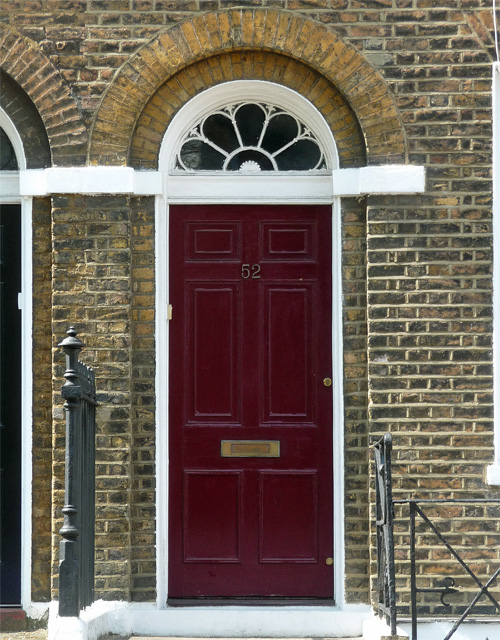
Walk into Surrey Square today and you meet a rectangle of Georgian brick, a primary school, and a slice of municipal park where a formal garden once stood. It is a street that came into being fast — laid out, built, and fully occupied within two years in the 1790s — and then sat largely unchanged for over sixty years before a church and new houses closed in around it. The eighteen-house terrace that gives the square its architectural character still stands on its west side, statutorily listed (Grade III in the Survey of London's 1955 appendix), a rare survival of the speculative building boom that once reshaped Walworth.
Name Origin
Named for the county, not a person
Surrey Square's name carries no hidden history, no forgotten landowner or family to trace — it is simply named after the county of Surrey, in which Walworth traditionally sat before London's administrative boundaries were redrawn. In the 1790s, when the square was laid out, "Surrey" was still the plain geographical fact of the place, and naming a new development after the county was a straightforward, unpretentious choice rather than a marketing flourish.
The square itself was designed by the architect Michael Searles, who was also responsible for the nearby Paragon, the crescent that once stood at what is now Bricklayers Arms — a reminder that Surrey Square was part of a wider pattern of formal, planned development spreading south and east from central London in this period. Searles gave the square a deliberate architectural identity: a terrace of houses facing a formal oblong of open ground, the kind of composition that turned a speculative housing scheme into something with the pretensions of a proper London square.
History
From inherited land to a Georgian terrace, built fast and left largely alone
The land on which Surrey Square would rise passed to Jane Driver, wife of Samuel Driver, in 1766, inherited from her uncle Abraham Pursehouse. It sat undeveloped for another quarter century before Michael Searles was engaged to lay out a formal square on it. His design placed an oblong of open ground in front of a new terrace, and construction moved with striking speed: the first stone was laid in 1792, and by 1794 the square was fully occupied. The terrace itself — eighteen houses, now numbered 20 to 54 — was built in 1795–96 by the Survey of London's reckoning — though Wikipedia's account has the first stone laid in 1792 and the square fully occupied by 1794 — its architectural merit resting on good proportions and simple, restrained detailing, with a fan motif executed in artificial stone decorating the pediment and parapet of the end pavilion. Searles had originally intended a grander central feature, a doorway with a pedimented hood on Doric columns, but this part of the scheme was never carried out.
William Driver, son of Jane and Samuel, lived in a large house on the square's west side from 1799 until his death in 1819, one of several long residencies that gave the new development an early settled character. For decades afterwards, Surrey Square changed remarkably little. It was only more than sixty years after the original terrace went up that further building took place, when All Saints' Church and neighbouring houses filled in the other three sides of the square, obscuring its original open configuration for good.
Culture
A design half-realised, a motif that travelled
Surrey Square's architectural identity rests on restraint rather than grandeur. Searles's terrace at Nos. 20–54 earned its listing — Grade III in the Survey of London's 1955 appendix — on the strength of good proportions and simple detailing rather than any single showpiece — though the fan ornament worked in artificial stone into the end pavilion's pediment and parapet gives the terrace a quiet decorative flourish. The same fan motif reappears in Searles's later work on a possible elevation for the Walworth Chapel, suggesting it was something of a signature device he carried between commissions in the area.
Michael Searles originally planned a grand central doorway for Surrey Square, with a pedimented hood held up by Doric columns — but that part of the design was never built, leaving the terrace's fan-motif pediment to carry the architectural interest alone.
The square's later history is one of infill rather than redesign. Where the original Searles composition offered open ground on three sides, the arrival of All Saints' Church and further houses decades later closed the space in, and what survives today of the original layout is fragmentary — a garden square whose eighteenth-century geometry has been overwritten by nineteenth-century Southwark's need for more buildings, not fewer.
People
Residents of a quiet square: a landowning family, a preacher-historian, and a painter
The square's earliest resident of note was one of its own builders' family: William Driver, son of Jane and Samuel Driver, whose inheritance had made the square possible in the first place. He lived in a large house on the west side from 1799 until his death in 1819, anchoring the new development with the kind of long, settled tenancy that speculative Georgian squares depended on to establish respectability.
Later in the square's history came the Rev. John Waddington, minister of Union Street Chapel and the Pilgrim Church in Southwark, and a historian and sociologist by inclination as well as calling. He lived at No. 34 (formerly No. 9) Surrey Square between 1856 and 1872, a period that overlapped with the church-building phase that transformed the square's appearance for good.
The square's most celebrated resident, however, was the painter Samuel Palmer, born at No. 42 (formerly No. 13) Surrey Square in 1805. Palmer's birth on the square ties this modest corner of Walworth to one of the more distinctive names in English Romantic art, born into a Georgian terrace built barely a decade before his arrival. Samuel Brandon, meanwhile, was recorded as the first occupant of the former No. 22 — a house later pulled down in 1884 to make way for Surrey Square School, itself a marker of the square's continuing evolution.
Recent Times
School, park, church — the square rebuilt from within
Surrey Square's more recent history has been shaped by institutions rather than individuals. No. 18 (formerly No. 1) served for much of the second half of the nineteenth century as the vicarage of the church of St. Mary Magdalen on Massinger Street, tying the square into the parish infrastructure spreading through Walworth at the time. Surrey Square Primary School now occupies the northern side of the square, its presence a direct descendant of the Surrey Square School built after the demolition of the former No. 22 in 1884.
All Saints' Church, built within the square more than sixty years after Searles's original terrace, remains one of the buildings that filled the three non-northern sides and permanently altered the square's open character. Today, part of the once-filled-in middle section has been reclaimed as public green space, known as Surrey Square Park — a modern echo, however partial, of the formal open ground Searles first laid out in the 1790s. The surviving terrace at Nos. 20–54 remains a listed building (Grade III in the Survey of London's 1955 appendix), the clearest physical link back to the square's founding decade.
Today
Garden square in name, patchwork in practice
Surrey Square today is a garden square in the loosest sense — a Walworth street just off the Old Kent Road where a Georgian terrace, a Victorian church, a primary school, and a modern park all share the footprint Michael Searles once laid out as a single formal composition. The listed terrace at Nos. 20–54 is the square's most legible historic fabric, its fan-motif pediment a small surviving flourish from a design that was otherwise never fully realised. Surrey Square Park offers a modest patch of green where the original open ground once stretched further, a reminder that the square's eighteenth-century shape has been reworked more than once, but never entirely erased.
On the Map
Surrey Square Then & Now
Frequently Asked Questions
Why is it called Surrey Square?
Surrey Square is named after the county of Surrey, in which Walworth traditionally lay before London's boundaries were reorganised. The name is straightforwardly geographical, chosen when the square was laid out in the 1790s.
What is Surrey Square known for?
Surrey Square is known for its Georgian terrace designed by architect Michael Searles, built in the mid-1790s, and as the birthplace of painter Samuel Palmer in 1805. It later saw All Saints' Church built within its grounds.
Who designed Surrey Square?
Architect Michael Searles laid out Surrey Square in the 1790s, designing a terrace of eighteen houses facing formal open ground. He also oversaw the nearby Paragon, the crescent that once stood at what is now Bricklayers Arms around the same period.