Time Walk
A Young Road Over Old Ground


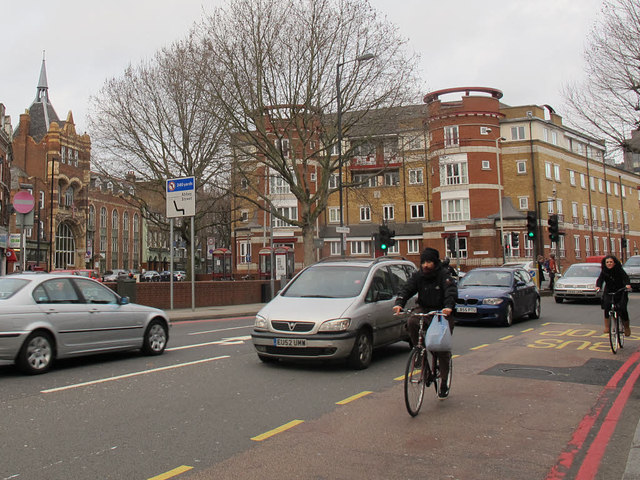
Tower Bridge Road runs south from the bridge it is named for, straight through the middle of Bermondsey. It is wide and lined with trees, a road built for traffic in a hurry. Its shops are in no hurry at all. Antique dealers and junk shops fill the middle stretch, and every Friday morning Bermondsey Square fills with market stalls.
Nothing on the surface hints at what lies underneath. The road was laid across the site of Bermondsey Abbey, and part of the abbey is still buried beneath its east side. A road this young, over ground this old: the explanation starts with the bridge.
Name Origin
Two Old Lanes Become One New Road
The road is named for the bridge at its northern end. Tower Bridge was built between 1886 and 1894, designed by Horace Jones, and it connected Iron Gate on the north bank with Horselydown Lane on the south — the lane now called Tower Bridge Road at its river end. Before the bridge, this stretch ran through Horselydown, meadowland used in the Middle Ages for grazing animals.
Further south, the new road also swallowed Freemans Lane, which was upgraded in the 1890s and in doing so severed the area from wharf development that had once run west towards London Bridge. Bermondsey itself, the district either side of the road, takes its own name from "Beormund's Ey" — Beormund's island. Tower Bridge Road, then, is not a name reaching back centuries: it is a Victorian label stitched onto much older ground.
History
A Road Laid Over an Abbey
This road was cut straight through the ruins of a medieval abbey. Bermondsey Abbey's earliest traceable remains are a Norman church of around 1080, recorded in the Domesday Book of 1086. Its main quadrangle, once called the Court Yard, is now Bermondsey Square, and the abbey's infirmary still lies underground on the east side of the road. A Puritan divine built a chapel in the square in 1699, and the abbey's old gatehouse — standing between the King John's Head pub and an oil shop — was not removed until the early 19th century.
South of the old abbey ground, St John Horsleydown was built between 1727 and 1733 in Fair Street, beside the lane that would later become Tower Bridge Road, to designs associated with Nicholas Hawksmoor. The road itself came much later. Tower Bridge opened in 1894, and the new approach road that followed absorbed Freemans Lane in the 1890s. A block of the nearby Devon Mansions flats was demolished around 1902 to make way for it.
The Bricklayers Arms roundabout and flyover, at the road's southern end, were approved by the London County Council in December 1962 at an estimated cost of £3,510,000, with the works scheduled for 1967.
In 1932, a workman at a petrol station on Tower Bridge Road dug up the consecration stone of Bermondsey Abbey — proof that the ground beneath the forecourt had once been holy ground.
Culture
Eels, Antiques and a Queer Cinema
Antiques have traded on this stretch since 1950. The market, officially the New Caledonian Market but known to everyone as Bermondsey Market, sits at Bermondsey Square on ground that was once the abbey's own quadrangle. Further along, at No. 10 Bermondsey Square, the Arzner is an independent cinema dedicated to queer cinema.
On the road itself, M.Manze is said to have opened in 1892 under Robert Cooke, serving pie and mash with eel — a trade older than the road that now carries it. A 1990 bronze sculpture by Ann Christopher, elected a Royal Academician in 1989, also stands on Tower Bridge Road.
People
A Queen, a Sailor, a Suffragette
A queen's last refuge may lie beneath the market stalls. Elizabeth Woodville, queen consort to Edward IV, is thought to have spent her final five years at Bermondsey Abbey, dying there in 1492 — on the ground Bermondsey Square now occupies, a short walk from the road's antique shops.
Albert Edward McKenzie was nineteen when he advanced down the Mole at Zeebrugge with his machine-gun on the night of 22–23 April 1918, and was severely wounded working his gun in an exposed position. King George V presented him with the Victoria Cross at Buckingham Palace, but McKenzie died of influenza that November, during the world flu pandemic, and is buried in Camberwell Old Cemetery. A memorial to him was unveiled in 2015 at the junction of Tower Bridge Road with Decima Street and Bermondsey Street.
Irene Dallas, born in Yokohama in 1883, ran the WSPU's campaign for the Bermondsey by-election from headquarters on this road. She had already been arrested in January 1909 trying to reach 10 Downing Street with fellow suffragettes, choosing a month in Holloway Jail over paying a £10 surety.
Recent Times
Shrinking Stalls, New Neighbours
The market is a fraction of the size it was. Redevelopment begun in 2007 replaced much of Bermondsey Square's market ground with a hotel, apartments and offices, reducing the stallholders from more than 200 to a few dozen.
Elsewhere the road has kept older company. Near Devon Mansions, opposite the former St Olave's Grammar School, statues commemorate Ernest Bevin, the dockworkers' trade unionist, and Samuel Bourne Bevington, Bermondsey's first mayor. A further bust of Bevin stands at the fork with Tooley Street and Queen Elizabeth Street. Just off the road, the One Tower Bridge development has risen since 2012 between Potters Fields and the road itself.
Today
A Wide Road Still Doing Its Old Job
The road still looks built for traffic, not for lingering. It runs a generous 18 metres wide, lined with an avenue of street trees planted when it was cut through in the 1890s. Antique shops still cluster where the market has traded since 1950, and the road still marks a clear change of scene between the bridge end and the docks to the east.
Walk its length today and the abbey is invisible — buried under warehouses, a cinema, and a Friday market — but the road above it is still doing precisely what it was built to do in the 1890s: carrying traffic to a bridge, over ground far older than either.
On the Map
Tower Bridge Road Then & Now
Frequently Asked Questions
Why is it called Tower Bridge Road?
It is named directly after Tower Bridge, built at its northern end between 1886 and 1894. Before the bridge, the route was made up of older lanes, including Horselydown Lane and Freemans Lane, which were widened and joined into a single new road in the 1890s.
What is Tower Bridge Road known for?
It is best known for Bermondsey Market, a Friday antiques market said to be the oldest of its kind in Britain, and for M.Manze, a pie and mash shop said to date from 1892. It also runs over the buried remains of Bermondsey Abbey.
What stood here before Tower Bridge Road was built?
Bermondsey Abbey, whose earliest traced remains date to around 1080, once stood on this ground, and the surrounding area was medieval meadowland called Horselydown. The road itself did not exist as one route until the 1890s, when older lanes were widened and joined.