Time Walk
A Crescent with a Ghost Street Inside It


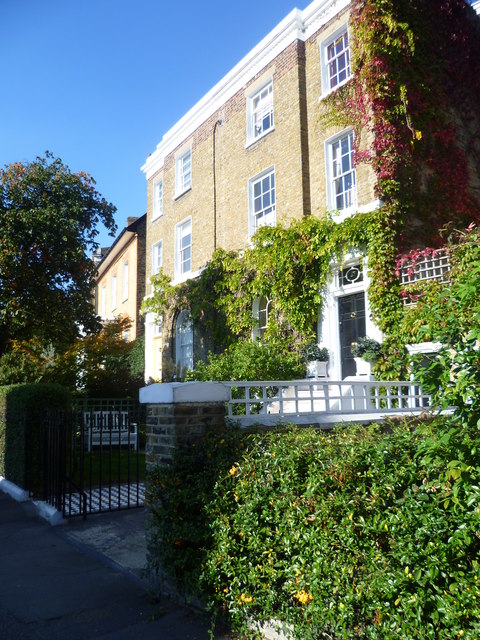
Two of its houses carry a name the street itself has never officially had. Walk the curve today and the villas look continuous, a single Victorian sweep. But at Nos. 14 and 24, tablets set into the brickwork still read "BEN LOMOND PLACE 1841" — a separate row, absorbed into the wider Crescent's numbering.
Beneath the uniform house fronts lies a patchwork of separate building leases, let out piecemeal between 1840 and 1841 by different builders working for the same landowner. That layered, parcel-by-parcel making is the thread worth following into the street's name.
Name Origin
From Manor Land to Park Estate
The street takes its name from the Stockwell Park estate on which it was laid out. The land had been part of Stockwell Manor, bought in 1781 by Benjamin Robertson of Stockwell. It passed to his heir, John Bedwell, who in 1806 sold it on to Edward Shewell.
Development waited until after Shewell's death. The northern part of what became Stockwell Park Road was laid out around 1832, but the Crescent itself was not built until William Cox of Kennington bought part of the estate in 1838 and carried the work forward.
One stretch briefly had its own identity. Nos. 14-24 (even) were originally Nos. 7-12 Ben Lomond Place, built in 1840-41 for a Westminster bookbinder, John Mackenzie, working with Frances Harrison under leases from Cox. Tablets on two of the houses still carry that earlier name and date. The sources used here do not explain why that stretch was called Ben Lomond, or why the wider district carries the name Stockwell.
History
Building a Crescent in Pieces
The Crescent went up house by house, not all at once. In 1840 and 1841, William Cox let Nos. 44 and 46 Stockwell Park Road and Nos. 2 and 4 Stockwell Park Crescent on 85-year leases; a local builder, John Notley, was party to the lease for No. 44 and may have built all four houses.
"BEN LOMOND PLACE 1841"Tablet on Nos. 14 and 24 Stockwell Park Crescent
Nos. 14-24 Stockwell Park Crescent were originally a separate row called Ben Lomond Place, built in 1840-41 — the name is still dated in stone on two of the houses.
People
A Trapeze Artist at No. 12
At No. 12 lived a woman whose career scandalised the authorities of her day. Zæo, a trapeze artist born around 1863, lived there between 1892 and 1899 with her manager, Henry W Wieland.
Her act was physical and daring: swinging trapeze work and dives from a high platform into a net, performed at the Royal Aquarium through the 1890s. A promotional poster showing her in trapeze costume drew formal moral outrage from the National Vigilance Association and the London County Council.
Zæo's poster, advertising her act at the Royal Aquarium, was enough to provoke the National Vigilance Association and the LCC into action in the 1890s.
She died in 1906, aged 43, survived by three children — Henry, Lizzie and Olga.
Frequently Asked Questions
Why is it called Stockwell Park Crescent?
It was built on land that had formed part of Stockwell Manor, as the Stockwell Park estate; the street took the estate's name. The deeper origin of "Stockwell" itself is not explained in the sources used here.
What is Stockwell Park Crescent known for?
A curved row of Victorian villas, several Grade II listed, built piecemeal in 1840-41 by different builders under leases from William Cox, with one stretch still bearing tablets reading its earlier name, Ben Lomond Place.
Who lived at Stockwell Park Crescent?
The trapeze artist Zæo lived at No. 12 from 1892 to 1899 with her manager, Henry W Wieland. Her Royal Aquarium act and its promotional poster caused a moral-outrage controversy in the 1890s.