Time Walk
A Side Road With a Manor's Name


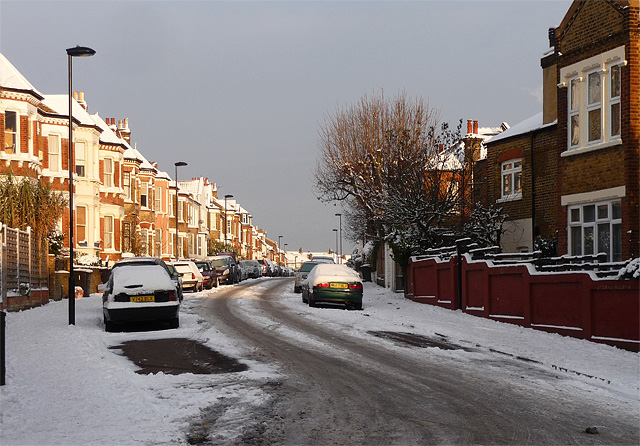
This narrow road carries the name of a vanished farm estate, not a person who ever walked it. Walk it today and you pass ordinary terraced housing and, at its edge, a tall Victorian stench pipe topped with a crown finial — a small industrial survivor among the brick.
Beneath the modern street lies an 18th-century manor record: a copyhold estate called Julians, folded into this corner of Lambeth long before any house stood here. That name is where the road's story really begins.
Name Origin
The Julians Estate
The name 'Julians' was already in use here in the 1730s. It came from a copyhold estate within Lambeth Manor, combined with another called Blackmans, which James Wall acquired in 1733. St Julian's Farm Road preserves that estate name long after the farm itself disappeared.
The name was shared, at least in form, with a neighbouring road: Leigham Court Road was originally called St Julian's Road. The sources consulted here do not explain the precise relationship between the two namings, only that both carried the Julian name in this part of Norwood.
History
From Manor Land to Terraced Street
The road's land history reaches back to a Lambeth Manor record, but its houses belong to a much later period. St Julian's Farm Road was developed broadly in the same era as the neighbouring Casewick Road, which crosses it, in the late Victorian and Edwardian decades.
A Victorian stench pipe with a crown finial — once used to vent sewer gases safely above street level — still stands at the edge of St Julian's Farm Road.
People
A Mutiny Veteran and a Music Professor
Edward Moorhead was a doctor who received the Indian Mutiny medal in December 1858 for his service during the Mutiny. By 1891 he was living on St Julian's Farm Road, his soldiering years decades behind him.
Two decades later, at No. 2, lived Robert Hopke Reed, a musician and professor of music, recorded there in 1911.
Today
A Quiet Boundary Line
St Julian's Farm Road still functions as a boundary. It marks the northern edge of the Leigham Court Road (South) conservation area, crossed by Casewick Road along its length. The name of a long-vanished manor estate, picked up in the 1730s, still marks this quiet corner of Norwood.
On the Map
St Julian's Farm Road Then & Now
Frequently Asked Questions
Why is it called St Julian's Farm Road?
It takes its name from Julians, a copyhold estate within Lambeth Manor, combined with another called Blackmans, which James Wall acquired in 1733. The name 'Julians' was already attached to this part of Norwood by the 1730s.
What is St Julian's Farm Road known for?
It is known locally for a Victorian stench pipe with a crown finial standing at the boundary of the Leigham Court Road (South) conservation area, and as the home, decades apart, of a Mutiny veteran doctor and a professor of music.
Is St Julian's Farm Road related to Leigham Court Road?
Leigham Court Road was originally called St Julian's Road, sharing a form of the same name, though the sources consulted here do not explain the exact relationship between the two namings.