Time Walk
A Family's Road


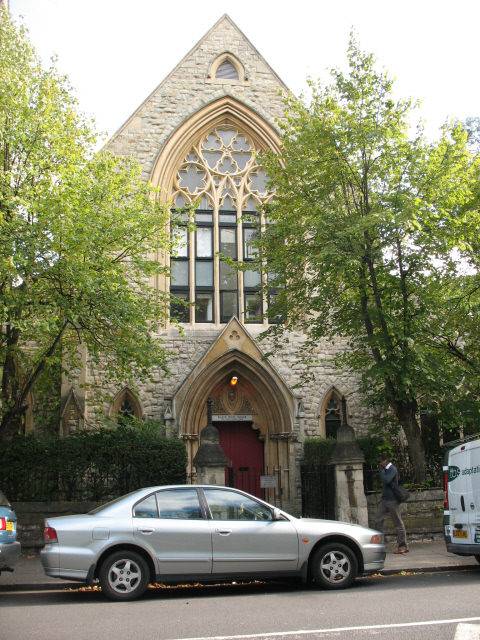
One family paid for almost everything standing on this road. The Minets, who owned the surrounding estate, funded its church, its library and its community hall, and all three still stand close together along the street. Walking it today means passing a spired former church now converted to flats, a Victorian library building, and a hall that once housed a groundbreaking black theatre company.
Beneath the terraced houses and gabled villas lies a single estate, laid out field by field from the 1870s. The road's own name is left unexplained by the records consulted here — which makes the family's name, stamped instead onto every building along it, the real story.
Name Origin
An Unexplained Name
No source used in building this page gives the origin of the name Knatchbull Road. The road ran through land belonging to the Minet family's estate, developed from the early 1870s, but the naming itself is not addressed in the records consulted here.
History
Building on the Minet Estate
By 1871 most of the Minet estate had been divided into plots, with building already under way on Knatchbull Road. The bulk of the estate was developed between 1871 and 1900.
James Lewis Minet gave the site for Church of St. James the Apostle and paid the whole cost of building it. Its foundation stone was laid on 19 June 1869, and the church — designed by George Low and built by Dove Brothers of Islington in Decorated Gothic style, seating 780 — was consecrated on 27 June 1870. A consolidated chapelry was formed for it in 1874. Lambeth's own description calls its slender stone spire an impressive landmark towering above the adjacent villas.
William Minet had a hall built nearby for the estate's tenants, intended also as a church hall for St. James's. His wife died in 1887 before it was finished; he then decided to turn the building into a library in her memory. The Minet Library, designed by George Hubbard, opened in 1890, and on 25 June that year William Minet conveyed the site and buildings to the Camberwell and Lambeth Commissioners. In 1935 Susan Minet gave a further quarter-acre of land near the junction of Knatchbull Road and Calais Street to Myatt's Fields.
William Minet originally planned the building that became the Minet Library as a tenants' hall and church hall for St. James's. He only decided to make it a library after his wife died in 1887, before the hall was finished.
"an impressive landmark with its slender stone spire towering above the adjacent villas"Lambeth Council, Minet Estate Conservation Area Designation Report
Culture
Black Theatre at Longfield Hall
Longfield Hall was built by the Minet family for their tenants, and nearly a century later it became an unlikely stage for a theatrical breakthrough.
Recent Times
A Church Rebuilt, A Church Converted
The first Church of the Sacred Heart, standing at Knatchbull Road and Camberwell New Road, was destroyed by enemy action in the Blitz of 8–9 October 1941. Its replacement, built between 1952 and 1958 with its foundation stone laid by Cyril Cowderoy, has been protected since 2015.
St. James's Church, the building James Lewis Minet funded in the 1860s, has since been converted to flats.
Today
What Survives Along the Road
The Victorian terraces remain the backbone of the street. Nos 51–73 form a long run of houses with bay windows, while No. 83, a late 19th-century detached house, shows fine ornament under a Dutch gable. No. 97a is an early 20th-century house with a double-gabled front, and Park Cottage, at the junction with Cormont Road, is a former park keeper's lodge.
On the Map
Knatchbull Road Then & Now
Frequently Asked Questions
Why is it called Knatchbull Road?
The sources used to build this page do not explain the origin of the name. The road was laid out on the Minet family's estate from the early 1870s, but no record consulted here addresses why it was called Knatchbull.
What is Knatchbull Road known for?
It is known for the cluster of buildings funded by the Minet family — Church of St. James the Apostle, the Minet Library and Longfield Hall — and for Longfield Hall's role as home to the Dark & Light Theatre Company, later the Black Theatre of Brixton.
What happened to Church of St. James the Apostle?
Built between 1869 and 1870 at James Lewis Minet's expense, with a spire once described as an impressive landmark, the church has since been converted to flats.
What was the Black Theatre of Brixton?
It began as the Dark & Light Theatre Company, founded by Frank Cousins in 1969 at Longfield Hall on Knatchbull Road. Renamed in 1975, it closed in 1977 after a prolific run of black plays.