Time Walk
A Road Built to Frame a Church Tower


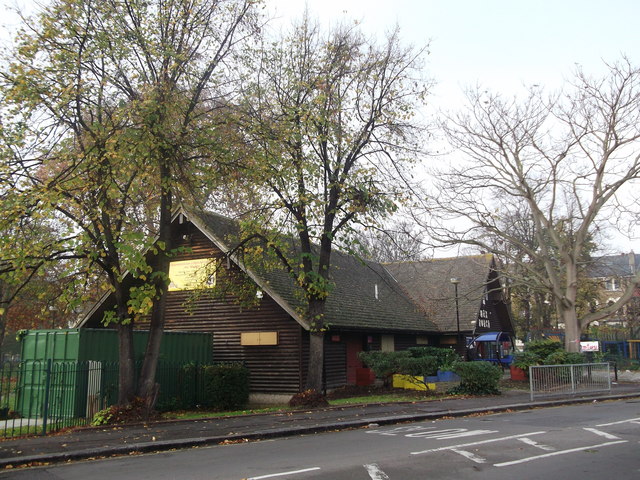
This street was laid out in the 1850s to curve the eye toward a church tower, not a crossroads. Walking it today, the broad roadway, old trees and a handful of surviving Victorian villas still hint at that planned grandeur.
Beneath the present street lies a longer road than the one now walked: its northern stretch was cut off in the early 1970s, leaving that section to survive today as Fiveways Road. That break is the key to the name that follows.
Name Origin
The Angell Estate's Main Street
Wiltshire Road was the long principal road of Angell Town, linked by short roads to Brixton Road and to the Lambeth Wick Estate. It formed the central street of the Angell family's estate on the east side of Brixton Road, developed in the 1850s.
Why "Wiltshire" itself was chosen is not explained in the sources used.
History
Repton's Curves and a Church at the Centre
The layout of Wiltshire Road shows the influence of Humphry Repton's theories of landscaping. It avoids any straight plan, instead curving its streets to create views centred on the tower of St John's Church. Houses near the church were built in a Gothic style with gabled porches and decorative windows. Some were built by James Barker of Peckham, who also built Angell Terrace.
St John the Evangelist Church stands on a triangular site bounded by Wiltshire Road, Angell Road and Angell Park Gardens. Built in 15th-century style, with a chancel, nave, aisles, a porch and a tower with corner pinnacles, it was designed by Benjamin Ferrey. Benedict John Angell Angell gave the site in 1852, and William Stone of Herne Hill paid for the building. The contractors tendered £5,302. The church, seating about 1,150, was consecrated by the Bishop of Winchester on 30 April 1853.
The building was restored in 1876, and a parish hall was added in 1882 by Sextus Dyball. It was badly damaged by fire in 1947 and restored afterwards by Thomas F. Ford. It is built of stone in Gothic style, with a tower finished with pinnacles.
Wiltshire Road once ran further north than it does now — the section beyond the 1970s Angell Town Estate survives today under a different name, Fiveways Road.
People
A Chorus Girl Turned Star
Jean Kent was born on Wiltshire Road in 1921. She started her career as a dancer and chorus girl at a young age, and went on to become one of the great stars of the golden age of British cinema. She died in 2013.
Recent Times
Clearance and Conservation
Most of the Italianate houses on Wiltshire Road were cleared in the 1970s for the Angell Town Estate. The same decade saw the street's northern end cut off, becoming Fiveways Road. In 1995 the Brixton Conservation Area was extended to include three of the surviving houses on Wiltshire Road.
Today
What Survives South of the Break
South of its junction with St John's Crescent, Wiltshire Road still has mostly imposing and intact mid-19th-century houses, along with a converted stable building. The street remains broad and leafy, its trees contributing to a spacious, green feel. At No. 49 stands the former vicarage, a three-storey mid-Victorian house set in a large, walled garden.
On the Map
Wiltshire Road Then & Now
Frequently Asked Questions
Why is it called Wiltshire Road?
It was the main road of Angell Town, an estate laid out by the Angell family in the 1850s. The sources consulted here do not explain why the name "Wiltshire" itself was chosen.
What is Wiltshire Road known for?
It is known as the principal street of the Victorian Angell Town estate, laid out on landscaping principles associated with Humphry Repton and centred on St John's Church, and as the birthplace of film actress Jean Kent.
What happened to the northern end of Wiltshire Road?
It was cut off in the early 1970s when the Angell Town Estate was built across it. That severed stretch now survives under a separate name, Fiveways Road.
What does St John's Church on Wiltshire Road look like?
Consecrated in 1853 and designed by Benjamin Ferrey, it is a Perpendicular Gothic church of Kentish ragstone with Bath stone dressings, with a battlemented west tower and corner pinnacles.