Time Walk
A Dead End with a Royal Pedigree

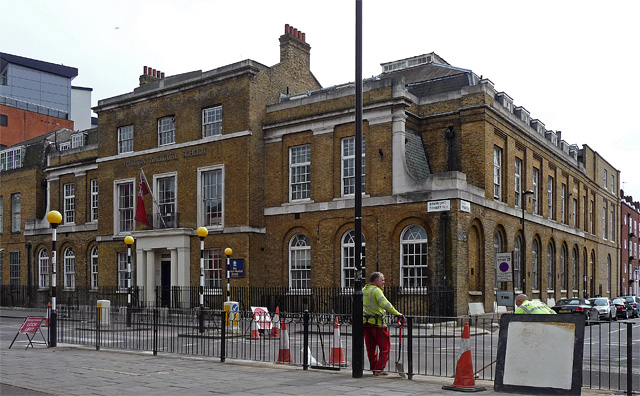
A prince once planned a town here, but what got built was a dead-end street that took its name from a duchy, not a duke. Walking in today there is little traffic noise — it is a cul-de-sac, giving onto the Peabody Estate rather than through to anywhere else. Climsland House, with its red brick front, stands on the west side.
Beneath the quiet lies a working street: printers' machinery clattered here for well over a century. Its name, and the land it sits on, trace back to a single Act of Parliament.
Name Origin
From Duke Street to the Duchy
The street began as Duke Street, laid out across an area known as Prince's Meadows in the early 1810s, following an Act of Parliament of 1810 that allowed the Prince Regent to grant building leases for a planned development called Prince's Town. Between 1810 and 1815 it was renamed Duchy Street.
The change of name points to the land's ownership rather than to any individual duke. The street sat within the manor of Kennington, which belonged to the Duchy of Cornwall. The sources used here do not explain why "Duke" was specifically replaced by "Duchy", only that the renaming happened in this period.
History
Printers, Ice, and a Terraced View
Duchy Street was formed as a link between Commercial Road, then called Upper Ground, and the newly extended Stamford Street. It soon became ground for industry rather than housing. The printing partnership of Applegath and Cowper set up its first steam press here in 1819, and William Clowes took over the works in 1821, occupying the ground between Duchy Street and Coin Street for the next 120 years.
In 1925-26 a large refrigerating plant was built in the block between Duchy Street and Broadwall, adding a second kind of industry to the area. In 1875 the Peabody Estate was built, its blocks deliberately sited so that views south down Duchy Street would terminate on them.
"burnt out in the recent war"Survey of London, Volume 23 (1950s)
People
The Printers of Duke Street
Applegath and Cowper, and the Clowes firm that followed them, are covered in the History section above.
Recent Times
Tenants Take On a Car Park
By the 1970s, Duchy Street's Peabody estate had its own tenants' association, which in 1975 won a government grant to turn Hatfields Gardens from a car park into a recreation area.
A tenants' campaign on the Duchy Street Peabody estate in 1975 turned a car park at Hatfields Gardens into a recreation ground, backed by a government grant.
Today
A Quiet Turning Off Stamford Street
Duchy Street remains a dead end running south from Stamford Street, giving access to the Peabody Estate. Climsland House still stands on its west side. The printing works and the ice plant are gone, but the street's role as a quiet route into a residential estate, rather than a through road, continues what the Peabody builders planned when they sited their blocks to close the view down it in 1875.
On the Map
Duchy Street Then & Now
Frequently Asked Questions
Why is it called Duchy Street?
It was laid out as Duke Street around 1810-1815 and soon renamed Duchy Street, after the land's ownership within the manor of Kennington, which belonged to the Duchy of Cornwall.
What is Duchy Street known for?
For over a century it was the site of a major printing works, first set up by Applegath and Cowper in 1819 and taken over by William Clowes in 1821, which stood until it was bombed in 1941.
Was Duchy Street always called by that name?
No. It began as Duke Street when first laid out across Prince's Meadows in the early 1810s, before being renamed Duchy Street between 1810 and 1815.