Time Walk
A Road Built to an Estate Plan


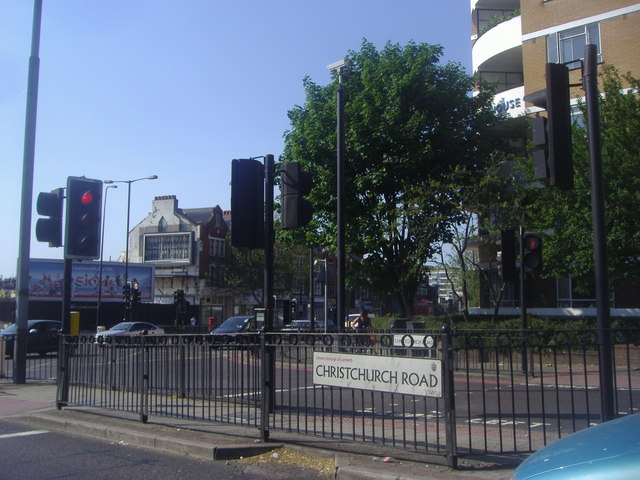
A church came first here, and the road was cut past it years later as part of a new estate's plan. Walking it today, three things stand out: the tall campanile of Christ Church above the rooftops, the curving balconies of a 1930s block, and the brick bulk of a former tram depot now selling cars.
Behind that 1930s block stands a rarer survivor still, an open-sided school built for children with poor health. The estate planners, the tram engineers and the school builders each left their mark here in turn — which makes the road's own name, oddly, the one thing nobody wrote down an explanation for.
Name Origin
Church Before Road
The sources used here do not explain why the road is called Christchurch Road. What they do establish is a sequence. Christ Church, a Grade I listed building designed by James William Wild, was built in 1842 in an Italian Romanesque style with a tall campanile. The road itself was laid out a few years later, in 1845–1846, as one of the two main arteries of the Roupell Park estate — formed out of the former Thurlow estate and straddling the boundary of Lambeth and Streatham. The church came first; the road followed. No source states that the one was named for the other.
History
Estate, Church, School, Tram
The Roupell Park estate gave the road its purpose as a through route linking new Victorian streets. Christ Church had already risen on the line of the road in 1842, its Italian Romanesque style and campanile unlike anything else nearby.
Nearly a century later, Christchurch House went up in 1938, a 1930s moderne block with stylish curving balconies. Behind it stands the former London County Council Aspen House Open Air School, opened in the 1920s for children with poor health, its open-sided classroom pavilions a rare survival of that kind of schooling.
On Brixton Hill, fronting the road, a tramway depot completed in 1923 presented an imposing brick facade; it survives largely intact and now serves as a motor car showroom. It included a shed designed by the LCC Tramways architect G. Topham Forest, built to hold 30 trams.
Behind Christchurch House stands the former Aspen House Open Air School, opened in the 1920s, a rare survivor of a special school built with open-sided classroom pavilions for children with poor health.
Culture
A Clash Guitarist's Childhood Home
Long before punk reached the charts, one of its future guitarists was growing up here.
People
Kate Carney's Last Years
Kate Carney spent her final years on this road. She returned to Christchurch Road in 1944, after the death of George Barclay. She died there in 1950, aged 80.
On the Map
Christchurch Road Then & Now
Frequently Asked Questions
Why is it called Christchurch Road?
The sources used here do not explain the name directly. Christ Church, a Grade I listed building, stood nearby from 1842, several years before the road was laid out in 1845–1846 as part of the Roupell Park estate.
What is Christchurch Road known for?
It is known for Christ Church, a Grade I listed Italian Romanesque church of 1842 with a tall campanile, for the 1930s moderne Christchurch House, and for a former tram depot of 1923 that survives as a car showroom.
Who lived on Christchurch Road?
Mick Jones of The Clash lived in Christchurch House as a child. The music hall performer Kate Carney returned to the road in 1944 and died there in 1950, aged 80.