Time Walk
A Southern Row in a Quiet Suburb


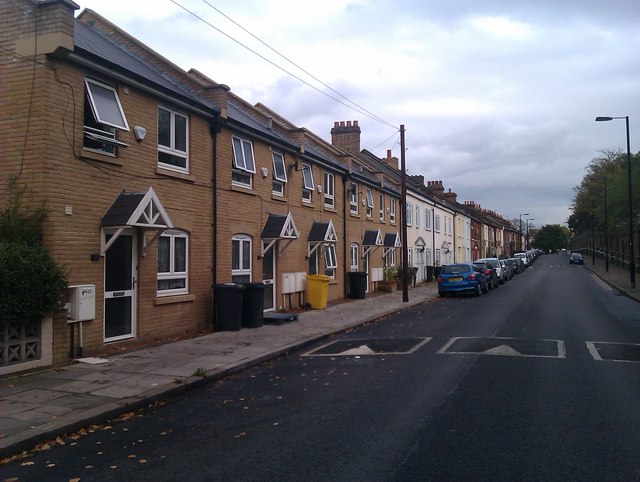
For twenty years this street went by a different name, Park Villas, after the row of houses built along it. Today it is a wide, tree-lined road with houses set well back behind front gardens, and the oldest survivors stand near the western end, where building first began.
For its first decades only the southern side was built up at all; the northern side stayed open ground. That earlier name, Park Villas, is where the street's story properly begins.
Name Origin
From Park Villas to Chestnut Road
Chestnut Road was not always called that. When it was laid out around 1850 it was known as Park Villas, a name that described the row of large houses built along it. At some later point it took the name it carries today.
The sources used here do not explain why the street was renamed Chestnut Road, or why that particular name was chosen.
History
Villas on One Side of the Road
Chestnut Road was laid out around 1850, and building began at its western end, on the south side of the street. By 1870 it comprised a series of large houses standing in substantial grounds that ran back as far as Robson Road, but development was still confined to that southern side. The houses at nos. 543–551 Norwood Road were built at around the same time as this first row of villas.
Park Villas was owned by Charles Blake by 1855, and his wider development in Lower Norwood later extended to Chatsworth Way, Idmiston Road and Ardlui Road by the 1880s.
The villas that survive today at nos. 3 & 5 and nos. 2, 4 and 8 are counted among the best examples of this earliest phase of West Norwood's development, and are included within the conservation area boundary for that reason. A wider group of Chestnut Road villas, dated to roughly 1840–1880, was proposed for inclusion in an extension to the West Norwood Conservation Area in 2003.
For fourteen years after 1864, the top floors of nearby Lancaster Villas could still see the towers of the Crystal Palace over the gardens of Park Villas, the row that became Chestnut Road.
People
A Clerk and a Landlord
Charles Blake owned the villas of Chestnut Road by 1855, his estate later reaching well beyond the original row.
Decades later, at No. 4, Herbert Charles Poupard was working as a clerk when he married Meta Elizabeth Gardiner at St Luke's, West Norwood, in 1915. It is a small, ordinary moment, but one of the few named lives the records attach directly to a house on this street.
Recent Times
When the Effra Came Back
On 14 June 1914 a three-hour thunderstorm forced the River Effra out of its sewer and flooded Chestnut Road, along with Ernest Street, East Place, Auckland Place, Wood Street, Dunbar Street and Robson Road. Some residents found their Sunday joints washed out of the oven, and those left homeless were housed at the Public Hall at Knights Hill, opposite Wolfington Road.
Today
What Remains of Park Villas
Chestnut Road today is still a wide, straight, tree-lined road, its houses set back behind front gardens on regular plots. The surviving villas remain compact, dignified, solidly middle-class houses, and the street now forms part of the West Norwood Conservation Area, a formal recognition of that early row first laid out as Park Villas.
On the Map
Chestnut Road Then & Now
Frequently Asked Questions
Why is it called Chestnut Road?
The street was originally called Park Villas when it was laid out around 1850. It was later renamed Chestnut Road, but the sources used here do not explain the reason for the change or the choice of name.
What is Chestnut Road known for?
It is known for its surviving mid-Victorian villas, particularly nos. 3 & 5 and nos. 2, 4 and 8, which are among the earliest buildings in the development of West Norwood and now lie within the West Norwood Conservation Area.
When was Chestnut Road built?
It was laid out around 1850 as Park Villas, with building starting at the western end on the south side. By 1870 the south side held large houses in substantial grounds, while the north side remained undeveloped.