Time Walk
Up the Hill from the Station

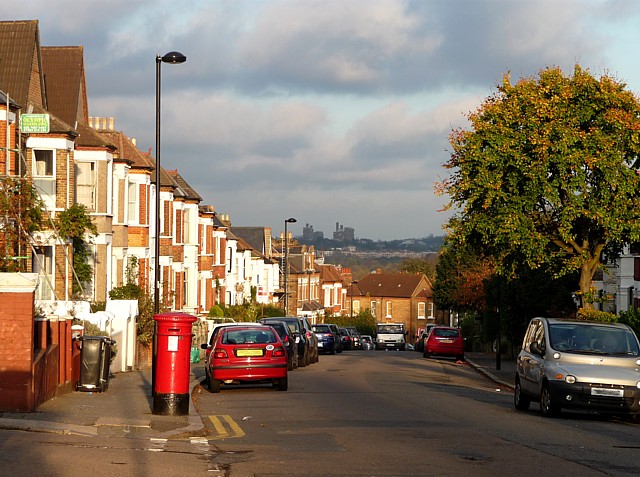
A school building here is almost all that's left of a Jewish orphanage that once stood in this corner of West Norwood. The road itself is a short, steep climb from the station, lined with Victorian terraces, and that quiet brick school set back from the pavement is the one building with a story to tell.
Underneath the terraces lies open farmland: fields of the St John's Lodge estate once stretched from Knights Hill across to where Wolfington Road now runs. That older, rural layer is easy to miss beneath the brick — but it is there, waiting in the road's name for an explanation the records consulted here do not give.
Name Origin
A Name Without a Paper Trail
Wolfington Road's name is not explained in the sources used here. No document consulted ties it to a person, a place, or an estate owner.
What can be said is where the name appears: attached from the late 19th century to a row of new houses climbing the hill above Knights Hill, on ground that had previously been open fields belonging to the St John's Lodge estate.
History
From Fields to Terraces and a Jewish Orphanage
Fields once ran here, part of the St John's Lodge estate's land stretching from Knights Hill across to the line Wolfington Road would later follow.
By the late 19th century that ground carried new housing. Nos. 2–8 are two pairs of houses from this period, each pair given its own bay-window design. Nearby, No. 62 Knights Hill turns a broad corner onto Wolfington Road, tying the new street into its older neighbour.
The most significant building to rise on the road was institutional rather than residential: a home built as part of a Jewish orphanage complex. Sources disagree slightly on its date: the West Norwood Conservation Area appraisal records it as built in 1910 as the Arnold and Jane Gabriel Home, while Lambeth's Local Heritage List dates it to 1907. Either way, it is one of the last surviving fragments of the orphanage complex that once stood here.
Culture
The Original Harris
St Julian's School remains the most notable building on the road: a locally listed, red-brick building with Edwardian detailing, carrying a large, contemporary rear extension.
People
A Photo-Engraver and His Fictional Double
Carl Hentschel brought his photo-engraving business to Wolfington Road. He is remembered today chiefly for a role he never performed in life: Jerome K. Jerome drew on him directly to create the character of Harris in Three Men in a Boat, one of English comic literature's best-known travelling companions.
The "Harris" of Three Men in a Boat was based on a real man, Carl Hentschel, who ran his photo-engraving works on Wolfington Road.
Recent Times
The School Grows On
St Julian's School continued to adapt its 20th-century building. In 2012, the former orphanage structure was successfully extended to the rear.
Today
Terraces, a School, and an Unexplained Name
Wolfington Road today is a quiet residential climb. St Julian's School, red brick and locally listed, is the one building here that carries a story of its own — a surviving fragment of an orphanage, and of a hill whose own name still goes unexplained.
On the Map
Wolfington Road Then & Now
Frequently Asked Questions
Why is it called Wolfington Road?
The sources used here do not explain the name. It appears attached to houses built on former farmland from the late 19th century, but no record consulted gives its origin.
What is Wolfington Road known for?
It is best known for St Julian's School, a locally listed building and one of the last surviving fragments of a 19th-century Jewish orphanage complex, and for its link to Carl Hentschel, the real-life model for Harris in Three Men in a Boat.
What is St Julian's School on Wolfington Road?
A locally listed red-brick building in the Arts and Crafts style, built around 1907–1910 as part of a Jewish orphanage, the Arnold and Jane Gabriel Home or House, and extended to the rear in 2012.