Time Walk
A Stitch Between Two Main Roads


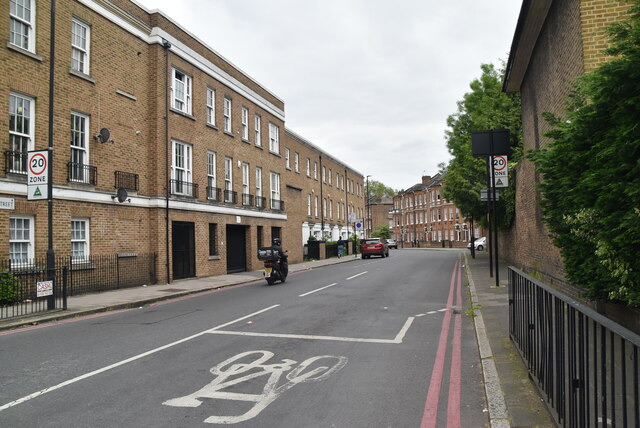
This was never a destination — it was a shortcut. From the 1820s it gave a direct link between the Brixton and Clapham Roads and Camberwell New Road. Walking it today, the eye is drawn first to the old pub building on the corner, and then to the flats further along.
Beneath the modern housing, the street still does the job it was cut for two centuries ago: a quiet connector rather than a main road in its own right. That plain, practical origin is all the sources have to say about why it exists at all — which brings us to its name.
Name Origin
A Name Without an Explanation
No source consulted here explains who or what Caldwell Street was named for. It appears in the record simply as a functional link road from the 1820s, one of the new streets threading across the former Lambeth Wick estate as it was developed.
History
From Georgian Terrace to Edwardian Pub to Council Flats
The street's built history is really the story of its corner. In 1906 the Russell Hotel rose at the junction of Brixton Road and Caldwell Street, a three-storey Edwardian pub with square bay windows, black marble columns, a steeply pitched tiled roof with tall chimneys, and striking Art Nouveau signage and lamp fittings. A rendered annex was later added to the rear of No. 112 Brixton Road, fronting onto Caldwell Street.
The Russell Hotel's Art Nouveau signage and lamp fittings were singled out as outstanding by Lambeth Council's own character assessment of the area.
Further along, change came in the 1950s. A late Georgian terrace at Nos. 120-124 was demolished in 1955 and replaced by Apollo Court, flats built by Lambeth Metropolitan Borough Council as part of the Caldwell Gardens Estate to the west. The Russell Hotel itself closed around 2000, ending nearly a century of trade at the corner it had anchored since 1906.
Today
Flats Where a Terrace and a Pub Once Stood
The street today is largely residential. Apollo Court stands where the Georgian terrace once did, part of the wider Caldwell Gardens Estate. At the Brixton Road corner, the old Russell Hotel building still carries its ornate façade and Art Nouveau fittings, even though the pub itself closed around 2000. The street remains, as it began in the 1820s, a short connecting link rather than a destination.
On the Map
Caldwell Street Then & Now
Frequently Asked Questions
Why is it called Caldwell Street?
The sources used for this page do not explain the origin of the name. It is first recorded as a link road connecting the Brixton and Clapham Roads with Camberwell New Road from the 1820s.
What is Caldwell Street known for?
Its best-known building is the former Russell Hotel, an Edwardian pub of 1906 at the corner with Brixton Road, noted for its ornate Art Nouveau signage and fittings. It closed around 2000.
What replaced the Georgian terrace on the street?
A late Georgian terrace at Nos. 120-124 was demolished in 1955 and replaced by Apollo Court, four-storey council flats built as part of the Caldwell Gardens Estate.