Time Walk
Under the Viaduct, Beside the Tower


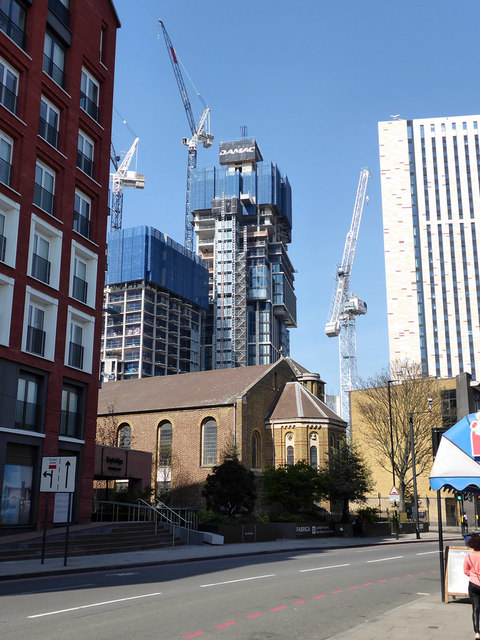
A merchant couple laid this street out in 1778, and a glass tower now rises 170 metres above it. Walking it today, three things stand out: the railway viaduct alongside, a run of older brick buildings, and that tower overhead.
Beneath the tower's shadow, a street built for a "neat residential area" of merchants' houses is still legible in its line, even if almost nothing of that first development remains to see. The street's current name hides an older one.
Name Origin
John and Sarah Bond's Street
Bondway was once simply Bond Street. In 1766, John Bond of Crutched Friars, a merchant, and his wife Sarah bought land in Vauxhall from Emma Miles, land that had previously belonged to John Plumer and William Freeman.
Twelve years later, in 1778, the Bonds obtained a building Act and laid out four streets on their new holding — Bondway, Miles Street, Parry Street and Wyvil Road — intended as a neat residential area. The street was named for its developers rather than any feature of the ground. According to Sheila Fairfield's The Streets of London (Papermac, 1983), Bondway is named after these late 18th-century developers, John and Sarah Bond.
History
From Merchants' Gardens to a Lodging House
The houses the Bonds' building leases produced on Bondway came with long gardens, a mark of the genteel residential street they intended. That character did not last. By 1879 the timber merchants William Bloore and son had already been established on Bond Street, later moving a short distance to No. 57 South Lambeth Road, where the firm remained. Industry had arrived where houses once stood.
In the 1950s the Survey of London described Bondway as running parallel to the railway viaduct, from South Lambeth Place south to Miles Street — the shape the street still holds. A five-storey brewery for Plowman, Barrett & Co. was built at No. 71 in 1885, standing on ground where a tower now rises. In 1892 Harry Bell Measures designed Rowton House on Bondway, the first of a chain of lodging houses for working men sponsored by the philanthropist Lord Rowton, built to replace the squalid lodging houses of the day.
Bondway once housed a five-storey brewery, built in 1885 for Plowman, Barrett & Co. at No. 71 — the very address where a 50-storey, 170-metre glass skyscraper now stands.
Culture
A Shilling for a Cubicle
Rowton House was the first building specially designed as a common lodging house for men whose work was irregular, built around a central courtyard. Decades later, Orwell gave the chain its most quoted description.
"splendid buildings"George Orwell, Down and Out in Paris and London, 1933
People
Builders, an Architect, a Writer
John Bond of Crutched Friars and his wife Sarah set the street in motion, buying the land in 1766 and obtaining the Act in 1778.
More than a century later, the architect Harry Bell Measures gave the street its most distinctive building, designing Rowton House for Lord Rowton's scheme to house working men decently for a shilling a night. George Orwell stayed among that chain and later wrote of the "splendid buildings" it provided, cubicle and bathroom included.
Recent Times
From Soup Run to Skyscraper
Bondway's name attached itself to a homelessness charity before it attached itself to a skyscraper. A soup run operating on the street was passed to the Bondway organisation in 1980, and by 2001 Bondway Housing Association was running a Central London Street Outreach Team.
Then came the tower. Apartments in the 50-storey DAMAC Residential Tower at 69-71 Bondway went on sale in July 2015, with every Thames-facing flat pre-sold. Originally due by 2020, the 170-metre building finally opened in June 2022.
Today
One of the Last Coherent Rows
Bondway's buildings are now described as one of the last coherent groups of Vauxhall's older commercial streetscape, a run of brick buildings four to six storeys high. Among them stand a former bank, Rowton House, and a narrow Dutch-style block from the 1880s, along with a former Elephant & Castle public house and an adjacent former bank building. Vauxhall bus station occupies part of the street, and South Lambeth Place links it through to South Lambeth Road.
Above it all now stands the tower the Bonds could never have imagined — on the same ground their building Act first opened up in 1778.
On the Map
Bondway Then & Now
Frequently Asked Questions
Why is it called Bondway?
It is named after John and Sarah Bond, a merchant couple who bought the land in 1766 and laid the street out, originally as Bond Street, under a building Act of 1778.
What is Bondway known for?
Rowton House, the first of Lord Rowton's lodging houses for working men, opened here in 1892 and was later described by George Orwell as "splendid buildings"; the street now also carries a 50-storey residential tower.
Was Bondway always called that?
No — the street was originally named Bond Street, after its developers, before becoming Bondway.
What stands on Bondway today?
A row of Victorian-era brick buildings including a former bank and Rowton House, Vauxhall bus station, and the 170-metre DAMAC Residential Tower at Nos. 69-71.