Time Walk
The Old Road to Dover


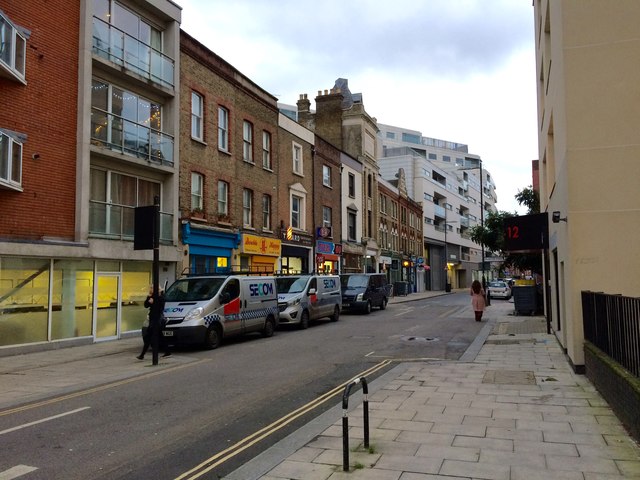
For centuries this was the main road from London to Dover. You would not guess it now. Tabard Street is a quiet backstreet, where Tabard Gardens opens a green square among blocks of housing and the tower of St George the Martyr stands just off its north side. The traffic left two hundred years ago, for the new road built alongside to relieve it.
It was called Kent Street then, and it followed the line the Romans had laid out. Its present name is borrowed from the Tabard, the inn nearby where pilgrims met for Canterbury and which Chaucer put into The Canterbury Tales. By the time the street took the name, the inn was already gone.
Name Origin
A Street Named for a Building It Never Met
The street takes its name from an inn that had already vanished by the time the name was applied. Until 1877 this was Kent Street, the ancient road leading out of London toward Kent and the Channel ports, a name it had carried for centuries as part of the main route to Dover. In that year the London authorities renamed it Tabard Street, after the Tabard, a public house that had stood nearby and had itself been pulled down around 1875.
The Tabard was no ordinary tavern. An inn of that name is thought to have been established on the site around 1306 or 1307, and by the late fourteenth century it was well known as a gathering point for pilgrims heading to the shrine of Thomas à Becket at Canterbury. The building was renamed the Talbot around the seventeenth century, was rebuilt after the great Southwark fire of 1676, and finally came down in 1874 or 1875 — only a couple of years before its name was transferred to the street itself.
So Tabard Street commemorates a building it barely overlapped with: the inn was gone before the street bearing its name existed. The older name, Kent Street, simply described where the road went; the newer one preserved the memory of where travellers had once set out from.
History
From Roman Crossroads to Slum Clearance
Long before it had any name at all, this ground lay on the edge of a much larger medieval estate. The Great Liberty Manor extended south as far as this road and the Old Kent Road beyond it, and scattered Roman burials have been found on either side of the street, evidence of activity here since the first centuries AD. The junction where Kent Street met Borough High Street may itself have started as a hamlet where the Roman roads now known as Stane Street and Watling Street crossed, and by the eleventh century the corner was occupied by property belonging to the de Ardern family, probably acquired from Canterbury after 1086.
By the sixteenth century the road was busy enough to need official attention. An Act of Parliament in 1565 ordered that Kent Street be paved with hard stone as far as the Lock Hospital, a leper hospital that stood on the street's west side near the first milestone from London Bridge. Its importance came from its position: this was the main highway out of London Bridge toward Kent, carrying traffic that had nowhere else to go.
Writing in 1720, John Strype described Kent Street's inhabitants as broom men and mumpers, with large yards for storing birch, heath and broom staves — the trade of a road serving carters and casual dealers rather than gentry. During the Civil War, eighty years earlier, the Lines of Communication fortifications had crossed the road's northern end on what is now the Old Kent Road, a reminder of how exposed this edge of the city once was.
Kent Street's status as the main road to Kent ended when a turnpike scheme, begun around 1750, gradually diverted traffic onto a new road to the north. Great Dover Street, built as that bypass, took over through traffic after 1814, leaving Kent Street to decline into a backstreet. The street was later extended through the churchyard on the north side of St George the Martyr church, altering its route further. No real clearance happened until 1887, when the Metropolitan Board of Works swept away four courts of old tenements on the west side, and the London County Council went much further in 1910, razing most of the east side under a major slum clearance scheme.
The Tabard Inn's name was not lost for long — the inn was demolished in 1874 or 1875 and the street took its name in 1877.
Culture
Chaucer's Pilgrims and a Roman Plaque
The street's most famous association belongs to an inn. The Tabard was already a well-known meeting point for Canterbury-bound pilgrims when Geoffrey Chaucer put it into his Canterbury Tales in the late fourteenth century. The inn survived — renamed, rebuilt, and eventually demolished — for another five hundred years after Chaucer wrote about it, a run of continuity remarkable for a Southwark tavern.
Today the street's public house is the Royal Oak, standing on Tabard Street itself, where the Players' Theatre Club still puts on music hall shows. St George the Martyr's church stands just off the street's north side, its churchyard separated from Tabard Street by the road's later extension through it — a small sign of how casually Victorian planners cut through old ground. Close by, Tabard Gardens gives the street its most visible amenity, a park carved out of the 1910 clearance and opened in 1929.
People
A Benefactor, an Antiquarian, a Martyr, an Architect
Four very different lives brush against this street's history. In 1617, John Bingham gave tenements in Kent Street to endow two scholarships at the university, a small act of civic generosity on a road better known for poverty than philanthropy.
A century later, the antiquarian John Strype walked the same road and found little to admire, describing in 1720 a population of broom men and mumpers living among yards stacked with birch and heath staves — an unusually vivid glimpse of who actually lived on Kent Street at the time.
Centuries earlier still, the street had witnessed something far grimmer. John Jones, a Franciscan priest, was executed in Southwark on 12 July 1598, and his dismembered remains were fixed atop poles along the road leading toward Newington — the road now represented by Tabard Street.
The street's twentieth-century transformation had its own named figure. Charles Winmill, an architect born in 1865 and active until his death in 1945, was involved in the slum clearance and replanning that reshaped the Tabard Street area, part of a career spent unpicking some of London's poorest streets.
Recent Times
Clearance, a Park, and Two Listings
The twentieth century remade Tabard Street's surroundings more than the street itself. The London County Council's 1910 clearance of the east side was followed, after a long gap, by the opening of Tabard Gardens in 1929, giving the area a park where courts and tenements had stood. Charles Winmill's replanning work sat within this era of civic improvement, part of a wider effort to clear what had by then become notorious slum housing around the street.
Some of the surviving buildings have since been formally recognised. The Tabard Street Centre, the former Tabard Street School, was listed Grade II in 1996, and No. 19 Tabard Street followed with its own Grade II listing in 2010. Between the Victorian clearance of 1887 and the twentieth-century rebuilding, the street's fabric has been renewed piecemeal rather than all at once, leaving a scatter of older buildings among newer housing.
Today
Still the Road Kent Street Left Behind
Tabard Street today is a quiet residential road bookended by bigger neighbours. Tabard Gardens still gives it a patch of green, and the Royal Oak still trades on the street itself. Just south of its junction with Borough High Street, the site of the old Marshalsea prison is now occupied by Southwark's John Harvard Library, and the brick wall that once marked the prison's southern boundary still stands, separating the library site from St George the Martyr's churchyard.
It is a street that has spent its whole life being renamed and rerouted, yet never quite disappearing — Kent Street's traffic is long gone, but its ground, and the memory of the inn that replaced its name, remain.
On the Map
Tabard Street Then & Now
Frequently Asked Questions
Why is it called Tabard Street?
The street was named in 1877 after the Tabard, a public house that had stood nearby and was demolished in 1874 or 1875. Before that it was known as Kent Street, the old road leading out of London toward Kent and the Dover coast.
What is Tabard Street known for?
It is best known for the Tabard Inn, a medieval pilgrims' inn immortalised in Chaucer's Canterbury Tales, and for Tabard Gardens, a park created after a major slum clearance scheme in the early twentieth century.
What was Tabard Street called before?
It was called Kent Street for centuries, forming part of the main route from London Bridge toward Kent, until it was renamed Tabard Street in 1877 after the demolished Tabard Inn.