Time Walk
Through the Arch, Over a Roman Road


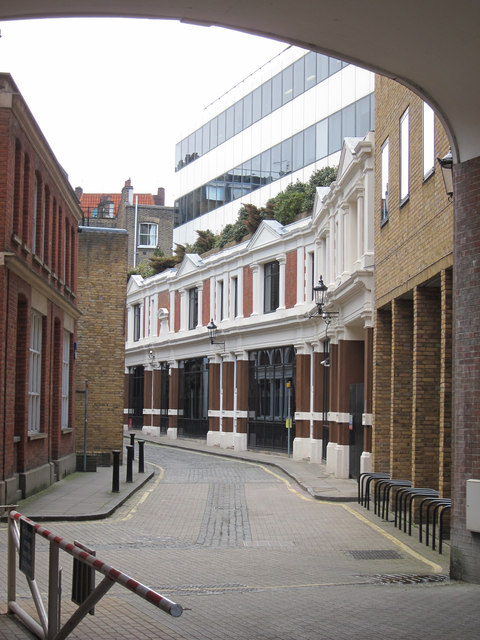
A narrow archway off Borough High Street opens onto a yard built over a buried Roman road. Today a visitor steps from the traffic into a quiet court lined with colonnaded Victorian shopfronts, watched over by the painted bust of Henry VIII on the King's Head pub. The arch and the small scale beyond it still feel like the entrance to an old coaching inn.
Beneath the paving, 19th-century workmen turned up fragments of Roman pavement, and in 1946 the archaeologist Kathleen Kenyon traced a Roman road running under the yard itself. The same ground later housed potters' courts and a hop merchants' gateway before the Blitz flattened almost every building around it. That long, buried memory is folded into the yard's name.
Name Origin
From Pope's Head to King's Head
The yard takes its name from an old tavern sign, not from any reigning king's household. Before the Reformation the inn on this spot was known as the Pope's Head. By 1542 a map of the area already shows it renamed the King's Head, a safer sign in a kingdom that had just broken with Rome. No document explains the change outright, but the timing speaks plainly enough: a Pope's Head quietly became a King's Head in the same years Henry VIII declared himself head of the English Church.
The new name stuck fast. It passed down through owners and tenants for more than three centuries, and the yard running back from the inn's gateway took its name along with it. Even after fire, bombing and rebuilding erased almost every physical trace of the original Pope's Head, the sign — and the king it now honoured — survived on the Victorian pub that still stands here, its bust of Henry VIII a visible reminder of why the name changed at all.
History
Owners, Fires and a Buried Roman Road
Ownership of the King's Head passed through some notable hands. At the start of Elizabeth's reign it belonged to Thomas Cure, who later founded Cure's College nearby. The property passed to the Humble family in 1588, and by 1647 it belonged to Humble Ward, Baron Ward. In 1676 the Borough fire burnt the inn to the ground; part of what rose afterward survived until as late as 1885.
The inn's standing drew official business too: in 1699 the court of the Surrey and Kent Sewer Commission met inside its walls. St. Thomas's Hospital owned the King's Head through the 18th century, when it was leased first to Henry Thrale and later to the brewers Barclay Perkins and Co.
Workmen digging in King's Head Yard in 1879-80 uncovered tessellated Roman pavements — evidence that someone had been living on this exact spot while Roman Southwark still stood.
Archaeology kept returning to the same ground. Diggers in 1879-81 found Roman pavements and the remains of an inhabited building on the inn's site, and in 1946 Kathleen Kenyon traced a Roman road running beneath the yard. Through the 19th century the Doulton pottery firm and James Stiff gradually bought up the surrounding courts and alleys, many themselves built over earlier potteries, and King's Head Yard became part of that industrial patchwork. War brought the heaviest change of all: in 1940 enemy action destroyed practically every building in the yard and in the streets to either side of it.
Culture
A Hop Merchants' Gateway
The King's Head pub itself is listed, dated 1881, and carries a Grade III-listed bust of Henry VIII on its front. Behind the Borough High Street offices stands the elaborate gateway, a surviving relic of LeMay's Hop Factors. On the yard's north side, two-storey colonnaded commercial buildings from the 19th and 20th centuries still frame the approach. Passing under the archway from Borough High Street still feels, as it should, like entering an old inn yard rather than a modern street.
People
Cure, Ward, Thrale and Kenyon
Thomas Cure owned the King's Head at the start of Elizabeth I's reign; he went on to found Cure's College, a charitable almshouse. The property passed in 1588 to the Humble family, and by 1647 it belonged to Humble Ward, Baron Ward — a peer's name attached to a Borough tavern.
In the 18th century the inn was leased to Henry Thrale, during the long span when St. Thomas's Hospital held the freehold; later the lease passed to the brewers Barclay Perkins and Co.
The yard's most recent named visitor came armed with a trowel rather than a lease. In 1946 the archaeologist Kathleen Kenyon traced the line of a Roman road running beneath King's Head Yard, adding one more layer to a site that had already given up Roman pavements in the 1880s. In the 19th century James Stiff, working with the Doulton pottery firm, bought up the ground around the yard as part of a wider purchase of the old pottery courts nearby.
Recent Times
Bombed, Bought and Built Over
The 20th century brought two sweeping changes. In 1922 Guy's Hospital bought the frontage of King's Head Yard, extending its holdings back to the yard's north side — sparing only the Grapes. Then came the war: in 1940 enemy action destroyed practically every building in the yard and in the streets either side of it.
What survives today is largely a post-war and Victorian fabric, rebuilt around the old line of the yard rather than a continuation of the buildings that Thomas Cure or Henry Thrale would have known. The King's Head pub itself, however, is a 19th-century survivor, dated 1881, that long predates the bombing and still carries the old name forward.
Today
Still an Inn Yard at Heart
King's Head Yard today works mainly as a passage. Together with White Hart Yard, it gives pedestrians a direct link between Borough High Street and Guy's Hospital. The colonnaded buildings on its north side, the hop factors' gateway behind the offices, and the King's Head pub with its bust of Henry VIII are what a walker actually sees. Little of what stood here under Thomas Cure or Humble Ward remains above ground, but the shape of the yard, the arch from the main road, and the name itself have outlasted fire, war and redevelopment alike.
On the Map
King's Head Yard Then & Now
Frequently Asked Questions
Why is it called King's Head Yard?
The yard is named after the King's Head, a tavern on Borough High Street that before the Reformation was known as the Pope's Head. By 1542 it appears under its new name, a change that lines up with Henry VIII's break with Rome.
What happened to King's Head Yard in the Second World War?
In 1940 enemy action destroyed practically every building in King's Head Yard and in the streets on either side of it. Much of what stands there today, including the colonnaded buildings on its north side, dates from after that destruction or survives from the 19th century.
What is King's Head Yard known for?
It is known for the King's Head, a listed 1881 pub with a bust of Henry VIII, for a surviving hop factors' gateway behind its offices, and for Roman remains — including a road traced beneath it in 1946 — found on the site.