Time Walk
A ridge road between three boroughs


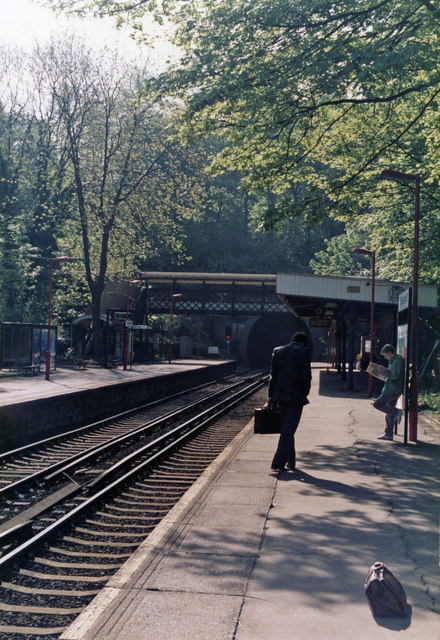
Sydenham Hill runs along the crest of a wooded ridge, its route quietly doing double duty as an administrative boundary: Wikipedia's account of the area notes that the road marks the meeting point of the London Boroughs of Southwark, Bromley and Lewisham. Heading southwest, it links the A205 at Forest Hill to the A212 at Crystal Palace. Buses 202, 356, 363 and the night route N63 run its length, with the 450 serving Fountain Drive just off it. Below the road on its west-facing slopes, in the Borough of Southwark, sit Sydenham Hill Wood nature reserve and the Dulwich and Sydenham Hill Golf course — green survivals of the estates that once lined the hill. Sydenham Hill railway station, reached from the private College Road, has a second entrance inside the Kingswood Estate, a reminder that much of this ridge remains laced with private roads and hidden approaches rather than open streets.
Name Origin
From a drunkard's settlement to a ridge road
Sydenham Hill is named for Sydenham, the settlement in the valley below, and Sydenham's own name is one of London's more colourful etymological puzzles. Lewisham Council's conservation area appraisal records that the name is possibly derived from the Anglo-Saxon "Cippas", meaning something close to a drunkard's settlement — an origin the council's own appraisal treats as probable rather than certain. Early recorded variations of the name include Syphenham, Sibbenham and Cippenham, spellings that shifted over centuries before settling into the modern form. The same appraisal traces the wider area's origins to the 6th century, when Saxon or Jutish farmers pushing south from Lewisham and the Thames are thought to have cleared forested land along the banks of the River Pool.
By the time the ridge itself needed a name distinct from the village below, "Hill" was simply appended to mark the high ground — the road that runs along the northeastern part of that ridge, as Wikipedia's account has it, connecting Forest Hill to Crystal Palace. The earliest dated reference the record offers to "Sydenham Hill" specifically as a place comes from 1852, when, according to the Lewisham appraisal, Crystal Palace was slated to be re-erected there after its move from Hyde Park — by which date the ridge already carried the name that would define the roads, villas and railway works built along it for the rest of the century.
History
Villas, railways and a vanished village
By 1835, the Lewisham conservation appraisal notes, Sydenham was still a charming Kentish village of farms, cottages and a scattering of grand houses — a rural character that the arrival of Crystal Palace on the ridge in the 1850s would upend. The area's older history reached back further still: the Old House, formerly Brookehouse Farm, was sold in 1713 to Edward Hodson, a wine merchant who added to its lands and rebuilt the house, and in 1786 the bulk of the Old House Estate passed to Mayow Wynell Mayow, a lawyer. The Old House itself stood on a site the appraisal locates roughly behind what are now the shops at 85–95 Sydenham Road.
The ridge's transformation into a residential enclave came in the second half of the 19th century, when, Wikipedia records, a run of large villas rose along Sydenham Hill — among them The Wood (1840), Beltwood House (1851), Highfield (1855), Dulwich Wood House (1858), Grange Court (1861), Dilkhoosh, later Fountain House (1864), Castlebar (1879), The Cedars (1894) and Sydenham Hill House (1898), each set in its own grounds on the newly fashionable hill. Rail infrastructure followed the houses: in 1863 the London, Chatham and Dover Railway opened its Chatham Main Line, driving a 1.2-mile tunnel through the hill from College Road to a point below the Brighton Main Line at Penge. A second line, serving Crystal Palace with a new Upper Sydenham station on the ridge's southern edge, opened in 1884. Meanwhile Mayow Wynell Adams, the Old House's final occupant, worked with architect Alexander Gordon Henell to lay out Mayow Road, Dacres Road and Inglemere Road on the northern part of the family estate, and in 1878 sold land for what became Mayow Park, originally the Sydenham Recreation Ground.
The disused railway tunnel that once carried trains to Crystal Palace still runs beneath Sydenham Hill Wood, sealed since the line closed in 1954.
Culture
A writer's childhood hill
Beyond that literary footnote, the ridge's cultural interest today lies mostly in what survives of its Victorian and industrial past. Sydenham Hill Wood, occupying the west slopes in Southwark, preserves fragments of the grounds of the vanished villas alongside the sealed Crystal Palace railway tunnel, while the neighbouring golf course occupies more of the same historic estate land. Two small structures on the road itself carry statutory protection: Historic England's list entry records a Grade II listed K2 telephone kiosk on the corner of Sydenham Hill, and a separate Grade II listing covers the Sydenham Hill Community Hall and its retaining walls — modest survivals that anchor the street's Victorian character amid later development.
People
Merchants, lawyers and a builder of roads
The people most closely tied to Sydenham Hill's documented history are less household names than local improvers. Edward Hodson, a wine merchant, bought the Old House — then still known as Brookehouse Farm — in 1713 and rebuilt it, expanding its lands in the process, the Lewisham conservation appraisal records. Ownership passed in 1786 to Mayow Wynell Mayow, a lawyer who acquired the bulk of the Old House Estate and whose family name would come to mark several roads on the ridge. It was Mayow Wynell Adams, described in the same appraisal as the Old House's final occupant, who did the most to reshape the northern part of the family estate: working with architect Alexander Gordon Henell, he laid out Mayow Road, Dacres Road and Inglemere Road, replacing fields and meadow with substantial villas, and in 1878 sold further land that opened as Sydenham Recreation Ground, now Mayow Park.
The one figure with a claim to wider cultural memory is the writer Joseph Ashby-Sterry, born into a family living on Sydenham Hill around 1836 or 1838, according to Wikipedia's account — a detail that places a literary life directly among the villas and grounds built along the ridge in the same decades.
Recent Times
From railway to nature reserve
The most decisive change to Sydenham Hill's 20th-century landscape came in 1954, when the Crystal Palace railway line closed, according to Wikipedia's account of the area, leaving its tunnel sealed beneath what is now Sydenham Hill Wood. The wood and the adjoining Dulwich and Sydenham Hill Golf course, both on the ridge's west slopes in Southwark, effectively preserved much of the grounds of the great Victorian villas after the houses themselves were lost, giving the hill a quieter, greener character than its 19th-century density of mansions might suggest. Two structures received formal recognition in the late 20th century: Historic England's list entries date the listing of the K2 telephone kiosk on the corner of Sydenham Hill to 1987, and the Sydenham Hill Community Hall and its retaining walls to 1998, both Grade II. Sydenham Hill station, still reached via the private College Road and a second entrance within the Kingswood Estate, continues to serve the ridge, while bus routes 202, 356, 363, the N63 night service and the 450 (for Fountain Drive) maintain the surface connections that the railway once dominated.
Today
Boundary, woodland, ridge road
Sydenham Hill today functions much as it has for over a century: a boundary road as much as a residential one, carrying traffic between Forest Hill and Crystal Palace while marking where Southwark meets Bromley and Lewisham. Its west-facing slopes remain given over to Sydenham Hill Wood and the golf course rather than housing, a legacy of the Victorian estates that once filled the ridge. The private College Road and the Kingswood Estate still control access to the railway station, and small listed survivals — a K2 kiosk, a community hall and its retaining walls — punctuate a road whose grander 19th-century villas have largely disappeared, leaving the wood and the sealed tunnel beneath it as the clearest physical memory of that era.
On the Map
Sydenham Hill Then & Now
Frequently Asked Questions
Why is it called Sydenham Hill?
It's named for Sydenham, the settlement below the ridge. Lewisham Council's conservation appraisal notes the name is possibly derived from the Anglo-Saxon "Cippas", roughly meaning a drunkard's settlement, with early forms including Syphenham, Sibbenham and Cippenham; "Hill" marks the ridge road itself.
What is Sydenham Hill known for?
Its Victorian villas (mostly now vanished), Sydenham Hill Wood with its sealed Crystal Palace railway tunnel, the neighbouring golf course, and its position marking the boundary of Southwark, Lewisham and Bromley.
Is there a railway tunnel under Sydenham Hill?
Yes — two, in fact. The 1863 Chatham Main Line runs through a 1.2-mile tunnel beneath the hill, still in use, while the 1884 Crystal Palace line's tunnel was abandoned when that line closed in 1954 and now lies within Sydenham Hill Wood.