Time Walk
A Suburban Road With an Unlikely Guest List


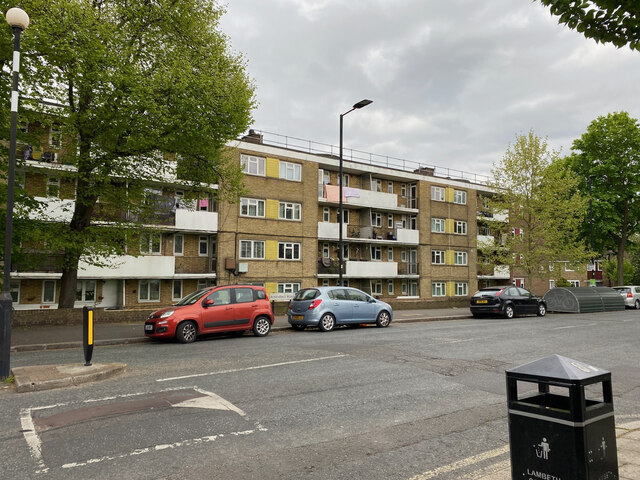
A quiet West Dulwich road once sheltered a wartime codebreaker and launched a comedy-rock band. Walking it today, you pass red-brick Peabody cottages with picket-fenced gardens, a church tower rebuilt after bomb damage, and a run of shopfronts still serving the neighbourhood.
Underneath the Victorian terraces lies an older landscape: a demolished seventeenth-century mansion, and farmland sold off after a lord's death. That deeper layer is where the road's own name begins.
Name Origin
Not a Valley of Roses
The name is not firmly settled in the sources used here. Norwood Street Histories argues it is "more likely" a tribute to the Rosendale family, early landowners in the medieval manor of Leigham, rather than a poetic reference to a valley of roses.
A mansion called Rosendale Hall once stood nearby, built in 1658 by William Sancroft, a member of a Royalist family that flourished through the Interregnum and the Restoration. It survived into the twentieth century before being demolished to make way for denser housing.
The road itself followed the break-up of the Thurlow estate. After Lord Thurlow's death in 1806, much of his Norwood land passed to London businessmen, and in 1844 his trustees drew up a development plan — after enfranchising 156 acres — that included building Rosendale Road, though only as far south as Park Hall Road.
History
Churches, a School, and a Philanthropist's Estate
Two railway companies crossed the new road before much building reached it. The London, Brighton and South Coast Railway built an iron bridge over Rosendale Road, engineered by R. J. Hood, on its Peckham-to-Streatham line opened in 1868, and the London, Chatham and Dover Company followed with a brick bridge for its Herne Hill–Tulse Hill line in 1869.
Churchgoers came first to a temporary iron church in the 1880s, serving the growing West Dulwich district. In 1887 the West Dulwich New Church Building Committee proposed a permanent church, and the Estates Governors of Dulwich College promised a site. The foundation stone of All Saints' Church was laid by the Bishop of Rochester on 31 October 1888, and the completed portion opened under licence exactly three years later. Designed by George Fellowes Prynne, it cost around £16,000, raised entirely from local gifts, and was consecrated on 13 November 1897, with a Consolidated Chapelry formed in 1899. It was originally intended as the cathedral for south London.
A separate Congregational chapel had opened earlier still: its foundation stone was laid on 7 October 1851 by the Rev. J. Burnet. It quickly proved too small, and in 1855 a larger chapel opened at the corner of Chancellor Grove and Park Hall Road, incorporating the original foundation stone in its fabric. That building was destroyed by enemy action during the Second World War, as was part of All Saints', which was restored in 1952 with a new belfry designed by J. B. S. Comper.
Education arrived at the same pace. The site for Rosendale Primary School was bought in 1894 for £2,800, over the objections of nearby residents who protested it would depreciate property values, claiming there were "no poor children anywhere near". Temporary iron buildings for 360 children opened in January 1897; the permanent school, designed by T. J. Bailey and built by Treasure and Son of Holloway for £15,589, opened on 8 January 1900 with room for 476 children and 276 infants.
Housing followed on a grand scale. George Peabody, an American philanthropist born in 1795, had set up the Peabody Trust in 1862 with a £500,000 donation "to ameliorate the condition of the poor and needy of this great metropolis and to promote their comfort and happiness." The Trust's first Rosendale Road flats, designed by William Cubitt and Co., went up in 1901; 82 cottages followed in 1905, and a further 64 designed by W. E. Wallis in 1907-8, with a communal hall added in 1913.
"to ameliorate the condition of the poor and needy of this great metropolis and to promote their comfort and happiness"George Peabody, 1862
All Saints' Church on Rosendale Road, consecrated in 1897, was originally intended to serve as the cathedral for south London — a grand ambition for a parish church on a suburban West Dulwich street.
Culture
Where a Comedy Band and a Wireless Museum Found a Home
The band mixed music hall, trad jazz and psychedelia with surreal humour and art-school irreverence, and came to wider attention through appearances in the Beatles' 1967 film Magical Mystery Tour and the 1968 ITV show Do Not Adjust Your Set.
Further along, at No. 23, the British Vintage Wireless and Television Museum holds a large collection of old radios and televisions, open by appointment only.
People
An Impressionist's Mother, an Instrument Maker, and a Codebreaker
Camille Pissarro, the Impressionist painter, lived in Lower Norwood and studied its mist, snow and springtime light; his widowed mother Rachel, born in 1795 and dying in 1889, lived on Rosendale Road itself.
Arnold Dolmetsch settled at 'Dowlands', 172 Rosendale Road, while teaching music at Dulwich College. Inspired by historic instruments he had seen in the British Museum, he built his first reproduction lute in 1893 and his first harpsichord in 1896 — a project encouraged by William Morris and shown at that year's Arts and Crafts exhibition — before founding his instrument workshop in Haslemere.
At 193 Rosendale Road, English Heritage unveiled a blue plaque in May 2024 to Joan Clarke, who had lived there as a child. Clarke worked in Hut 8 at Bletchley Park alongside Alan Turing during the Second World War and became the only female practitioner of Banburismus, a codebreaking technique.
Recent Times
Residents Vote for Protection
Residents pushed for formal recognition of the street's Victorian character. Lambeth's committee agreed to propose conservation area designation in October 1993, and a petition of 75 residents from Rosendale Road and Carson Road backed the move in September 1994, with a single objection.
Consultation followed in February 1995: of 17 Rosendale Road addresses that replied, 16 favoured designation, and a further petition of sixty Dalmore Road residents supported it that same month.
Today
West Dulwich's Second Parade
Rosendale Road still carries one of West Dulwich's two shopping parades, the other being at the Park Hall Road junction.
At the top of the road, the Peabody Hill estate's allotments sit on the western side of Tulse Hill, a quiet survival from the estate's early-twentieth-century planning. From a wartime codebreaker's childhood home to a comedy band's birthplace, this ordinary suburban road keeps turning up extraordinary names.
On the Map
Rosendale Road Then & Now
Frequently Asked Questions
Why is it called Rosendale Road?
The sources used here do not settle it firmly. Norwood Street Histories suggests it honours the Rosendale family, early landowners in the medieval manor of Leigham, rather than meaning "valley of roses". A mansion called Rosendale Hall also stood nearby from 1658.
What is Rosendale Road known for?
Its Peabody Estate cottages, All Saints' Church (once intended as a south London cathedral), and an unusually eclectic list of residents — among them codebreaker Joan Clarke, instrument maker Arnold Dolmetsch, and the founders of the Bonzo Dog Doo-Dah Band.
When was Rosendale Road built?
It was planned in 1844 by Lord Thurlow's trustees, following the 1806 break-up of his Norwood estate. Most of its surviving Victorian houses date from 1885 to 1911.
What is the Peabody Estate on Rosendale Road?
A housing estate built by the Peabody Trust from 1901, with cottages added in 1905 and 1907-8 and a communal hall in 1913 — funded by George Peabody's 1862 philanthropic donation.