Time Walk
Past a Platform That Isn't There

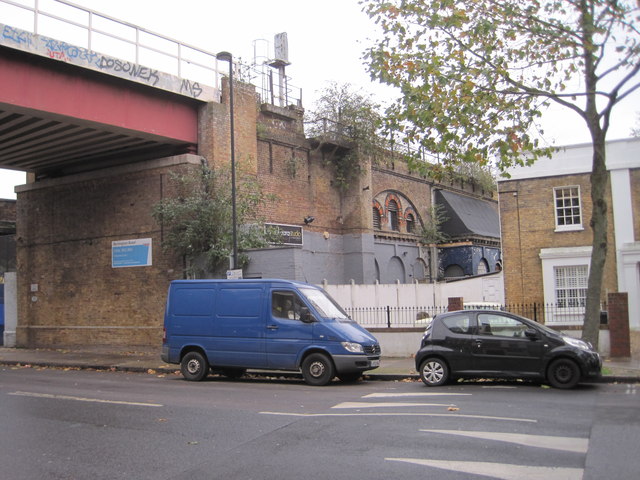
A vanished railway station once had its entrance halfway along this road. Today the street is mostly postwar council blocks, with mid-Victorian houses surviving at its southern corner.
Beneath the flats lies a Victorian speculative estate, laid out on land once belonging to the Lords Holland and named, local tradition holds, for a Royalist baron. That naming is where the real story of the street begins.
Name Origin
A Baron's Legacy, Oddly Named
Barrington Road's name is linked to Henry Hastings, who in 1660, when Charles II was restored to the throne, was created 1st Baron Loughborough. Hastings had commanded Royalist forces in Leicestershire during the Civil War. In the 1660s he was living at Loughborough House, just east of Brixton Road, at the corner of the present Loughborough Road and Evandale Road. That house was rebuilt before 1700 and later used as a boys' boarding school until its demolition around 1854.
Local tradition draws this connection, though it doesn't explain why the street is called Barrington rather than Loughborough itself.
History
From Lambeth Wick Estate to Railway Junction
A grand country estate gave way to speculative streets. The engineer Henry Currey drew up a plan for the layout of St James's Crescent, Millbrook Road and Barrington Road as part of the wider Lambeth Wick estate. Building lots fronting Barrington Road were first offered to the public by advertisement in 1843. Development continued through the 1840s and 1850s under the 3rd Lord Holland, and sections of Barrington Road and neighbouring Loughborough Park from that period survive, aside from later replacements.
A railway station arrived on the street in 1866, when the London, Brighton and South Coast Railway opened Loughborough Park station with an entrance in Barrington Road. The company had itself built both pairs of lines running through here, from Crow Lane junction in Peckham to the Barrington Road junction in Brixton. From 1 May 1867 a steam passenger service on this new South London line connected Victoria and London Bridge to inner south London suburbs including Brixton. The station changed its name more than once, becoming Loughborough Park and Brixton in 1870 and finally East Brixton in 1894. It stood on the east side of the southernmost rail bridge over Barrington Road, near Coldharbour Lane. It closed in 1976.
The long-vanished East Brixton railway station, which once had its entrance on Barrington Road, makes a brief cameo in the background of the 1948 comedy film A Date with a Dream, caught on camera as two soldiers stroll past.
Culture
An Orphanage, a School, and a Walk-On Role
A girls' orphanage once stood where flats rise today.
Numbers 43, 55 and 57 Barrington Road served as the Brixton Orphanage for Fatherless Girls from the 1880s until 1936. A school built in the 1880s to serve the orphanage, College Green Court, was designed by the architect E. J. Tarver. It later became an annex to the Brixton School of Building between 1947 and 1970.
Recent Times
Flats Over the Railway
Council housing reshaped the street after the war. Eleven-storey blocks of the Loughborough estate rose around Barrington Road, part of a broader rebuilding of Loughborough Junction.
Today
What Still Stands
Victorian houses still mark one busy corner. Numbers 59, 61 and 63 Barrington Road, mid-Victorian houses, prominently define the corner where Barrington Road, Coldharbour Lane and Moorland Road converge. A short walk along, the Gresham Baptist Chapel stands at No. 36 Barrington Road.
On the Map
Barrington Road Then & Now
Frequently Asked Questions
Why is it called Barrington Road?
Local tradition links the name to Henry Hastings, created 1st Baron Loughborough in 1660, who lived nearby at Loughborough House. The sources used here do not explain why the street itself is called Barrington rather than Loughborough.
What is Barrington Road known for?
It was home to the former Loughborough Park, later East Brixton, railway station from 1866 to 1976, and to the Brixton Orphanage for Fatherless Girls from the 1880s until 1936. The station also made a brief screen appearance in the 1948 film A Date with a Dream.
When did Barrington Road's railway station close?
East Brixton station, which opened as Loughborough Park in 1866 with an entrance on Barrington Road, closed in 1976, ending a century of rail service on the street.