Time Walk
A Lane Renamed, A Theatre's Back Wall


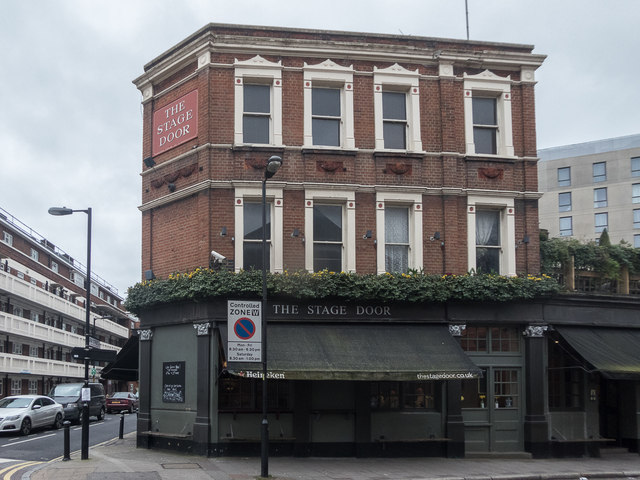
This was once a country lane called Higlers Lane, long before it carried a theatre's shadow. Walking it today, three things stand out: the Old Vic's imposing brick rear, a corner pub called the Stage Door, and a quiet former mission hall set back behind railings.
Underneath the Victorian terraces lies an 18th-century meadow called Chalcroft, once let out as garden ground. That older, rural layer explains how a modest side street ended up with a theatre at one end and a run of long-forgotten pub names along it. The name itself leads somewhere less certain.
Name Origin
From Higlers Lane to Webber Street
The street was known as Higlers Lane as late as 1809, and the name still appears in the 1825 Victuallers' Recognizances. At some point it became Webber Street, the name it carries now. The sources used here do not explain the change, or where "Webber" itself comes from.
History
Chalcroft Meadow to a Carpenter's Development
The ground here was once a meadow called Chalcroft, let out in the 18th century as garden ground.
Between 1818 and 1821 a carpenter named Samuel Short took a lease over the whole property, bounded by Webber Street, the New Cut, and Short Street, and built it up himself. Early pubs show the street settling into ordinary working life soon after: the Angel stood at what was then 1 Webber Street by 1862, and the Halfway House at 29 Webber Street by 1856, both addresses later renumbered as the street filled in. A pub called the Bell Tavern, previously at Friar Street, was given the address 57 Webber Street when the street was renamed.
By the turn of the 20th century the street had taken the form still visible today. A mission hall, now the Waterloo Christian Centre, was built around 1900, and apartment buildings matching those on neighbouring Mitre Road were added around the corner around 1905. In 1998 part of the street, including Nos. 1-7 and the former mission building, was brought within a protected conservation area.
Before it became Webber Street, this road was a country lane called Higlers Lane, laid out across an 18th-century meadow known as Chalcroft that had once been let out as garden ground.
Culture
A Theatre's Back Door
The Old Vic itself turns its back on Webber Street, but it is an imposing back, presenting an elevation of arched red-brick bays to the street.
A short way along, the former London City Mission, now the Waterloo Christian Centre, stands set back behind spiked railings, its original entrance facing Ufford Street rather than Webber Street itself.
People
A Photographer's Childhood Home
Bert Hardy's family home, The Priory, stood on Webber Street. Born in Blackfriars in 1913, the eldest of seven children, he left school at 14 to work for a chemist who also processed photographs. His first real break came in 1935, when he photographed King George V and Queen Mary passing in a carriage during the Silver Jubilee and sold 200 small prints of the picture.
Hardy went on to become one of the defining photographers of Picture Post magazine between 1941 and 1957. He served as a war photographer with the Army Film and Photographic Unit from 1942 to 1946, took part in the D-Day landings in June 1944, and was among the first photographers to enter the newly liberated Belsen. In October 2008, following a popular vote, Southwark Council unveiled a Blue Plaque to him on The Priory.
On the Map
Webber Street Then & Now
Frequently Asked Questions
Why is it called Webber Street?
The street was earlier known as Higlers Lane, recorded under that name in 1809 and in the 1825 Victuallers' Recognizances. The sources consulted here do not explain when or why it was renamed Webber Street.
What is Webber Street known for?
It runs past the rear of the Old Vic Theatre, carries a former mission hall now used as the Waterloo Christian Centre, and was the site of the family home of Picture Post photographer Bert Hardy, marked with a Blue Plaque since 2008.
What stood on the site of Webber Street before it was built up?
The land was originally a meadow called Chalcroft, let out as garden ground in the 18th century, before carpenter Samuel Short leased and developed the area between 1818 and 1821.