Time Walk
A Lord Mayor's name on a Victorian hill


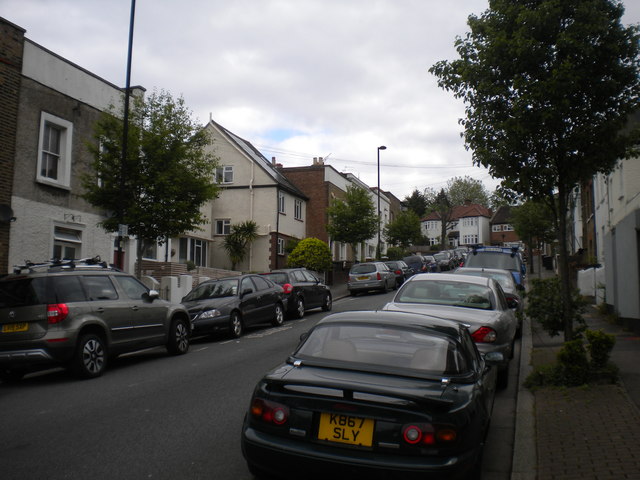
A seventeenth-century Lord Mayor gave his family name to what became one of Lambeth's smartest Victorian addresses. Most of the grand early houses are gone now, replaced by flats, schools and the brick arches of a railway junction. One early villa still stands as a reminder of what the whole hill once looked like.
Beneath the flats and school buildings lies a planned estate of long leases and strict building rules, laid out by one man in the 1820s. That story, and the family name behind it, come next.
Name Origin
The Tulse Family's Hill
The areas now known as Tulse Hill and Brockwell Park correspond roughly with the manors of Bodley, Upgrove and Scarlettes. During the Commonwealth these manors were held by the Tulse family, from whom Tulse Hill takes its name.
The family member most clearly tied to the name is Sir Henry Tulse, Lord Mayor of London in 1683. His daughter Elizabeth married Richard, the first Lord Onslow, who served as Speaker of the House of Commons from 1708 to 1710. Tulse Hill is one of nine wards of the metropolitan borough of Lambeth, and as early as 1331 the area formed part of the district known as Lambeth Deane, alongside Brixton, Herne Hill and Norwood.
History
Dr Edwards's Estate for the Well-to-Do
In 1789 most of the Bodley, Upgrove and Scarlettes property was sold to William Cole. It was Dr Thomas Edwards, a legal writer who married Mercy Cressingham around 1811, who built Tulse Hill and Upper Tulse Hill roads before 1821, and the parish took the roads over as early as 1822, abolishing the tolls. By 1843, just over twenty years into the development, Edwards's property carried some 125 houses.
This was development aimed squarely at the wealthy. Plots were let on leases of up to 99 years, with safeguards fixing a minimum house cost of around £700, a minimum distance from the road, and a ban on any school, shop, trade or manufactory without permission. A new road, now Trinity Rise, was built shortly after 1844 to link Tulse Hill with Norwood Road. In 1855 Jonah Cressingham gave the site for a church and parsonage on Trinity Rise, and Holy Trinity Church, designed by T. D. Barry and seating 1,000 at a cost of about £6,000, was consecrated on 5 February 1856.
Railways arrived in the late 1860s. The London, Brighton and South Coast Railway opened a suburban line through Tulse Hill in 1868, and a spur line between Tulse Hill and Herne Hill opened on 1 January 1869, used also by the London, Chatham and Dover Company and the London and South Western Company. The London County Council bought 78 acres of the neighbouring Brockwell estate in 1891 for £117,000.
By the time the Survey of London described the street in the 1950s, the smaller houses that had lined Upper Tulse Hill since the second quarter of the nineteenth century were fast disappearing under redevelopment.
"the success in the 19th century of this type of suburban development, catering for large families with ample domestic service, was as striking as the rapidity of its disappearance in favour of flats in the 20th century"Survey of London, Vol. 26, 1950s
Culture
A Future Archbishop in the Parish
The church is protected as a listed building, built in a fourteenth-century style with no pillars blocking the view of pulpit or altar. By 1886 its parish held a population of 6,302, served by three clergy.
People
Writers, Composers and a Soldier
The writer and political activist Yvonne Kapp was born at 170 Tulse Hill in 1903, into a Jewish immigrant family. The composer Michael Finnissy, later a leading figure of the New Complexity movement, was born in Tulse Hill in 1946.
The artist and banknote designer Stephen Gooden was born in Tulse Hill in 1892. Thomas James Rowsell, later honorary chaplain to Queen Victoria, was the youngest of fifteen children of the lawyer Samuel Rowsell of Tulse Hill. Arthur Fleming-Sandes, a Victoria Cross recipient, was born at Northstead Road, Tulse Hill Park, in 1894.
The painter Euan Uglow lived in Tulse Hill as a child, where his father worked as an accountant, and attended the local Strand School.
Recent Times
A Street of Schools
Through the twentieth century Tulse Hill became known for its schools. Strand School, a boys' grammar school, moved here from King's College in the Strand in 1913 and closed in 1979 after contested attempts to make it comprehensive. Tulse Hill School, an eight-floor comprehensive for boys serving almost two thousand pupils, opened in Upper Tulse Hill in 1956 and closed in 1990. Dick Sheppard School, founded for girls by the London County Council as Tulse Hill School's sister establishment, ran from 1955 to 1994. St Martin-in-the-Fields High School for Girls relocated to a larger Tulse Hill site in 1928 and closed in 2024.
On 25 July 1989 Diana, Princess of Wales officially opened the Landmark Aids Centre in Tulse Hill, a day centre offering treatment and support for HIV/AIDS patients.
Today
One Villa, One Station
No. 166 Tulse Hill is a protected early-to-mid nineteenth-century stucco villa, one of few survivors of the estate Dr Edwards built. Tulse Hill station, rebuilt after its original glass roof was removed following the 1905 Charing Cross roof collapse, now carries four platforms on the Thameslink route toward Blackfriars and Sutton.
On the Map
Tulse Hill Then & Now
Frequently Asked Questions
Why is it called Tulse Hill?
It is named after the Tulse family, who held the manors of Bodley, Upgrove and Scarlettes during the Commonwealth. Sir Henry Tulse, Lord Mayor of London in 1683, is the family member most clearly linked to the name.
What is Tulse Hill known for?
Tulse Hill is known for the exclusive Victorian estate Dr Thomas Edwards built here from the 1820s, its 1868–69 railway junction, Holy Trinity Church on Trinity Rise, and a run of 20th-century schools including Tulse Hill School and Strand School.
When was Tulse Hill developed?
Dr Thomas Edwards built Tulse Hill and Upper Tulse Hill roads before 1821, and the parish took them over in 1822. By 1843 the estate held 125 houses, built under leases restricting house cost, siting and trade.
Who lived or was born in Tulse Hill?
Writer Yvonne Kapp, composer Michael Finnissy, artist Stephen Gooden and Victoria Cross recipient Arthur Fleming-Sandes were all born here. Painter Euan Uglow grew up here and attended Strand School.