Time Walk
A Square That Lost Its Southern Side


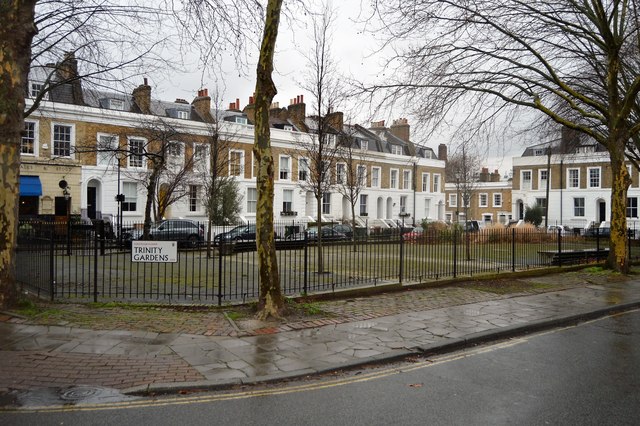
Half of this square was blown away in the Second World War, yet the other half still stands as it was built. Walk in from Acre Lane, and the two sides tell different stories: Victorian terraces on one flank, postwar blocks on the other. A pub, a mid-19th-century almshouse terrace, and a garden laid to lawn sit at the centre of it all.
Beneath the garden lawn lies a square built for Victorian Brixton's expansion, named for reasons no surviving record explains.
Name Origin
Trinity Square, Before It Was Gardens
The street was first built as Trinity Square in 1849-50, laid out with conventional terraced housing around a central square. Nearby on Acre Lane, the Trinity Asylum almshouses had already stood since 1822. The sources used here do not explain why the name "Trinity" was chosen for the square itself.
History
From Terraces to Almshouses to Ruin
Trinity Square filled in quickly after its 1849-50 construction. By 1871 the Ordnance Survey map showed it fully built out, long rows of terraces framing a garden laid to lawn and trees. The linked terrace to the east, Brighton Terrace, appears on the 1841 Tithe Map connecting the square to Brixton Road; none of its original houses have survived.
To the north, the City of London Corporation bought fields in the 1830s to build almshouses, the first sixteen funded by subscriptions marking the 1832 Reform Bill. These were replaced in the 1850s by the Gothic-style Rogers Almshouses, and the original sixteen houses were themselves demolished in the 1880s, replaced by the Gresham Lodges built in the square's southeast corner in 1884. Education followed: in 1899 Thomas Bailey's grandson sold land at 48-50 Acre Lane to the London School Board, and by 1902 Santley Street School, now Alpha House, had risen on the grounds behind, teaching over a thousand children.
War reached the square directly. Between 1939 and 1945 its southern side was destroyed by enemy action, and railings across the locality were removed for the war effort. Daisy Dormer Court was built on the ruined southern side after the war, and the commercial corner buildings at Acre Lane were rebuilt to replace war damage. The square was protected as a conservation area in 1978.
The table tomb of shipbuilder George Green now stands in Trinity Gardens, having been moved here from the old Trinity churchyard.
Culture
Britain's First Licensed Black Music Station
A radio station made this square's name reach far beyond Brixton. Choice FM was launched at 16-18 Trinity Gardens, and on 1 April 2021 the Nubian Jak Community Trust put up a blue plaque there; the Trust names Neil Kenlock and Yvonne Thompson in connection with the station's founding.
"the UK's only black radio station to have held a London-wide commercial licence"Nubian Jak Community Trust
People
A Shipbuilder's Tomb, an Almshouse Patron, Two Broadcasters
George Green, born in 1767, served his shipbuilding apprenticeship under John Perry at the Blackwall Yard, then the largest dock on the Thames, building and repairing ships mainly for the East India Company. He married Sarah Perry in 1796 and died on 21 February 1849.
Thomas Bailey financed the Trinity Asylum almshouses on Acre Lane when they were built in 1822, and managed them until his death in 1828.
Neil Kenlock, co-founder of Choice FM, is named on the 2021 plaque at 16-18 Trinity Gardens, alongside Yvonne Thompson.
Today
Surviving Terraces, A Protected Square
Fine 1840s terraces survive at Nos. 46-53 and Nos. 60-64, two floors above a half-sunk basement, built in pale brick with plastered trim and peaked roofs. The Trinity Arms at No. 45 is a pub of the same age and materials, with 1930s shopfront tiling added at street level. Nearby on Ferndale Road, the 1880s Freemen's Buildings almshouse flats, with their iron walkways, round out a square still built from more than one century's answers to the same ground.
On the Map
Trinity Gardens Then & Now
Frequently Asked Questions
Why is it called Trinity Gardens?
It was built as Trinity Square in 1849-50. The sources used here do not explain the choice of "Trinity," though an earlier Trinity Asylum almshouse had stood nearby on Acre Lane since 1822.
What is Trinity Gardens known for?
It is best known as the home of Choice 96.9, Britain's first 24-hour black music radio station with a commercial licence, which broadcast from studios here between 1990 and 2004.
What happened to the southern side of the square?
It was destroyed by enemy action during the Second World War. Daisy Dormer Court was later built on the site, and nearby commercial buildings at Acre Lane were also rebuilt after war damage.
Is there anything from the original 1849-50 square left?
Yes. Terraces at Nos. 46-53 and 60-64 survive from the 1840s, along with the Trinity Arms pub, all built in yellow stock brick with stucco dressings.